
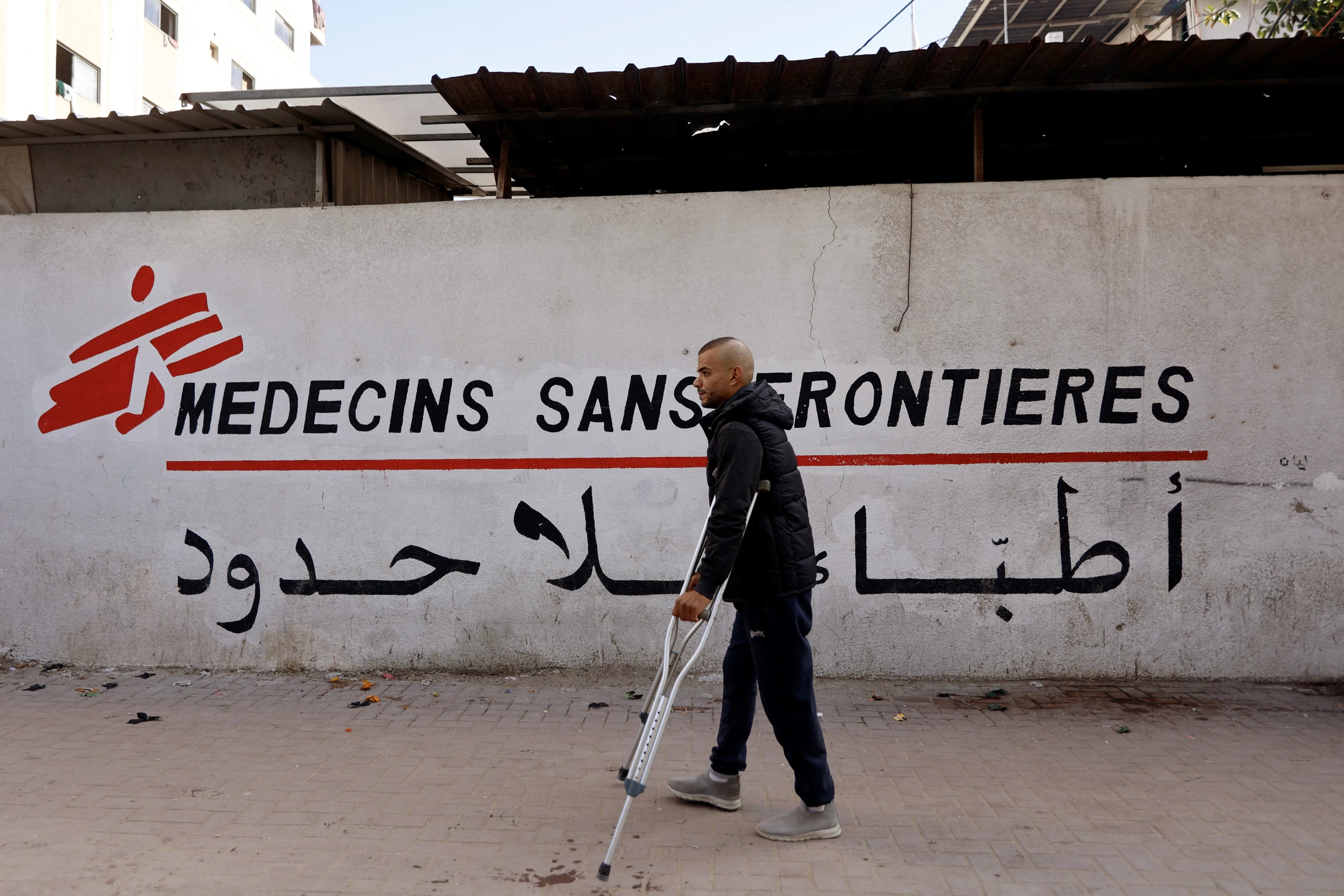
ERBIL, Kurdistan Region of Iraq – UN human rights chief Volker Turk on Wednesday issued a statement condemning Israel’s recent announcement that almost 40 aid organizations will be blocked from operating in Gaza starting Thursday, including Doctors Without Borders, Oxfam, and the Norwegian Refugee Council.
The ban is set to take effect unless these groups comply with new regulations demanding detailed personal information about their Palestinian staff.
“This is the latest in a pattern of unlawful restrictions on humanitarian access, including Israel’s ban on UNRWA (the UN Relief and Works Agency for Palestine Refugees in the Near East), as well as attacks on Israeli and Palestinian NGOs amid broader access issues faced by the UN and other humanitarians,” the statement reads.
It continues: “I urge all states, particularly those with influence, to take urgent steps and insist that Israel immediately allow aid to enter Gaza without hindrance. Such arbitrary suspensions make an already intolerable situation even worse for the people of Gaza.
“I remind the Israeli authorities of their obligation under international law to ensure the essential supplies of daily life in Gaza, including by allowing and facilitating humanitarian relief,” the statement concluded.
For Israel's part, Gilad Zwick, spokesperson for the Ministry of Diaspora Affairs and Combating Antisemitism, told AFP on Wednesday that “they refuse to provide lists of their Palestinian employees because they know, just as we know, that some of them are involved in terrorism or linked to Hamas,” adding that 37 NGOs have so far failed to comply with the new rules.
Hamas condemned the Israeli move as “criminal behavior” and called on the United Nations and the international community to denounce the decision.
The Knesset on Monday passed a law nullifying the diplomatic protections of UNRWA staff, allowing for legal action against the body, which has assisted refugees for over 70 years, in Israeli courts and prohibiting Israeli companies from supplying water, electricity, fuel, and communication services to the agency’s institutions.
The law also authorizes the expropriation by Israeli authorities of the two UNRWA offices in East Jerusalem, including the agency’s headquarters and its main vocational training center.
“Despite Israel's obligations, these legislative steps have been accompanied by unilateral actions on the ground that show a repeated disregard for international law,” UNRWA Commissioner-General Philippe Lazzarini said, adding that the maneuver “is a direct affront to the mandate granted to the Agency by the UN General Assembly and contrary to findings of the International Court of Justice.”
By revoking these protections, Tel Aviv is chipping away at the long‑standing principle of “inviolability” that traditionally legitimizes UN bodies. Under the 1946 Convention on the Privileges and Immunities of the United Nations — ratified by Israel in 1949 — UN agencies rely on diplomatic immunity and the inviolability of their premises as part of their role as neutral mediators. Their offices are considered inviolable and are supposed to be treated much like foreign embassies.
On Wednesday, Lazzarini criticized the move as “a dangerous precedent.” He also warned, “Failing to push back against attempts to control the work of aid organizations will further undermine the basic humanitarian principles of neutrality, independence, impartiality, and humanity underpinning aid work across the world.”
On Tuesday, the foreign ministers of Canada, Denmark, Finland, France, Iceland, Japan, Norway, Sweden, Switzerland, and the United Kingdom issued a Joint Statement on the Gaza Humanitarian Response, voicing “serious concerns about the renewed deterioration of the humanitarian situation in Gaza which remains catastrophic.”
The ministers called on the Government of Israel to “ensure that international NGOs are able to operate in Gaza in a sustained and predictable way.” They warned that, as 31 December approaches, “many established international NGO partners are at risk of being deregistered because of the Government of Israel’s restrictive new requirements,” a move that “could result in the forced closure of INGO operations within 60 days in Gaza and the West Bank.”
Such a scenario, they stressed, “would have a severe impact on access to essential services including healthcare,” noting that “one in 3 healthcare facilities in Gaza will close if INGOs operations are stopped.” The statement underscores that INGOs are “integral to the humanitarian response” and, working with the UN and Palestinian organizations, “collectively deliver approximately $1 billion in aid across Palestine each year.”
Against that backdrop, the ministers warned: “Any attempt to stem their ability to operate is unacceptable. Without them, it will be impossible to meet all urgent needs at the scale required.”
The list of organizations facing suspension, as outlined by Zwick, includes the Medecins Sans Frontieres (MSF), Norwegian Refugee Council, World Vision International, CARE, and Oxfam. His comments were issued in response to these planned bans.
MSF has been explicitly accused by Israeli authorities of employing two workers who are allegedly members of Islamic Jihad and Hamas.
On Wednesday, the charity said Israel notified the organization that its registration would be revoked later Wednesday, requiring the charity to shut down its operations by March 1, and called on Israel to permit its continued operations in Gaza and the occupied West Bank through 2026.
“We call on the Israeli authorities to ensure that MSF and other INGOs (international non-governmental organizations) are registered in Israel to continue working in the West Bank and Gaza in 2026,” MSF told AFP in a statement.
Last week, the organization warned that Israel’s new registration rules for international non-governmental organizations “risk leaving hundreds of thousands of people in Gaza without lifesaving healthcare in 2026.” Under the changes, “the new requirements threaten to withdraw registration from INGOs beginning Jan. 1,” a move that “would prevent organizations, including MSF, from providing essential services to people in Gaza and the West Bank.”
With Gaza’s health system already “destroyed,” MSF stressed that “independent and experienced humanitarian organizations losing access to respond would be a disaster for Palestinians.” The organization called on Israeli authorities “to ensure INGOs can maintain and continue their impartial and independent response in Gaza,” warning that “the already restricted humanitarian response cannot be further dismantled.”
Israel had already clamped down on UNRWA last year, claiming, without evidence, that Hamas had substantially compromised its Gaza branch.
The agency says investigations uncovered certain “neutrality-related issues” within UNRWA but maintains that Israel has yet to present evidence backing its accusations.
 Facebook
 LinkedIn
 Telegram
 X
X