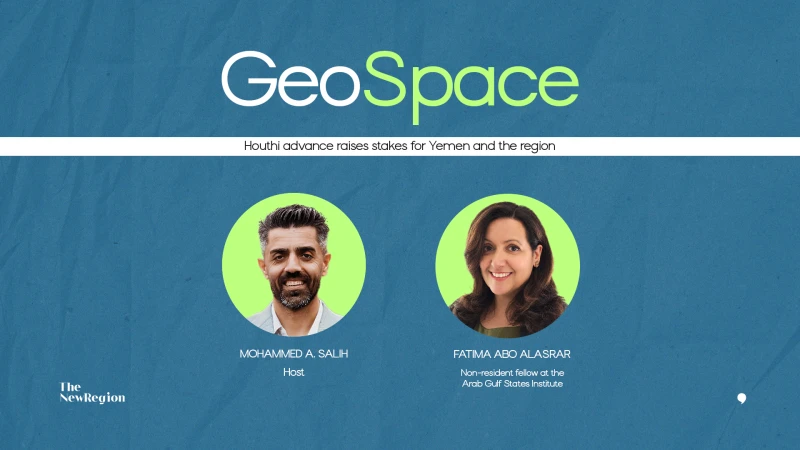
On the latest episode of The New Region's GeoSpace podcast, Mohammed A. Salih hosted Fatima Abo Alasrar, a prominent analyst of Yemeni and Gulf affairs and Senior Policy Analyst at the Washington Center for Yemeni Studies. The two discussed how Saudi Arabia's recent military intervention against the UAE-backed Southern Transitional Council (STC) has reshaped Yemen's political landscape and exposed deepening rifts within the Gulf.
Abo Alasrar explained that the STC fundamentally misread the moment when it announced a pathway to southern statehood. The timing proved catastrophic, coming just days after Israel's recognition of Somaliland and the STC's own signals about joining the Abraham Accords.
“The STC did not misread Saudi Arabia's tolerance for Southern aspirations. Riyadh lived with that for a very long time. But what it misread was really the timing and the alignment,” she said. “Saudi Arabia tolerates autonomy as long as the alignment would hold. But what Saudi does not tolerate is strategic freelancing.”
The swift collapse of STC leader Aidarus al-Zoubaidi's position, culminating in his flight to the UAE, has created a political windfall for the Houthis. Abo Alasrar noted that the Iran-backed group is “relishing this moment,” as the fragmentation weakens any unified bargaining position against them.
“The fragmentation for them, narrows the set of actors that are capable of credibly counterbalancing them. So, a divided South, a divided coalition, weakens any unified bargaining position that, the internationally-recognized government of Yemen has. It also reinforces the Houthis' claim that they are the only coherent authority left,” said the analyst.
Abo Alasrar noted thaat the divergence between Saudi Arabia and the UAE extends beyond Yemen to Sudan and Somaliland as well. “Yemen here has become some kind of arena for these differences to happen,” she explained, though she emphasized that Saudi-UAE tensions disrupt coordination but not individual ambitions.
“This divergence will continue to impact not just Yemen, but the stability of the region… Politically, what we can see is that, yes, Saudi might have the upper hand, but the STC may not be the vehicle Abu Dhabi can openly advance without clashing with Riyadh.”
“Militarily, the escalation is costly, and the UAE did draw down, repeatedly, but every time that it decided to reduce from its presence somehow, we've seen that it's still maintains indirect influence.”
For Washington, Abo Alasrar suggested the Saudi intervention may actually be viewed as stabilizing, preventing further escalation on the Kingdom’s southern border at a moment of regional volatility.
 Facebook
 LinkedIn
 Telegram
 X
X