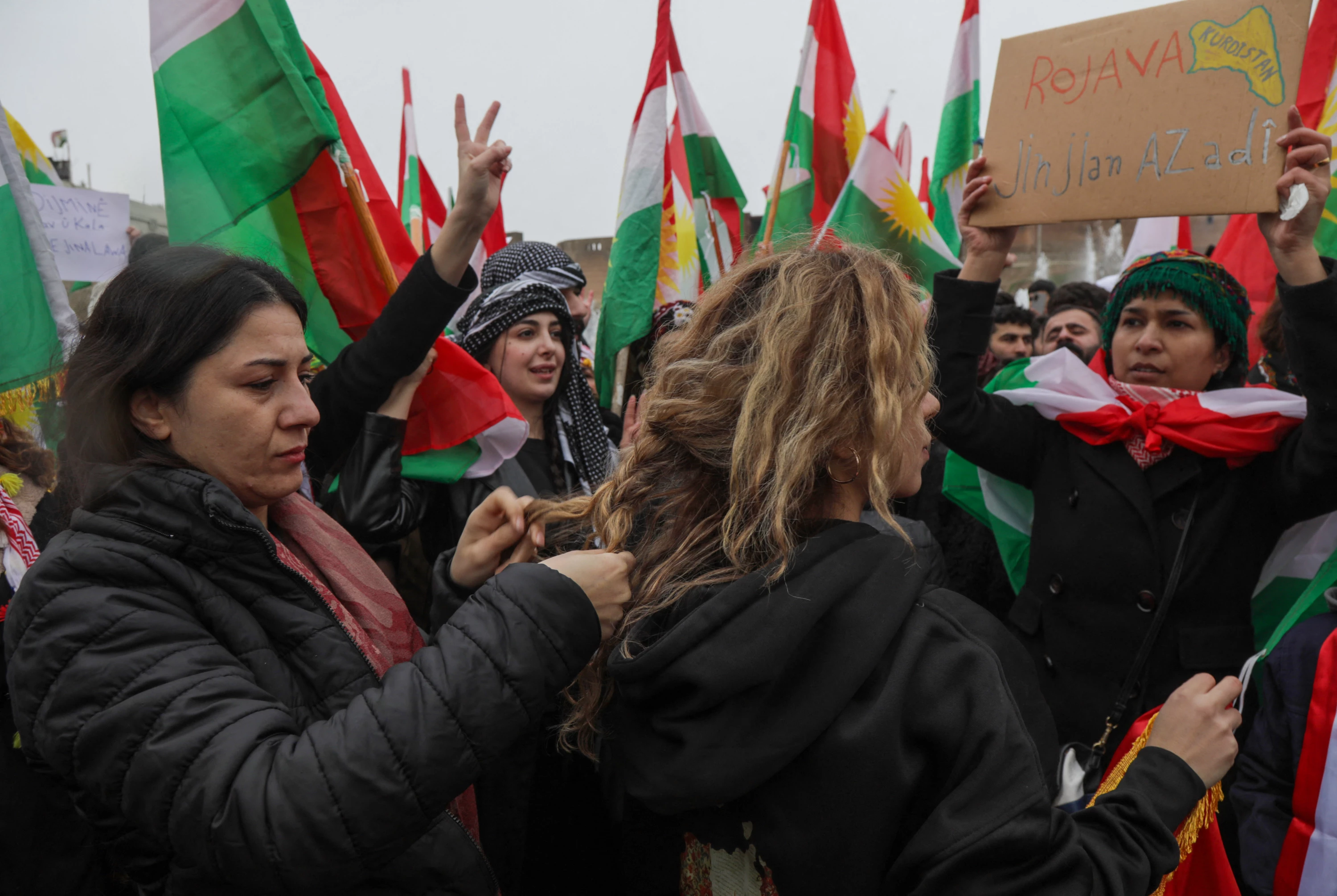
ERBIL, Kurdistan Region of Iraq – After a Syrian Arab Army soldier bragged while holding a Kurdish fighter’s braid in Raqqa, a widespread wave of condemnation erupted, sparking a global trend of solidarity with women braiding their hair in support of Rojava (northeast Syria) - a symbol of “strength and freedom.”
In one of the alleged human rights violations linked to Damascus-affiliated factions, a video circulated on social media showing a man holding the braided hair of an allegedly killed Kurdish female fighter, saying, “This is the hair of a heval [comrade]. When questioned by the person filming, he happily responded, saying, “She is dead anyway.”
The video sparked widespread condemnation on social media regionally and globally, with people braiding their hair in protest. The man later deleted his social media accounts and posted a new, contradictory video, claiming that “the hair was not real hair, it was a wig.”
The Kurdistan Women’s Union, a prominent women empowerment organization based in the Kurdistan Region, responded on Friday, declaring its support for Rojava and describing the move as a “barbaric act that reflect ISIS [Islamic State]-like behavior.”
“As Kurdish women and our Kurdish culture, braids are not merely a hairstyle for beauty, but rather a symbol for women’s strength and freedom. Every braid is a message of resistance,” said the union’s secretary Ziba Taha in a statement.
Damascus has launched a brutal offensive against Rojava in a bid to secure interim President Ahmed al-Sharaa’s vision of a united, centralized Syria, despite the country’s marginalized minorities repeatedly calling for federalism.
The assault has left hundreds dead and forced Kurdish-led forces, who defeated ISIS in Syria, to cede swathes of territory and withdraw to Hasaka province, with the attacking Syrian forces violating ceasefires, committing human rights violations, and possibly war crimes in their offensive.
Thousands in the Kurdistan Region’s capital Erbil rallied beneath the city’s historic citadel for Rojava, protesting the brutality and violence committed by Syrian government and government-aligned forces.
Taha said that in an act of solidarity, members, “in addition to participating in demonstrations, are active in social media through a symbolic, meaningful display and taking part in the resistance in Rojava, by braiding thousands of braids in response.”
As the trend spread, many men also joined by shaving their hair and posting images online in solidarity with the Kurdish women fighters.
Commenting on the men’s participation, Taha said it “gave us even more hope,” adding that it “once again united the Kurdish voice and made women a symbol of the struggle.”
“Therefore, we are not wrong to say that among the Kurdish nation, women are not victims, but rather characters, symbols, and icons for the entire nation,” she stressed.
On Friday, Rojava’s all-female Women’s Protection Units (YPJ) blasted Damascus-affiliated factions for carrying out “the most despicable acts” against the bodies of Kurdish-led female fighters.
The attacks have tried to “particularly expose the bodies of female fighters,” the YPJ – a key component of the SDF – said in a statement, stressing that the “inhumane acts” will not go unanswered.
“Our braided hair has become the fear in our enemy's heart, because victory will definitely belong to women and freedom-loving peoples,” the YPJ asserted.
Since clashes erupted in January, footage showing human rights violations by Damascus-affiliated forces has circulated widely on social media, depicting threats and harm against Kurdish fighters and civilians.
The SDF on Friday shared documents of alleged war crimes committed by the Syrian Arab Army and its affiliated groups during their brutal offensive against Rojava, noting that it is a limited sample, as "violations are occurring without documentation."
Monitors say more than 1,000 people have been killed on both sides, and the conflict has displaced about 155,000 people, according to Syrian government figures.
 Facebook
 LinkedIn
 Telegram
 X
X