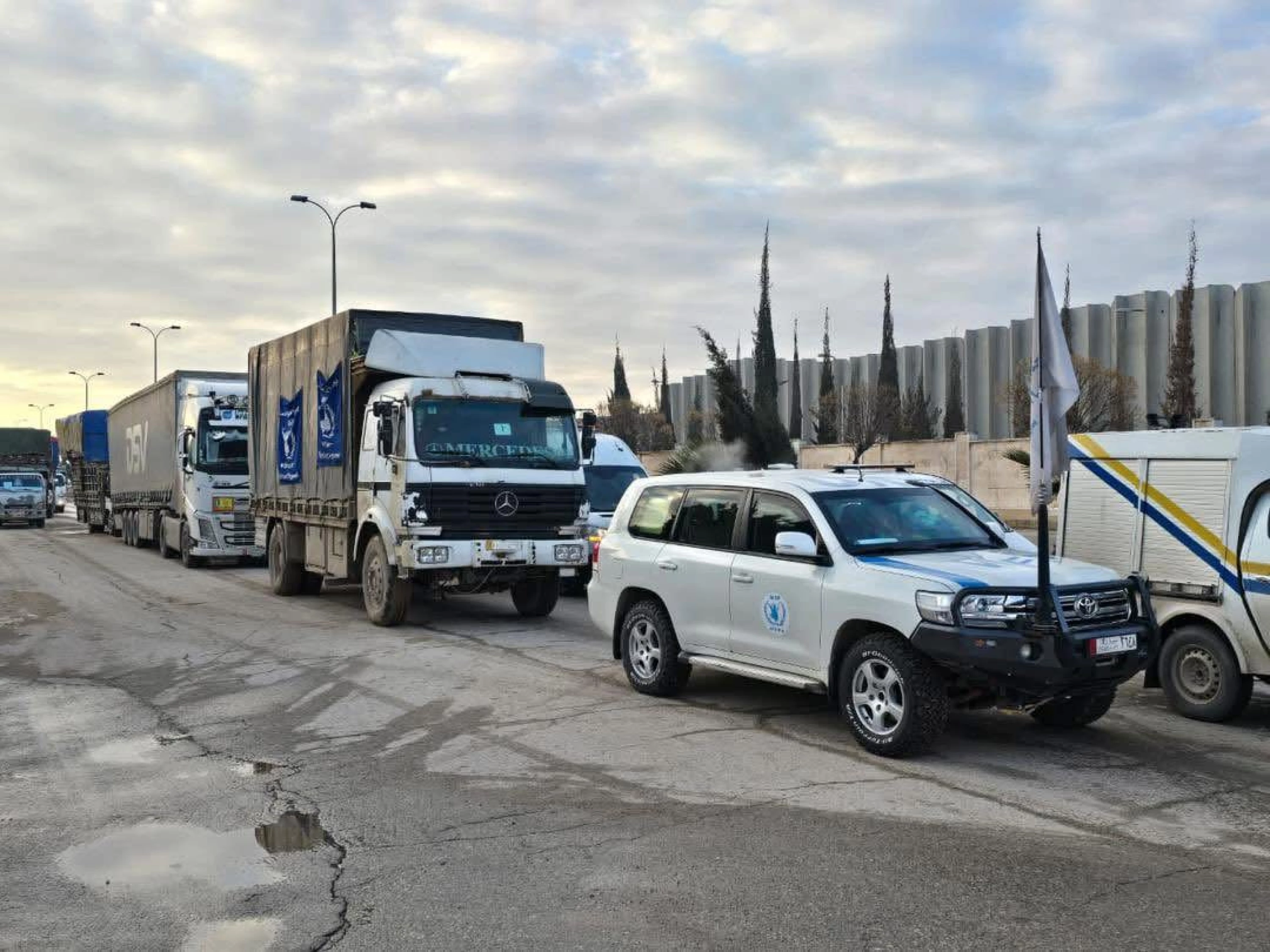
ERBIL, Kurdistan Region of Iraq – Residents of the besieged city of Kobane are facing acute shortages of water, medicine and fuel as a UN aid convoy consisting of 24 trucks carrying vital humanitarian supplies arrives in the city, local sources said on Sunday.
UNHCR Representative in Syria Gonzalo Vargas Llosa said Sunday morning that a convoy of 24 trucks carrying food, relief supplies and diesel had departed to provide life-saving and winter assistance, with local sources on the ground confirming to The New Region later on Sunday evening that the convoy had arrived in Kobane.
The UN's aid mission comes after the Kurdish Red Crescent appealed to the United Nations' High Commissioner for Refugees Barham Salih, a Kurd, for help.
The city of Kobani hosts approximately 400,000 people and has been besieged since January 19, when Syrian government forces took Ain al-Issa.
The Syrian government's suffocating blockade has seen all roads leading to the city blocked, amid mounting pressure as the city's humanitarian situation deteriorated. The siege also slashed electricity in Kobane, and curbed access to basic services. The Syrian army on Sunday announced a humanitarian corridor to Kobani that so far has not seen any aid coming in.
The Kurdish Red Crescent in the city said Saturday that at least five children had died from the cold and lack of medical supplies.
“The humanitarian situation is catastrophic and brings back painful memories for the people of Kobani of the time when the city was previously besieged (in 2014) by the so-called Islamic State," the organization said.
In 2014, Kobane was besieged by the Islamic State (ISIS), with the extremist organization eventually pushed back with the help of U.S. airstrikes. At the time, 150 Peshmerga fighters also crossed the border into the city to help defeat the Jihadists.
“The people need everything, but we need water urgently," Berivan Issa, co-chair of the Humanitarian Affairs Office in Kobani told The New Region.
Issa told The New Region a day earlier on Saturday that Kobane would soon run out of medicine and fuel, adding that 200,000 displaced persons (IDPs) from the city's surrounding villages are currently living in Kobane.
Helin, a psychologist working in Kobani, who used a pseudonym due to safety reasons, said that the Syrian government has suffocated Kobane for several days.
“For the past 14 years, we have endured devastating war. We suffered under ISIS, endured siege and violence, and were forced to flee to Turkey. After six months of intense conflict, we returned to Kobane—only to face one of the most horrific massacres carried out by ISIS against my family, loved ones, friends, and the people of my city,” she said.
“In just two hours, on June 25, 2015, approximately 500 people were brutally murdered. Women, children, infants, and the elderly were slaughtered indiscriminately—anyone ISIS encountered. Following the intervention of the International Coalition, our city was liberated," she lamented.
However, she said that now Kurds in Kobane are openly being threatened with “killing, beheadings, mutilation of bodies, the enslavement of our daughters, and sexual violence—the same atrocities they previously committed against us. They are currently besieging Kobane from all directions.”
“More than 500 families have fled nearby villages and sought refuge in the city, escaping ISIS threats,” she added.
“They have no shelter or safe place and are now living in the streets, schools, and mosques—under freezing temperatures below zero, with heavy snowfall. There is no humanitarian aid, no emergency response, and no services to support our people.”
Ali, a 28 year old man whose identity The New Region withholds for security reasons, warned of a real risk for underage children in Kobane. “If they don't have (baby) milk, because also this week it will be snowing, and it will be so cold and they could face malnutrition. Many children are exposed to that.”
Although the Syrian defense ministry on Saturday announced a 15-day extension to its ceasefire with the Kurdish-led Syrian Democratic Forces (SDF), clashes have continued both in the Kobani region and the Hasakah province.
The media centre of the Syrian Democratic Forces (SDF) on Sunday announced that a child was killed and three others were injured as a result of ongoing artillery shelling carried out by Damascus factions on the village of Al-Qasimiya west of Kobani.
 Facebook
 LinkedIn
 Telegram
 X
X