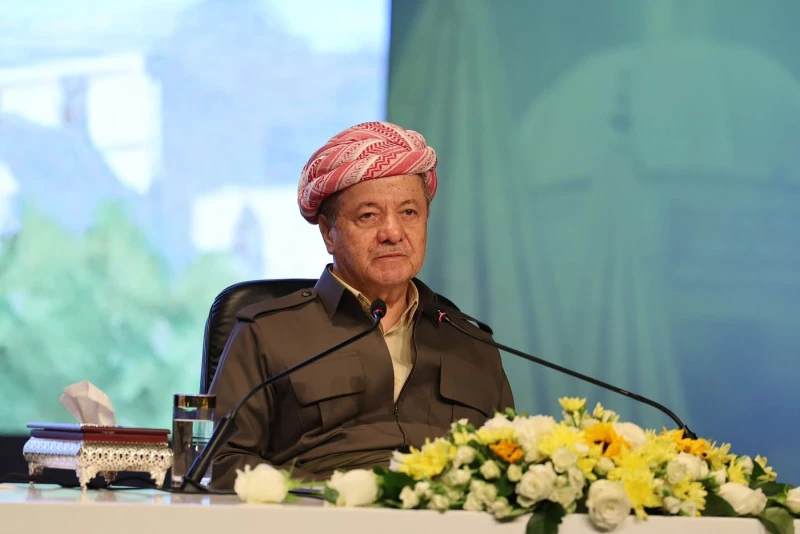
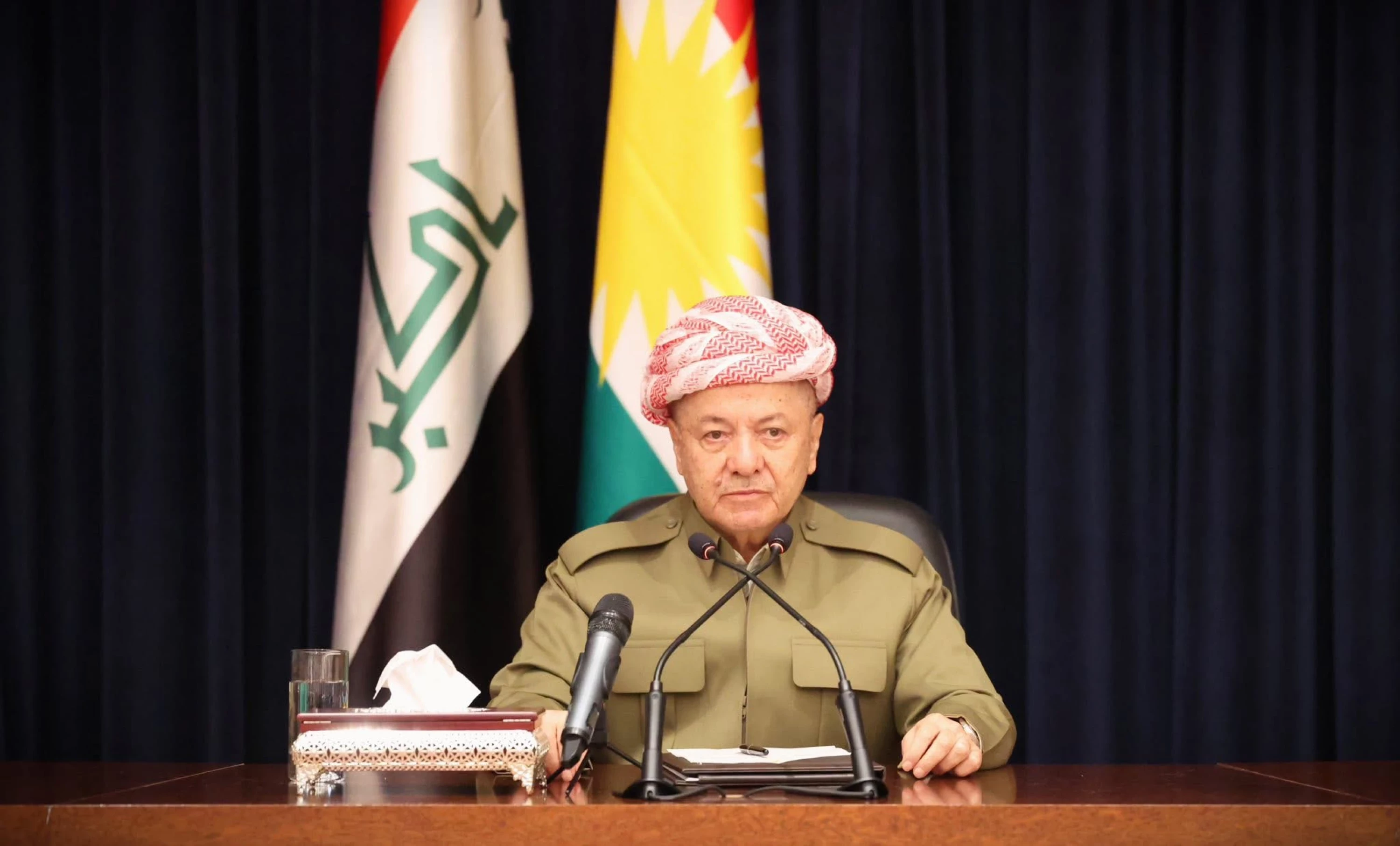
ERBIL, Kurdistan Region of Iraq – President Masoud Barzani on Saturday said that rushing to elect Iraq’s next president will lead to “counterproductive” results and “deeper divisions,” stressing the need for further consultation and taking into account the entitlement of all political components.
Iraqi parliament’s First Deputy Speaker Adnan Faihan on Saturday said that the parliament’s leadership is scheduled to hold a meeting this week with heads of political blocs to set a date for the presidential election session.
“We believe that the current call for a parliamentary session to elect the President of the Republic and subsequently appoint the prime minister requires further consultation,” Barzani said in a letter to the leaders of Iraq’s ruling Shiite Coordination Framework.
The Kurdish leader stressed that the process must take into account the “representation of all components of the political process according to their electoral strength.”
He noted that for the Kurdish component to achieve a “fair representation,” the Shiite and Sunni sides must understand the Kurdish position on electing a candidate “through a Kurdish mechanism for the Kurdish parties or parliamentary blocs in Parliament.”
With the election of the Iraqi president having exceeded the constitutional deadline by two months, the Kurdistan Region’s ruling Kurdistan Democratic Party (KDP) and the Patriotic Union of Kurdistan (PUK) have yet to agree on a unanimous candidate for the position.
While Barzani expressed understanding of the Kurdish component’s “failure” to reach a decision, “attempts to push through or impose a solution will lead to counterproductive results and deeper divisions, which the country does not need at this delicate and sensitive stage.”
In December, Barzani said that “the person nominated for the presidency does not have to be from the PUK or the KDP. They can be from another party or be neutral. The most important thing is that this person enjoys Kurdish consensus and truly represents the people of Kurdistan in assuming the presidency of the Republic of Iraq.”
The Kurdish parties have previously convened to reach an understanding regarding a candidate, but the outbreak of the regional war largely halted these efforts, with the Kurdistan Region continuously coming under attacks by pro-Iranian militias in the Region, raising major security concerns.
Head of the KDP Bloc in the Iraqi Parliament Shakhawan Abdullah, in a presser on Sunday, said that the matter of electing the president should occur in conjunction with the election of the prime minister.
Abdullah asserted that convening for the election of a president alone “will not be successful, and its impact will be negative,” adding that a majority of political forces agree that the appointments should be chosen in tandem.
He further argued that the election of a premier “is much more important” than that of the president. “That is if they want a prime minister who has legitimacy and holds more authority than the current prime minister. They should focus on electing a prime minister, not a president.”
In late February, Prime Minister Mohammed Shia’ al-Sudani’s coalition said that the failure of the Kurdish parties to decide Iraq’s next president represents a “clear violation” of constitutional deadlines and significantly weakens Iraq.
According to constitutional timelines, the Iraqi president was required to be elected by the parliament within 30 days of the new legislature’s first session, which took place in late December.
 Facebook
 LinkedIn
 Telegram
 X
X