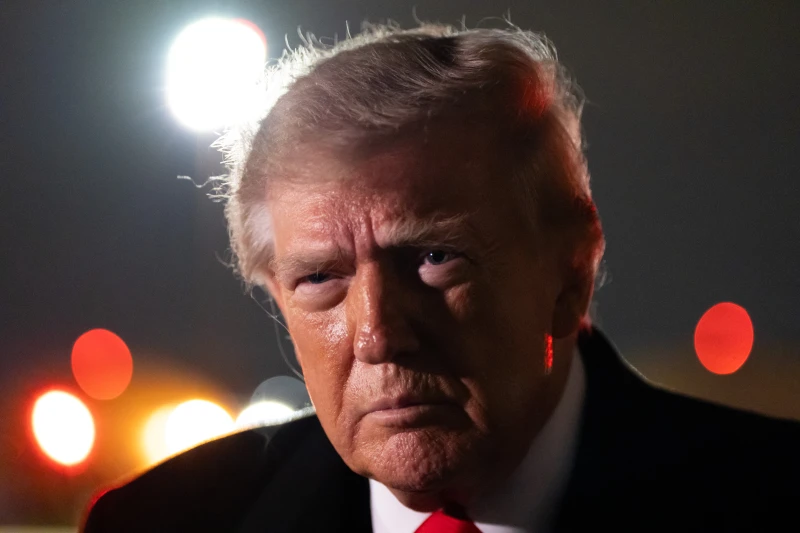
ERBIL, Kurdistan Region of Iraq – US President Donald Trump on Saturday said that they are engaged in “very good conversations” with Tehran, amid a renewed blockade of the vital Strait of Hormuz by Iran, adding that they will have “some information” by the end of the day.
“We have very good conversations going on. It’s working out very well. They got a little cute as they have been doing for 47 years,” Trump said, adding that “they wanted to close up the strait again, you know, as they have been doing for years.”
“They can’t blackmail us,” the US president asserted. “We will have some information by the end of the day. We are talking to them.”
On Friday, Iranian Foreign Minister Abbas Araghchi said in a brief post on X that the Strait of Hormuz was “completely open” to all commercial ships in line with the ceasefire in Lebanon between Israel and Hezbollah,
Trump welcomed the move in a post on Truth Social, while keeping the American blockade of Iranian ports in place until a deal is reached, prompting Iran’s Islamic Revolutionary Guard Corps (IRGC) to reimpose the previous state of “strict management” of the strait, citing what it described as Washington’s repeated breaches of commitments.
IRGC’s closure of the vital waterway came hours after Iranian parliament speaker Mohammad Bagher Ghalibaf said that the Strait of Hormuz “will not remain open” if the US continues its blockade of Iranian ports.
“They have no navy, they have no Air Force, they have no leaders, they have no nothing. Actually … it is regime change, you call that enforced regime change,” Trump said.
In a statement earlier on Saturday marking the anniversary of the Islamic republic’s army, Iran’s new Supreme Leader Ayatollah Mojtaba Khamenei praised the army, saying they have “stood up to the sinister plans of America, the survivors of the Pahlavi tyranny, and the separatists who wanted a divided Iran, and created epics.”
“As its drones strike the American and Zionist criminals like lightning, its valiant navy is ready to make its enemies taste the bitterness of new defeats,” the hardline Iranian leader said.
The strategic waterway of Hormuz, responsible for roughly 20 percent of the world’s oil shipments, has been one of the focal points of the conflict since its start in late February. The key chokepoint was closed by Iran as a means in its war with the US and Israel, sharply driving up global oil prices.
On April 11, Tehran and Washington held negotiations in Islamabad, mediated by Pakistan. The talks failed to produce a lasting agreement.
The Pakistani initiative ushered in a two-week ceasefire between the two warring sides. Trump has repeatedly claimed that Tehran and Washington are in continuous talks, as the conflict, and the Middle East’s security by extention, hangs in the balance.
 Facebook
 LinkedIn
 Telegram
 X
X