ERBIL, Kurdistan Region of Iraq - Turkey's pro-Kurdish Peoples' Equality and Democracy Party (DEM Party) on Sunday called for Ankara to establish a commission to investigate cases of forced disappearances during the conflict between the Turkish state and the Kurdistan Workers' Party (PKK), saying that confronting the issue constitutes a key step "in building a peaceful and democratic society."
In a statement marking the commencement of the 'Week of the Disappeared,' the party sought to highlight the thousands of cases of forced disappearances during the conflict, which were prolific.
"In Turkey, a new phase has been reached in the process of a democratic and peaceful solution to the Kurdish issue compared to the previous year," the DEM Party said, citing the PKK's decision to dissolve itself upon the directive of its imprisoned leader, Abdullah Ocalan.
"The reality of enforced disappearances, dating back to the Ottoman era, deepened especially during the last 50 years of armed conflict, and disappearances specific to this period took place. Therefore, confronting the past is unavoidable in the process of building peace and a democratic society."
Human Rights Watch previously described a "wave of so-called "actor unknown murders" that struck "Kurdish nationalist intellectuals and journalists" during the PKK insurgency, with the number of such deaths "rising to almost 1,200 between 1991 and 1994."
"The Turkish Penal Code should explicitly define enforced disappearance as a crime against humanity, and it should be legally stipulated that there can be no statute of limitations for crimes against humanity, with this provision being applied retroactively," the pro-Kurdish party said, in addition to urging Ankara to become a party of the UN International Convention for Protection Against Forced Disappearance.
"A truth commission should be established to investigate the fate of those who have disappeared and to identify the perpetrators. The Department established within the Ministry of Justice should effectively investigate all unsolved murders, especially without considering the statute of limitations, and should mobilize the competent Public Prosecutor's Offices in this regard."
Bereaved families seeking justice for loved ones who were forcibly disappeared have faced myriad obstacles when pursuing legal avenues, with a case regarding the disappearance of eight people, including three children, in Madrin in the mid-1990s having been thrown out in May after it was deemed to have been outside the legal statute of limitations.
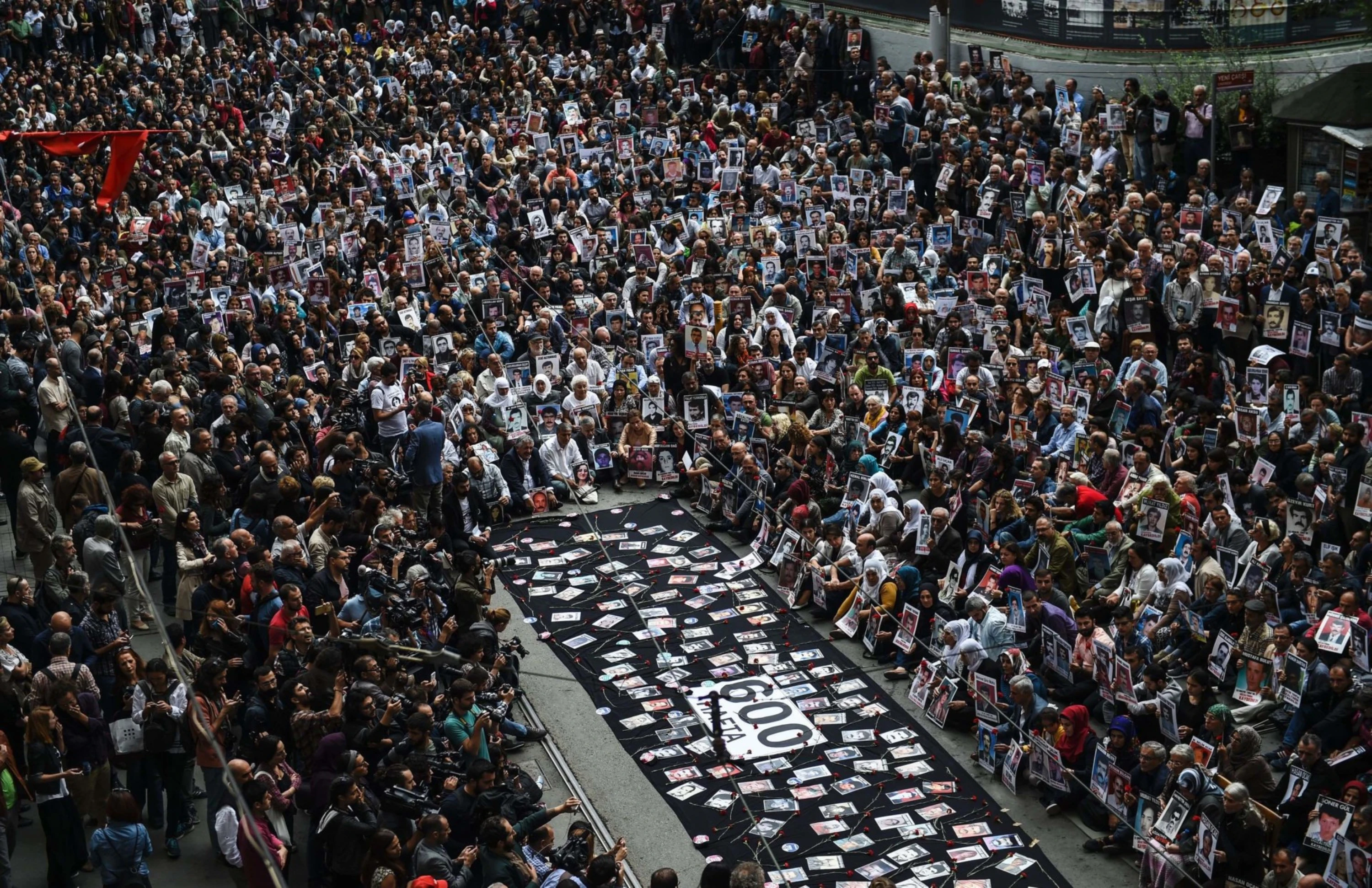
An organization known as the 'Saturday mothers' has gathered in Istanbul every Saturday for thirty minutes since 1995 to demand authorities shed light on those that disappeared, often facing state crackdowns on their weekly assemblies.
Central to many of the cases of disappearances is the Turkish Gendarmerie's Intelligence Organization (JITEM), whose existence was long denied by Ankara, with details of its structure emerging during trials in 2008.
Among a host of high-profile Kurdish rights activists who met their end in mysterious circumstances was Vedat Aydin, the leader of the pro-Kurdish People's Labor Party (HEP), who was killed in 1991 in southeastern Turkey (Bakur).
A 2009 trial implicated nine JITEM members in the slaying, but the proceedings were halted after a court in Malatya found it did not hold jurisdiction for the case and returned it to Diyarbakir (Amed), with no convictions ever having been achieved.
 Facebook
 LinkedIn
 Telegram
 X
X