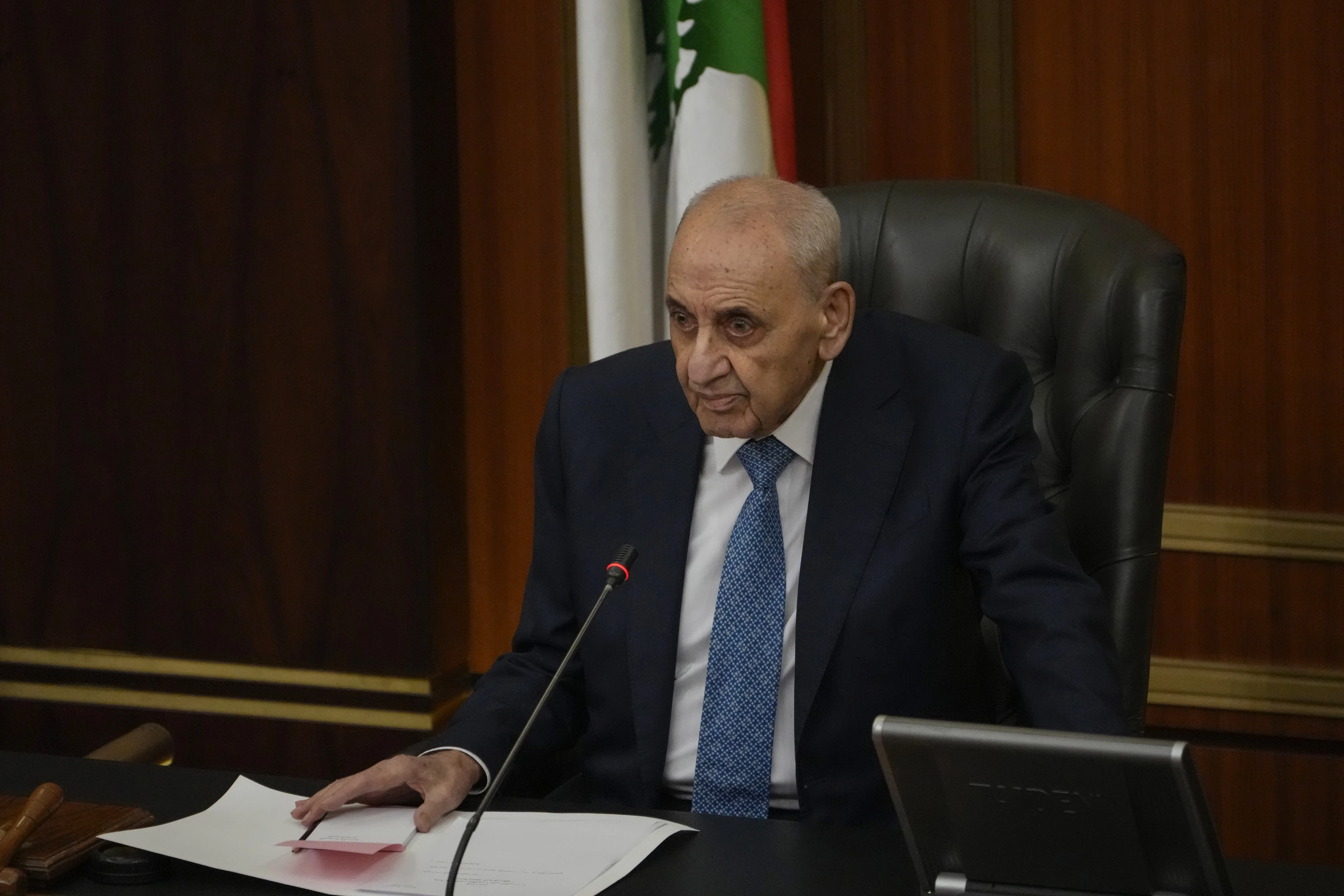
ERBIL, Kurdistan Region of Iraq - Lebanese Parliament Speaker Nabih Berri said Friday that he supports Hezbollah’s withdrawal from south of the Litani River if Israel simultaneously withdraws from occupied territories in Lebanon, coming amid a tenuous ceasefire between Beirut and its southern neighbor.
“I agree with Hezbollah's withdrawal from south of the Litani in parallel with the Israeli withdrawal from the occupied areas,” Berri, who leads the country's Shiite Amal party that often aligns with Hezbollah, said in remarks carried by Al Jazeera.
The Lebanese speaker criticized the current ceasefire arrangement, saying the ceasefire declaration had been “booby-trapped with pilot zones without the entry of any actors.”
The remarks came two days after Israel and Lebanon announced a ceasefire agreement following US-mediated negotiations.
The deal called for the establishment of pilot zones under the exclusive control of the Lebanese Armed Forces and is intended to pave the way for a broader agreement through further dialogue, essentially aiming to achieve a US-Israeli demand for the Lebanese state to maintain a monopoly on arms to the detriment of the Iran-backed militant group.
On Thursday, Hezbollah Secretary-General Naim Qassem rejected the agreement, describing the outcome of the negotiations as “futile, humiliating, and disgraceful for Lebanon.”
“The ceasefire must be complete and comprehensive without condition, by land, sea, and air, and without bulldozing or demolition,” Berri said. “Instead of this hybrid agreement, we could have viewed the beginning of the text positively if it had included an unconditional ceasefire.”
According to Al Jazeera, Berri argued that an unconditional ceasefire should have been the foundation of any agreement.
He argued that the declaration sought to achieve politically what Israel failed to achieve through war and warned against making Hezbollah’s disarmament the central objective of any agreement.
The stretch of territory between the Litani River and the city of Sidon has emerged as Hezbollah’s primary stronghold, overseen by its Badr unit. Prior to the war, the group’s core presence was concentrated south of the Litani, particularly within the Nasr and Aziz sectors. However, heavy losses and extensive damage to those units during the conflict have shifted its center of gravity northward, into the Badr-controlled area.
 Facebook
 LinkedIn
 Telegram
 X
X