
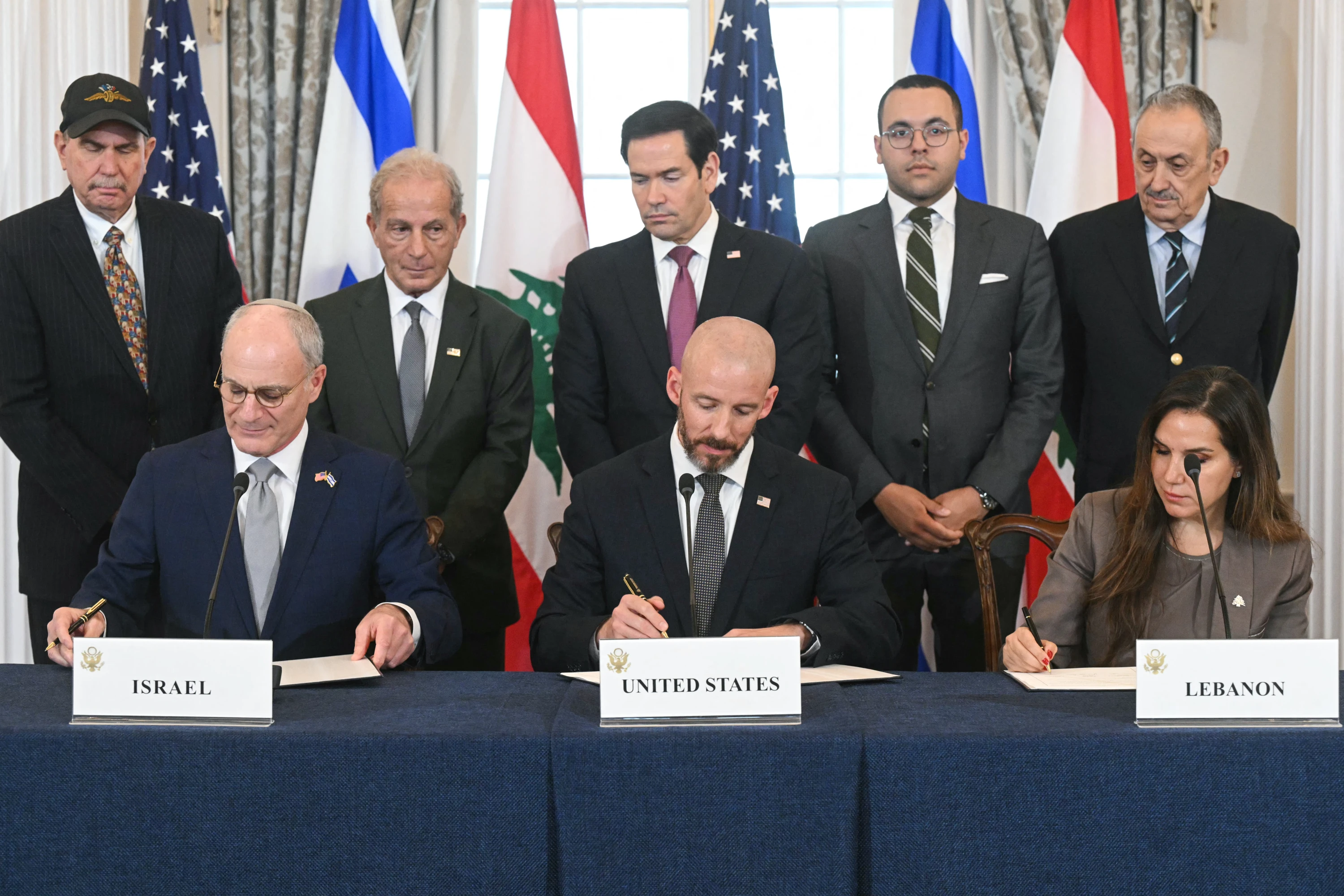
ERBIL, Kurdistan Region of Iraq - Israel and Lebanon signed a framework agreement on Friday, with US Secretary of State Marco Rubio saying the moment marks “the beginning of the beginning,” and that “there's a lot of work ahead.”
The agreement, reached with US mediation, comes amid ongoing hostilities between Israel and the Iran-backed Hezbollah in southern Lebanon since March, which has resulted in thousands of casualties and led to the displacement of hundreds of thousands of civilians.
During the signing ceremony, Rubio said the agreement “begins to put in place a framework for lasting peace and security, and that’s what these two nations deserve.”
“The people of Lebanon have suffered tremendously now for decades as a result of outside interference in their affairs, of countries trying to use the country as a launchpad for attacks,” he added.
“There’s a lot of work ahead. We don’t in any way underestimate the difficulty of the task ahead, but we understand the importance of it, how vital it is, and we are honored to have played a part in bringing this together,” the US Secretary continued.
The agreement reportedly allows for the Lebanese Army to take control over some areas that are currently occupied by the Israeli military, though the latter will still maintain a presence below the so-called “yellow line” that extends roughly 4 to 10 kilometers inside Lebanese territory, from the Mediterranean coast to the Syrian border.
Nada Hamadeh, Lebanon's ambassador to Washington, said the trilateral framework is “the first step on the road to restoring Lebanese sovereignty and territorial integrity, securing a permanent and final cessation of hostilities, enabling our people to go back to their land and allowing all Lebanese to live in peace, security and prosperity.”
Israeli Ambassador Yechiel Leiter said the deal aims to achieve “real peace” between the two countries.
“In this performance-based trilateral framework agreement: Iran is out. Hezbollah is out. And the road to peace between Israel and Lebanon is in,” he added.
In a video statement, Israeli Prime Minister Benjamin Netanyahu hailed the US-brokered deal as “a major achievement” and “a major blow to Iran,” saying Israel will maintain its military presence in a security zone in southern Lebanon while allowing the Lebanese Army to begin deploying in designated areas.
“The most important point is that Israel will remain in the security zone in southern Lebanon. This is a major achievement, and we will maintain our presence there as long as Hezbollah is not disarmed and as long as there is a threat to the State of Israel,” Netanyahu said.
He said the agreement was also directed against Iran and Hezbollah. “Iran has been trying to force us to withdraw from southern Lebanon through pressure. In effect, Israel, Lebanon, and the United States are telling them: this is none of your business. You have no role in Lebanon—not Iran, not Hezbollah, and not any terrorist organization,” Netanyahu said.
“We will continue to maintain the original security zone, beyond the range of anti-tank missiles. We will not allow Hezbollah or civilians to enter it. That remains unchanged,” Netanyahu added. “Most importantly, Israel is making one thing clear: our security comes before everything else.”
Lebanese President Joseph Aoun hailed the reaching of the agreement as “the first step on the path to restoring Lebanon's sovereignty over its complete, undivided territory.”
The US-mediated talks began in April, following the March 2 escalation between Israel and Hezbollah, against the backdrop of the US-Israeli war on Iran. The conflict triggered a wave of Israeli strikes that, according to Lebanese authorities, have killed more than 4,100 people and displaced around one million.
 Facebook
 LinkedIn
 Telegram
 X
X