ERBIL, Kurdistan Region of Iraq – Iraq is working with US companies to end gas flaring, develop oil fields, and diversify export routes to reduce reliance on the Strait of Hormuz, the country’s oil minister said Saturday, amid Prime Minister Ali al-Zaidi’s visit to Washington and as Baghdad courts US companies for investment.
Iraqi Oil Minister Basim Mohammed Khudair, who is in Washington as part of Zaidi’s delegation, told state media that the country seeks to eliminate gas flaring by 2028, while there are also ongoing projects to develop the Mansouriya and Akaz gas fields aimed at eliminating import needs.
“The issue of flaring gas will be completely resolved by the end of 2028 and the beginning of 2029,” Khudair said, adding, “There are important and ongoing projects proceeding in parallel in major gas fields such as the Mansouriya and Akkas fields, in addition to other fields.”
Iraq is notorious for the deadly practice of gas flaring, ranking as one of the world’s worst polluters through the phenomenon despite strides taken by successive governments to curb its impact.
Gas flaring is a process in which oil wells burn the excess gas they cannot store or use. It is considered a convenient method to eliminate the byproduct known as associated petroleum gas.
But the process has drawn vast criticism for its environmental impact and waste of valuable resources.
Despite producing 3.1 billion cubic feet of natural gas daily, Iraq continues to flare a substantial portion due to inadequate processing infrastructure.
Also on Saturday, Khudair signed a memorandum of intent with British oil giant BP and the US-based ConocoPhillips to exchange information on the “exploration opportunities” in Kirkuk province’s oil fields.
The minister said there are also plans to diversify export routes for Iraqi oil, including Turkey’s Ceyhan port, so the country does not rely solely on the Strait of Hormuz.
As a means in its war against the US and Israel, Iran has shut the Strait of Hormuz, a key waterway responsible for the transport of roughly 20 percent of the world’s oil, sharply driving up global oil prices.
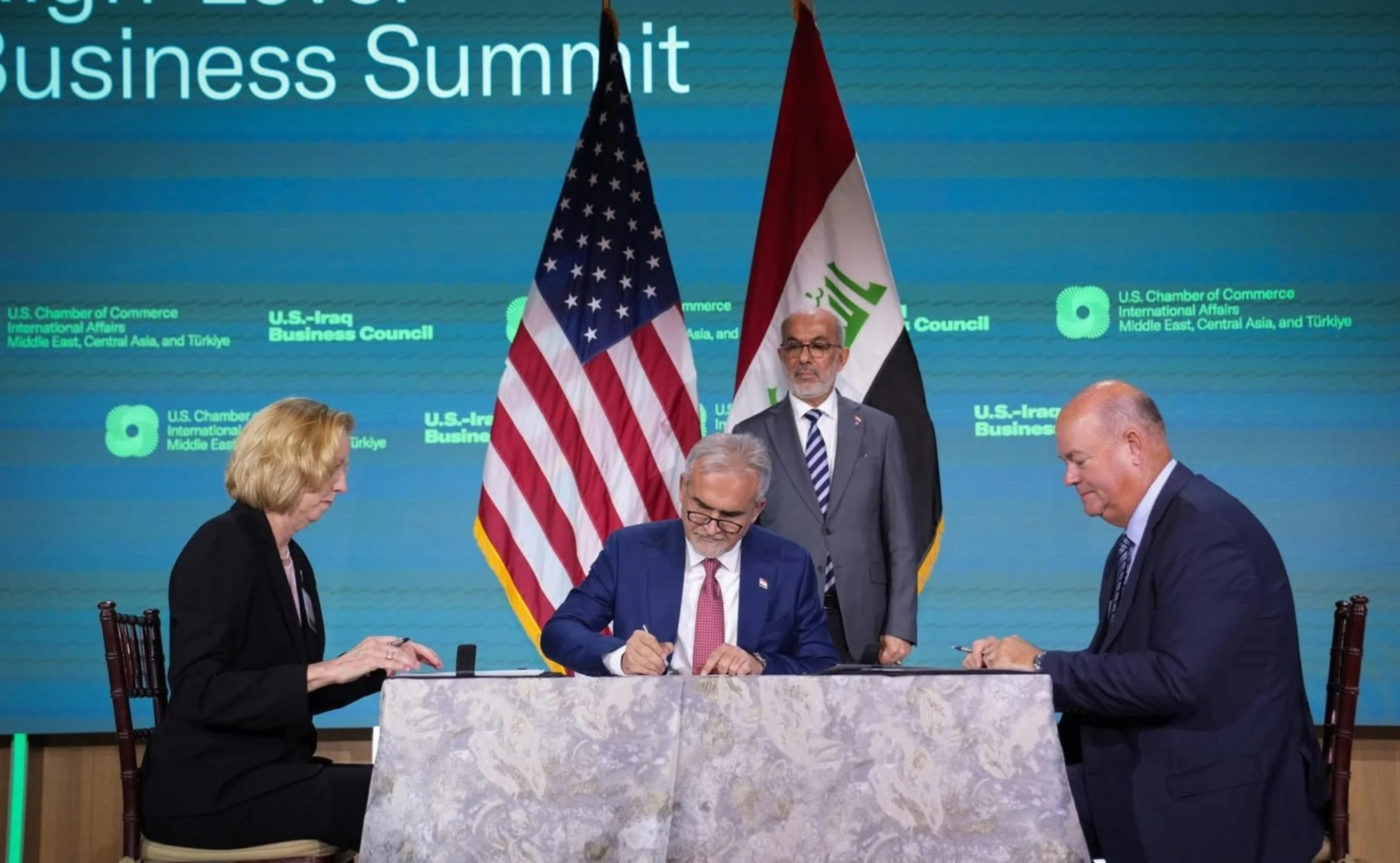
Speaking at a high-level US-Iraq business summit on Friday, US Special Envoy for Iraq Tom Barrack said that Zaidi's regional economic vision will render the Strait of Hormuz “an afterthought in two years” and pave the way for energy security in the Middle East.
Zaidi arrived in the US on Monday for a week-long visit that saw him meet US President Donald Trump in the White House, in addition to conducting talks with myriad US companies in a bid to bolster Iraq's economy with foreign direct investment.
“This approach emerged from discussions and the signing of a memorandum of understanding with a consortium comprising two American companies, Chevron and TE Capital, in addition to the Qatari company UC,” Khudair said.
On Thursday, Zaidi called on the US-based Chevron oil firm to expand its operations in Iraq to help Baghdad achieve its objectives of increasing crude oil production and diversifying export routes.
“The ministry is currently conducting a study on how to construct a strategic pipeline extending from Basra to Kirkuk, and from there to the port of Ceyhan,” Khudair added, noting that “the project also includes a study on extending a branch of this pipeline to the Syrian port of Banias.”
Iraq and Syria on Friday signed an agreement pledging to rehabilitate the Kirkuk-Baniyas oil pipeline, offering Baghdad another opportunity to diversify its export pathways and reduce reliance on the Strait of Hormuz.
 Facebook
 LinkedIn
 Telegram
 X
X