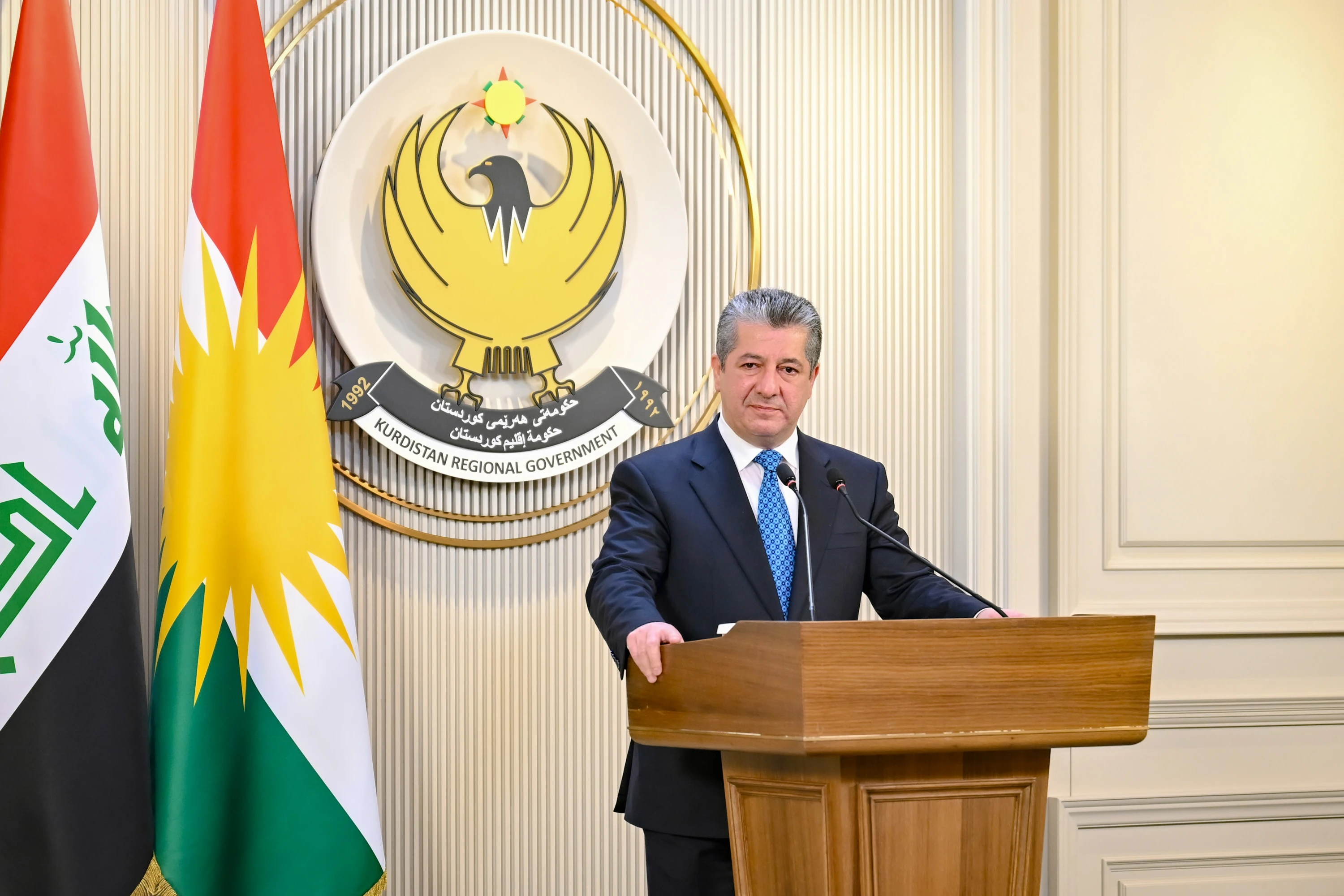
ERBIL, Kurdistan Region of Iraq – A recent spate of drone strikes that targeted the Kurdistan Region’s capital of Erbil originated from the northern Iraqi city of Mosul, Prime Minister Masrour Barzani said Monday, calling on the federal government to hold the perpetrators accountable.
Erbil and the Kurdistan Region have come under wave after wave of attacks since the breakdown of the US-Iran ceasefire agreement and the reemergence of hostilities, with strikes focusing on US interests and the bases of Iranian Kurdish opposition groups.
“Unfortunately, in the past two or three days, a number of the drones that targeted Erbil were launched from inside Iraqi territory, from the direction of Mosul,” Barzani said during a Monday presser.
He reiterated his calls on the federal government to hold the perpetrators accountable and prevent further attacks on the Kurdistan Region.
“We will again say that the federal government is responsible for preventing the source of these attacks and threats against the Region. It must not allow the outlaws to threaten the security and stability of the Kurdistan Region and all of Iraq in this manner,” the premier stressed.
During the presser, Barzani said that Erbil has been in contact with Baghdad and Washington to provide a permanent defense mechanism, with the US-led coalition set to depart the country.
“We’ve had these discussions and conversations with all our friends, including the Americans, and we’ve raised our concerns about the vulnerabilities of the Kurdistan Region, especially that we are defenseless; we don’t have adequate defense systems against incoming drones or missiles,” he said.
However, Erbil has yet to obtain permission to acquire air defense systems. The current systems in place are installed by the US-led coalition.
“So far, they have been providing protection because of their own presence, but of course, after the departure of these troops, there will be a different situation,” the premier explained.
The US-led coalition is set to depart the Kurdistan Region by the end of September, according to a US-Iraq agreement.
In May, Tehran declared the Kurdistan Region a site of “hostile bases” under its security doctrine, warning that the United Arab Emirates (UAE) had been given the same designation, making both subject to preemptive strikes.
“The Kurdistan Region stands with a peaceful solution to all issues. We do not support war and violence and the Kurdistan Region is not party to any war or conflict,” Barzani reiterated.
Sixteen bomb-laden drones were intercepted over the Kurdish capital within the span of three days last week, prompting the US embassy to urge its citizens to remain on high alert.
The Kurdistan Region came under hundreds of drone and missile attacks by Iran and its Iraqi proxies from late February until Tehran and Washington signed a memorandum of understanding in mid-June. Attacks resumed after hostilities between the two sides flared again on July 8, just 21 days after the agreement was signed.
Fuel crisis
During the presser, Barzani announced that he has directed relevant authorities to investigate and resolve the shortage of petrol fuel in the Kurdistan Region and “to find a prompt solution.”
Petrol stations in the Kurdistan Region sell three grades of gasoline: “Normal,” the standard grade, along with higher-octane “Improved” and “Super” fuel. Some government-affiliated stations also sell subsidized “Normal” fuel.
Gasoline prices have risen across the Kurdistan Region amid the renewed regional conflict, driven by shortages and higher costs of materials needed to produce “Improved” and “Super” fuel, resulting in reduced supply and higher prices at stations.
Barzani said regional tensions and a shortage of oil allocated to the regional government from Baghdad for producing fuel have been the main causes for the recent price surges.
Earlier in the day, Sipan Sherwani, a KDP lawmaker in the Iraqi parliament, blamed the fuel shortage in the Kurdistan Region on Baghdad’s unwillingness to allocate a greater share of oil.
“The share of oil for the Region is a very low amount, which is only 50,000 barrels of oil [per day],” Sherwani told a press conference in Baghdad.
He stressed that they have asked the federal oil minister to “assess and study under any basis they desire whether the share is fair or not.”
According to the premier, Erbil and Baghdad are in talks to increase the oil share for the Kurdistan Region.
A source from the natural resources ministry told The New Region on Sunday that a high-level meeting is scheduled for Monday to review proposals to adjust fuel prices proportionate to the cost of importing materials used to produce Improved and Super gasoline.
The ministry is assessing potential price adjustments for Improved and Super gasoline to ensure higher costs do not become a burden on the private sector and allow importers to continue importing and selling fuel, the source said.
The proposals include raising the prices of both Improved and Super gasoline by 300 Iraqi dinars per liter, the source explained. Based on the proposal, Super gasoline would rise to 1,500 Iraqi dinars per liter, while Improved gasoline would increase to 1,300 Iraqi dinars per liter.
 Facebook
 LinkedIn
 Telegram
 X
X