
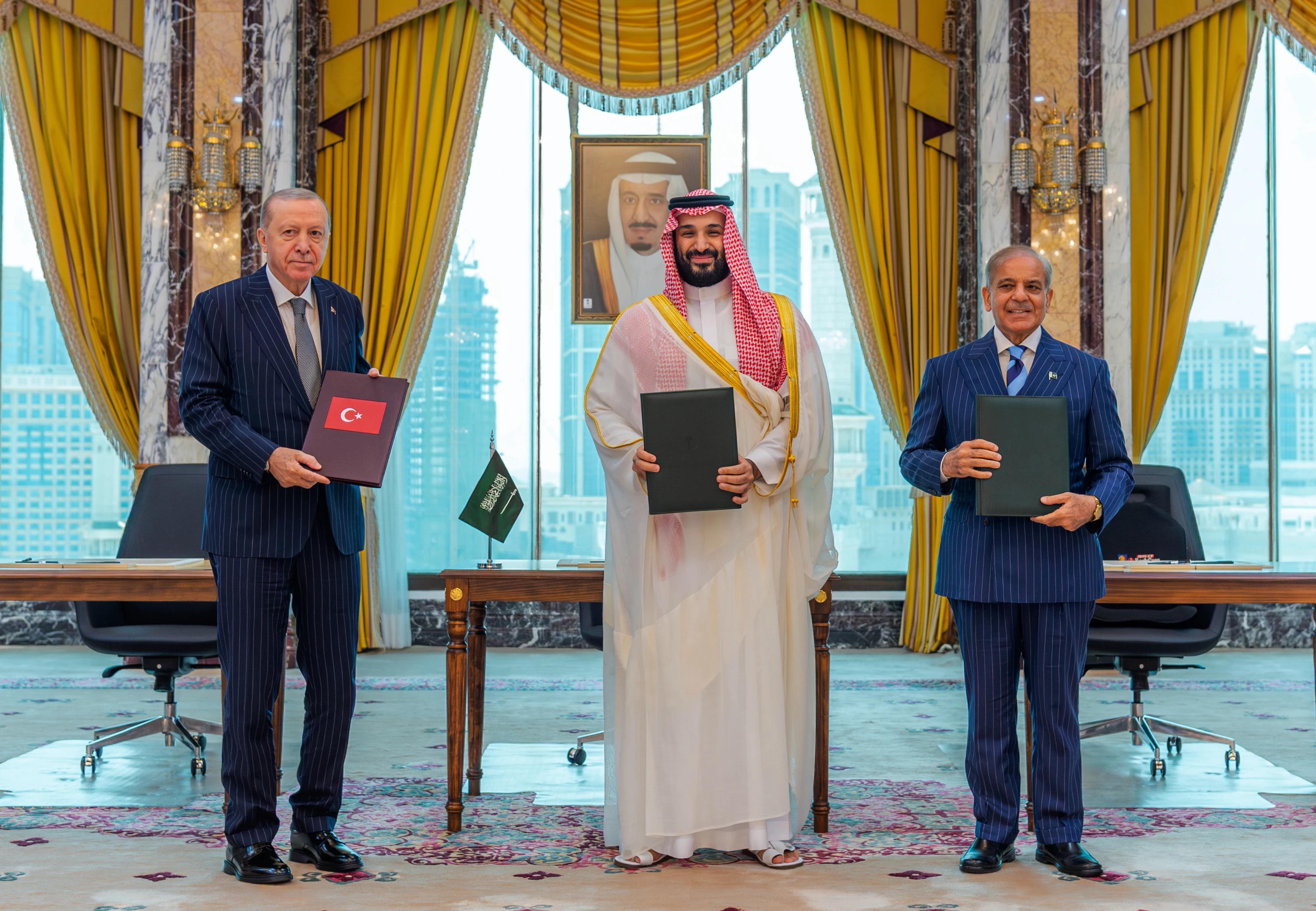
The shifting regional landscape since October 7, and the multiple rounds of conflict between Iran on the one hand and the United States and Israel on the other, continue to create new alignments and strategic pulls and pushes across the Middle East. The latest major development in this rapidly evolving landscape was the Mecca Joint Defense Agreement between Saudi Arabia, Pakistan, and Turkey—the three major Sunni powers in the Middle East-South Asia region—signed on August 7.
The agreement has been touted as a NATO-style pact that would entail the mutual defense of any of the three countries should they come under attack. This might be an exaggeration, particularly given a number of reasons. First, this is mainly a pact to defend Saudi Arabia. It’s hard to see the Saudis and Turks defending Pakistan against India, or the Saudis joining a military response against Israel, say, should Turkey and Israel come to clash in or over Syria. Second, Pakistan and Saudi Arabia have had a similar agreement since September 2025, but Islamabad has not defended Saudi Arabia in any meaningful sense against Iranian attacks during the two rounds of conflict between Iran and the United States this year. Third, it is hard to fathom that Turkey would intervene on Saudi Arabia's behalf to respond in kind to Iranian attacks. Ankara would risk a confrontation with Tehran and its proxies should it actually join forces with Riyadh to respond to such aggression. A first major test of this alliance has now come with the August 9 Yemeni Houthi attacks on Saudi Arabia’s Aramco oil facilities. We will have to wait and see whether the alliance responds and in what ways.
As things stand, the Iran-US-Israel conflict appears to be open-ended. There have been three rounds of conflict between the three parties since June 2025, and more are quite possible. Saudi Arabia certainly feels the direct and indirect effects of this ebbing and flowing confrontation. During the 39-day conflict, lasting from late February to early April, Saudi territory was directly attacked by Iran and allied Shiite militias from Iraq, while the Strait of Hormuz was shut down by Iran.
In the latest round of hostilities in July, Iranian strategy involved activating the Houthis in Yemen as well, opening another front whereby Saudi interests came under attack from the south, north, and northeast, an indication of the country being somehow under siege from the iran-led axis. More importantly, in addition to Hormuz, Bab al-Mandeb and the Red Sea region came once again under Houthi fire. Even the Suez Canal no longer appears entirely safe, as Houthi and Iranian missiles and drones can potentially reach that area too. The late July attack on the Egyptian Mediterranean port of Damietta appears to have been a warning shot against Egypt and global trade, though the Houthis and Iran officially denied involvement in the strikes.
These are critical arteries—and consequently chokepoints—for global trade, with up to $2 trillion in trade between Asia, Europe, Africa, and beyond passing through these strategic waterways annually. With Bab al-Mandeb, and potentially even Suez, joining the geography of this conflict, the prospects for Saudi Arabia, the rest of the Gulf, and indeed the wider region and world look far darker than perhaps initially thought. Even the East-West oil pipeline that the Saudis have relied on to bypass Hormuz might offer only a partial solution if continued Houthi attacks threaten shipping in the Bab al-Mandeb-Suez stretch. The recent effort to create a Muslim maritime protection force involving more than a dozen participating countries is another demonstration of the Saudi urge to protect its interests amid the ongoing volatility surrounding its borders.
With this picture in mind, the drivers of the defense pact become clearer, particularly from the Saudi perspective. It reveals that the Gulf lacks sufficient military power and capabilities to ward off these threats on its own and needs to rely on outside powers for protection. For a long time, the US played this role, but the pact is certainly a sign that the Saudis feel the need for reinforcements, if not alternatives. This is an act of strategic diversification of security providers for Riyadh.
Signing the agreement in Mecca also bestowed considerable symbolic weight on the pact. There are perhaps few other places in the Muslim world that would generate the same degree of popular Muslim support for their protection as Saudi Arabia, given that it is Islam's birthplace and home to its two holiest sites: the Kaaba in Mecca and the Prophet's Mosque in Medina. Calling the pact the Mecca Agreement was therefore an apt move by all parties, particularly the Saudis.
While mainly aimed at Iran and its proxies under the current circumstances, the agreement is also aimed at Israel. Following the Israeli attack on Doha last September, continued Israeli military presence in Syria, and the ongoing stalemate over the Palestinian question, the possibility of normalization between Saudi Arabia and Israel appears minimal. Even US provision of civilian nuclear technology to Saudi Arabia would not likely result in normalization with Israel under current circumstances. The Saudis and other Gulf countries are largely unhappy with the ill-conceived war against Iran initiated by Israel, which has only wounded Iran in ways that make it a greater threat than ever to the Gulf.
The Saudi and Turkish sides are particularly mindful of Israel and would hope that a new alignment bringing together two of the region's major military and energy-economic powers with the Muslim world's only nuclear-armed state would help deter both Iran and Israel. This is something we will have to watch, particularly in Syria, where Turkish and Saudi involvement keeps deepening.
Overall, Israel is unlikely to directly attack Saudi Arabia or its interests, but Iran will continue to test the strength of this alliance through its proxies. A reported Houthi attack on Aramco on August 9 could be an early sign of such testing. Recent remarks by Iraqi militia leader Akram al-Kaabi vowing "punishment" against the Saudis also indicate that Iraqi groups could rejoin the fray as well. Kaabi’s threats came despite earlier declarations by these groups that they had decided to halt a response to Saudi strikes against them in late July, which themselves came in retaliation for repeated militia attacks on Saudi Arabia since February.
Another important question is whether Egypt will eventually join the alliance. Turkish officials have expressed their desire for Cairo to do so. The recent attack on Damietta shows that Tehran appears willing to expand the geographical scope of its attacks on global trade and supply chains, presumably hoping that such pressure might deter further US and Israeli attacks. Egypt has shown little appetite for joining the trilateral military pact. Joining the alliance would expose it more directly to attacks from the Iran-led axis, particularly the Houthis. But if it faces further Iranian or proxy attacks, Egypt might eventually calculate that joining the Mecca alliance would help it better counter the Iranian threat.
Ultimately, what all of this also shows is what the various Gulf actors continue to overlook: the need for an effective pan-Gulf Cooperation Council (GCC) military alliance that genuinely commits member states to mutual defense. Relying primarily on outside actors will likely deepen GCC divisions, invite further trouble, and, at crucial moments of need, might not deliver the level of protection Gulf states expect. Even though a joint defense coordination mechanism has existed in the GCC region since the 1980s, it is in practice paralyzed by internal rivalries and clashing interests.
In a rapidly reshaping regional scene, the Gulf cannot continue to be an effective actor if it lacks sufficient security power and remains incapable of protecting its own security. The Gulf states have enormous energy and financial power, and they have successfully leveraged both to expand their regional and global influence. But in the continuously volatile Middle East, energy and financial power alone will not be enough.
The views expressed in this article are those of the writer and do not necessarily represent the position of The New Region's editorial team.
 Facebook
 LinkedIn
 Telegram
 X
X