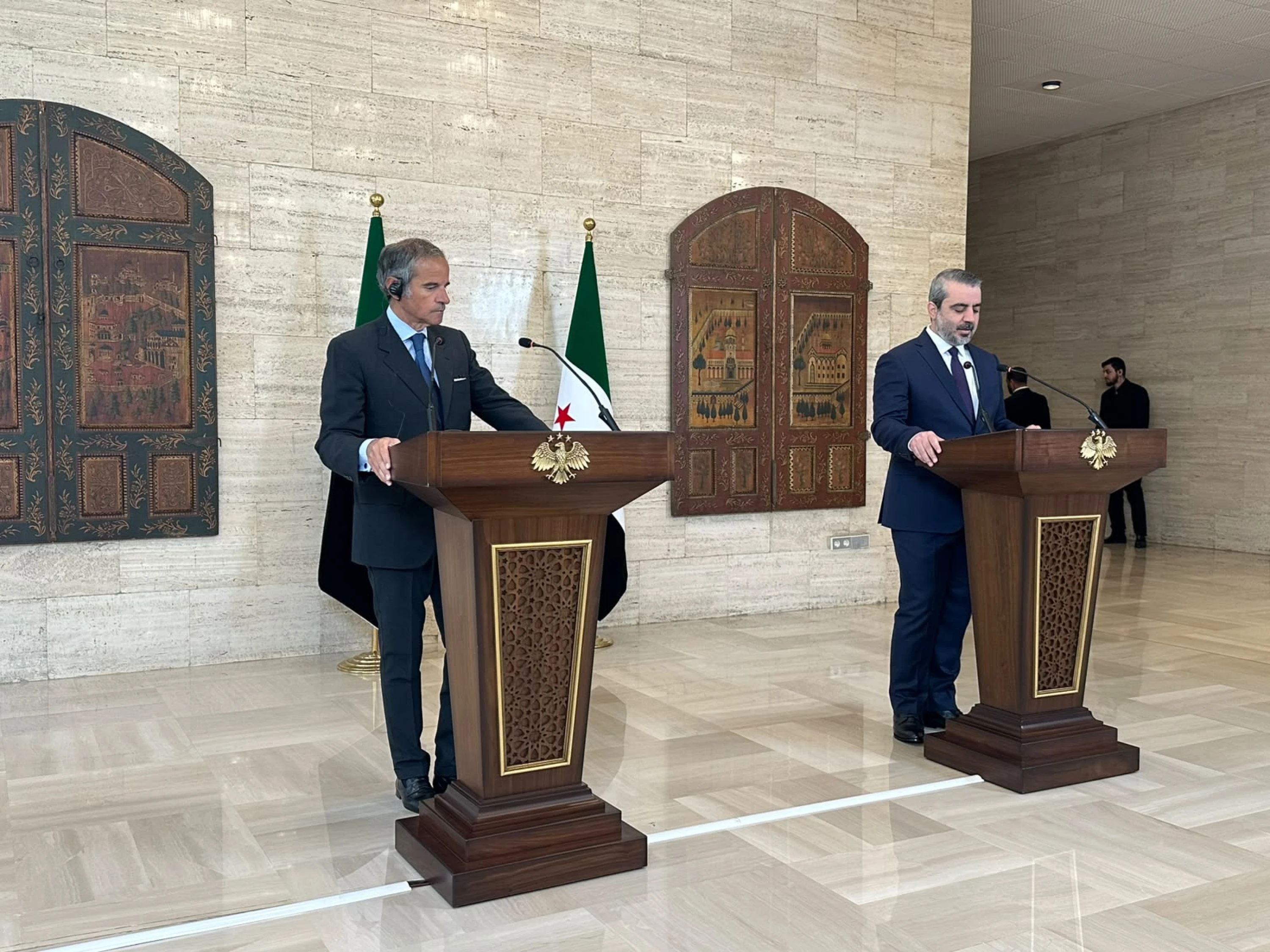
ERBIL, Kurdistan Region of Iraq – Syria and the UN’s International Atomic Energy Agency (IAEA) on Tuesday said that their recent cooperation marked “the most significant advance to date” and agreed to increase cooperation regarding undeclared nuclear sites in the country, during the IAEA chief’s visit to Damascus.
In a joint statement, Syria and the IAEA said that the agency’s chief Rafael Grossi’s visit to a site in the eastern Deir ez-Zor province and a “second location related to the nuclear material identified by Syria recently, marks the most significant advance to date in the cooperation between Syria and the Agency, towards resolving the outstanding safeguards issues.”
On Tuesday, Grossi said that the agency’s inspectors had found “tons of nuclear materials” at a previously undeclared site in Syria, praising Damascus’s “courageous decision” to report the site.
Foreign Minister Asaad al-Shaibani, speaking alongside Grossi in Damascus, said that Syria has “declared of our own free will the presence of nuclear materials at an undeclared site within the legacy left by the former regime.”
The materials “do not pose a risk,” Shaibani said, noting that they will remain under Syrian national custody.
The materials will be placed under the “international safeguards system,” according to Grossi.
“Syria and the Agency agreed on concrete steps, now being implemented, to enable the Agency to address the outstanding safeguards issues arising from activities undertaken under the former regime,” the joint statement said.
Damascus also reaffirmed its commitment to the Non-Proliferation Treaty (NPT), according to the statement, with Shaibani underlining that “Syria has acted on its own initiative in bringing these matters to the attention of the Agency, guided by the conviction that full transparency in this field is integral to Syria’s role as a source of stability and security in its region.”
During his visit, Grossi visited the site in Deir ez-Zor - known as al-Kibar - that the IAEA had suspected contained a nuclear reactor. Israeli fighter jets bombed and destroyed the site in 2007.
Last year, the IAEA said it discovered uranium particles at the Deir ez-Zor site during an inspection in 2024.
“At Deir ez-Zor, the Director General was briefed on the excavation work being carried out by Syria and observed features of the site relevant to the Agency’s assessment of the nuclear related activities formerly conducted there,” the statement said.
 Facebook
 LinkedIn
 Telegram
 X
X