
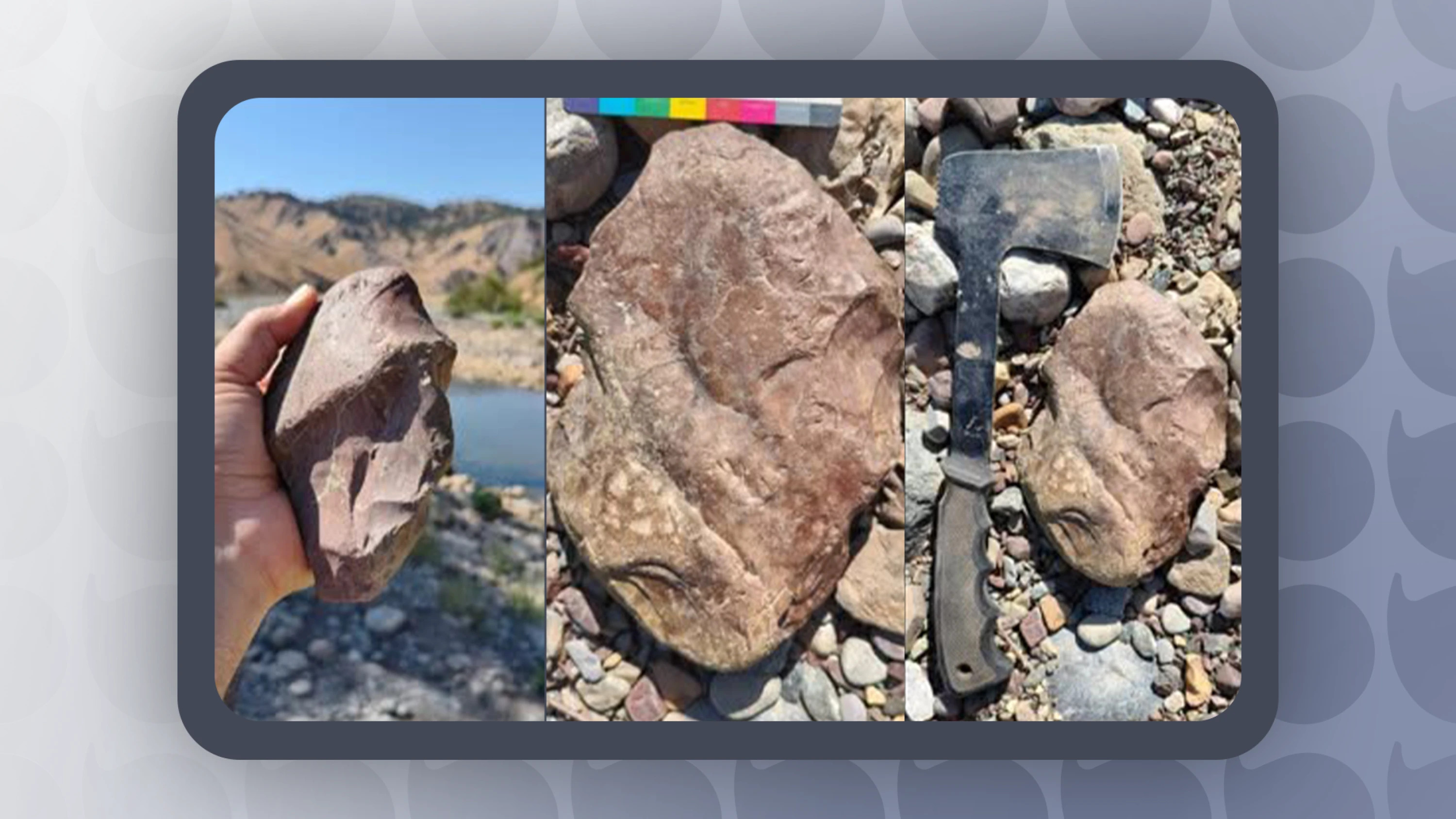
ERBIL, Kurdistan Region of Iraq – A stone hand-axe believed to date back to between 300,000 and 200,000 years ago has been discovered in Sulaimani’s Sharbazher district, a University of Sulaimani professor said Thursday, marking a rare finding that highlights Kurdistan's rich prehistoric past.
“In a rare and unexpected discovery, in the boundary of Waja village in Sharbazher, on the bank of the river, we found a stone hand-axe,” Dlshad Zamua, an archaeologist and Professor at the University of Sulaimani, said in a post on Facebook.
He said the tool was made from a type of stone resembling quartz that is found in the area.
“After consultation with Kurdish specialists from Eastern and Southern Kurdistan [Western Iran and the Kurdistan Region] … we all agree that the stone tool dates back to the Old Stone Age,” the professor noted.
Based on the tool’s size and manufacturing style, the majority of the archeologists that assessed the instrument believed it was made “between the end of the Lower Paleolithic and the beginning of the Middle Paleolithic — meaning a date of roughly 300,000 to 200,000 years ago,” according to Zamua.
However, he stressed that determining the tool’s precise age will require further research, describing the current estimate as a result of a preliminary assessment that could be revised following further research.
He explained that during this era, people often set up temporary settlements near rivers, and when the rivers froze during cold climates, they used such hand-axes to break the icy surface.
The discovery adds to a growing number of archaeological findings highlighting the Kurdistan Region’s early human history. The Region is home to a number of significant prehistoric sites, including Shanidar Cave, where Neanderthal remains have been discovered, and the Jarmo site, one of the world’s earliest known farming communities.
 Facebook
 LinkedIn
 Telegram
 X
X