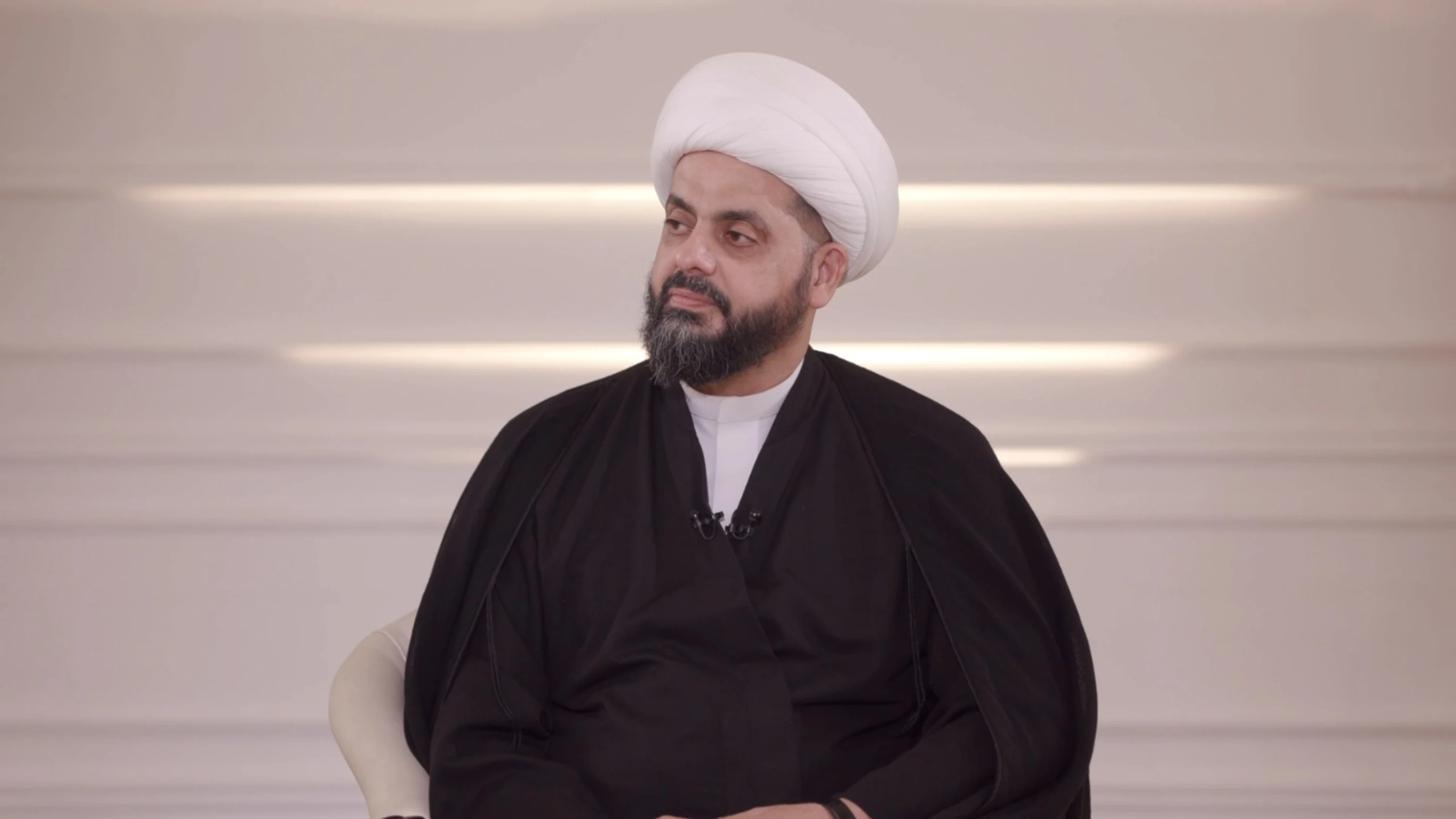
ERBIL, Kurdistan Region of Iraq – Qais al-Khazali, leader of the pro-Iran Asaib Ahl al-Haq (AAH), on Thursday acknowledged that the Kurdistan Region’s Peshmerga are a constitutionally recognized institution within the Iraqi state, but claimed that the forces must be brought under the command of Iraq’s Commander-in-Chief.
Iraqi Prime Minister Ali al-Zaidi pledged in May to disarm Shiite armed factions and bring their weapons under state control by September 30. As the deadline approaches, the Shiite factions and their supporters have begun pointing the finger at the Peshmerga, claiming that the Kurdish forces should be subjected to the same treatment.
“The Peshmerga is considered an institution recognized under Iraqi law and, consequently, the Constitution. Therefore, the issue is not about ‘confining’ Peshmerga’s arms, as their arms are officially registered, but rather about whether or not they submit to and obey the orders of the Commander-in-Chief of the Armed Forces,” said Khazali during an interview with his affiliated channel al-Ahad TV.
The 2005 Iraqi constitution allows federal regions in the country, such as the Kurdistan Region, to establish and organize internal security forces “such as police, security forces, and guards of the region,” and the Peshmerga fall under the last category.
“The reality is that there is a disconnect; the Peshmerga takes decisions solely from its own political leadership in the Region, with absolutely no link to the Commander-in-Chief. This runs counter to state sovereignty and state centralization,” Khazali added.
Khazali was among the first faction leaders to publicly respond to Zaidi’s call, announcing AAH’s readiness to join the government’s program to restrict weapons to the state.
The move was a natural next step for Khazali to complete his transition to political activity – a process which had begun years earlier-, particularly after the candidates of al-Sadiqoun bloc, the AAH’s political wing, achieved significant gains in the November 2025 parliamentary elections.
Khazali expressed his “support” for the demands to place the Peshmerga forces under the command of the Iraqi state, describing those calls as “legitimate”, and added that he will mention this point in upcoming meetings of the State Administration Coalition.
Formed in 2022, the State Administration Coalition brings together Iraq’s main Shiite, Sunni, and Kurdish political parties. The bloc seeks to unify Iraqi decision-making and convenes regularly.
“Just as Shiite political forces are required to fulfill their duty of persuading the Islamic Resistance factions to place weapons exclusively in the hands of the state, which is a responsibility we will not shirk, the same message must be directed at the leaders of the Region; we are all in the same boat, and state sovereignty must be absolute and undiminished,” the AAH chief added.
Iraq’s ruling Shiite Coordination Framework has formed a committee, in coordination with the government, to determine the appropriate mechanisms for implementing the process of restricting weapons to the state, after the ruling Shiite bloc was reportedly tasked by Tehran to negotiate on behalf of the factions with the Iraqi government to avoid escalations between the two sides.
“We want our brothers in the Region to take a step forward with us on this path, provided they believe in a unified Iraq. The second point concerns the authority of the Commander-in-Chief to deploy federal units, including into Kurdistan. To this day, the federal government cannot deploy even a single police officer into the Kurdistan Region; this is a clear issue that, in my view, requires resolution,” Khazali added.
The Kurdistan Region’s Peshmerga ministry on Thursday announced that the unification and restructure process of Peshmerga forces has been successfully completed, reorganizing the forces under a single command and control structure of the Ministry of Peshmerga Affairs.
The historic process, overseen by the US-led international coalition against the Islamic State (ISIS), sought to incorporate the Peshmerga’s Unit 80 forces, affiliated with the Kurdistan Democratic Party (KDP), and Unit 70 forces, affiliated with the Patriotic Union of Kurdistan (PUK), into the Peshmerga ministry.
The two formations make up the majority of Kurdish Peshmerga forces, numbering over 150,000 troops.
 Facebook
 LinkedIn
 Telegram
 X
X