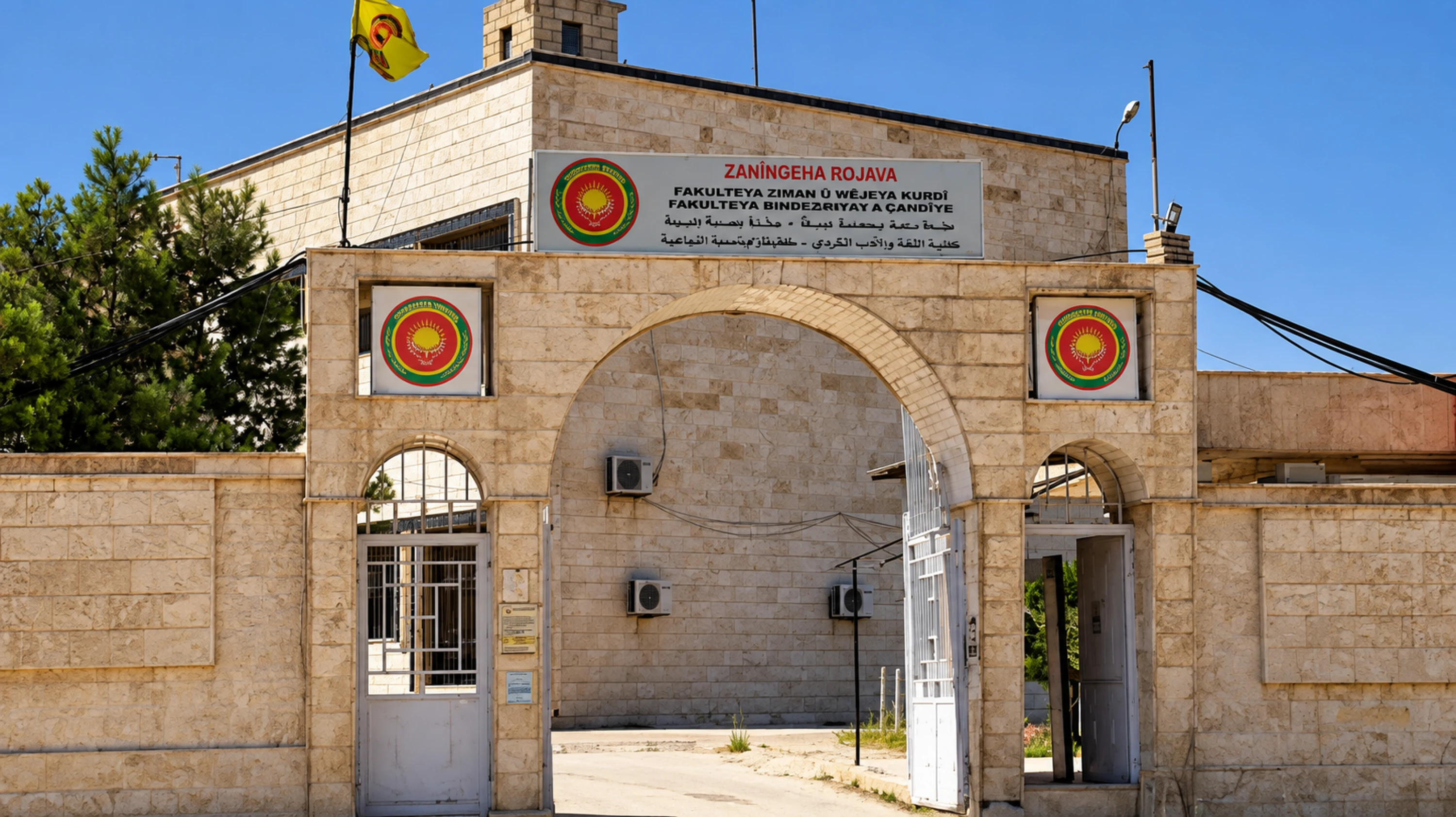
ERBIL, Kurdistan Region of Iraq – The Rojava University on Sunday expressed “skepticism” about the delay in integrating the institution into Syria’s higher education ministry, lamenting its “unclear” status and voicing rejection of any potential centralized decision to be made about the university by Damascus.
“Some time has passed since the initiation of the process to integrate Rojava University with the Ministry of Higher Education and Scientific Research in Syria,” the university said in a statement marking its 10-year anniversary, asserting that the implementation of the process remains “shrouded in ambiguity,” as time runs short with the new academic year approaching.
The university further lamented the “skepticism” in its integration process, asserting that it would “reject” any “decisions regarding the university that might be made and implemented centrally.”
“We maintain that centralization has never been effective in academic affairs, nor would it be the appropriate response in this context,” the university argued, stressing that “changes should not be imposed upon the university through sudden, centralized decisions … [instead] decisions concerning the institution must be reached through dialogue, transparency, and respect for the region's unique context.”
The university said that the preservation of its academic system and right to education in the mother tongue constitutes a “fundamental, non-negotiable principle for us.”
In July, Syrian Higher Education Minister Marwan al-Halabi visited the university and said in a statement that the ministry was working towards gradually merging the institution with al-Furat University, which is located in Deir ez-Zor and has campuses in Raqqa and Hasaka.
The Syrian education ministry in August announced a new plan for Kurdish-language instruction in the country, under which students in Kurdish-majority areas would receive a maximum of three classes in their mother tongue per week, a dramatic shift from the Kurdish language curriculum northeast Syria’s residents enjoyed for a decade.
In addition, the Syrian government has not moved to introduce the Kurdish language as an official language in Syria, despite repeated requests by Kurdish authorities and the recent integration of Rojava’s administration and military institutions into the Syrian state.
The failure to enshrine Kurdish as an official language in the Syrian constitution, a position it enjoys in Iraq, and the limiting of Kurdish classes to thrice weekly has been met with dismay by many of Rojava's Kurds, for whom mother tongue education was a cornerstone of the autonomous administration.
The university criticized the decision in a statement released in late August, saying that the measure could have negative educational and academic consequences, and arguing that “the optimal academic solution lies not in sidelining one language in favor of another, but in adopting a bilingual education model” involving both Kurdish and Arabic.
Founded in 2016 in the city of Qamishli, Rojava University was built during the Syrian civil war, with the aim of providing students in northeast Syria an opportunity to complete their studies after many were deprived of education due to the unrest.
According to its official website, the facility was built on the foundations of “democratic nation, women's freedom, ecological society, and creating relationships of love and respect between entities.”
 Facebook
 LinkedIn
 Telegram
 X
X