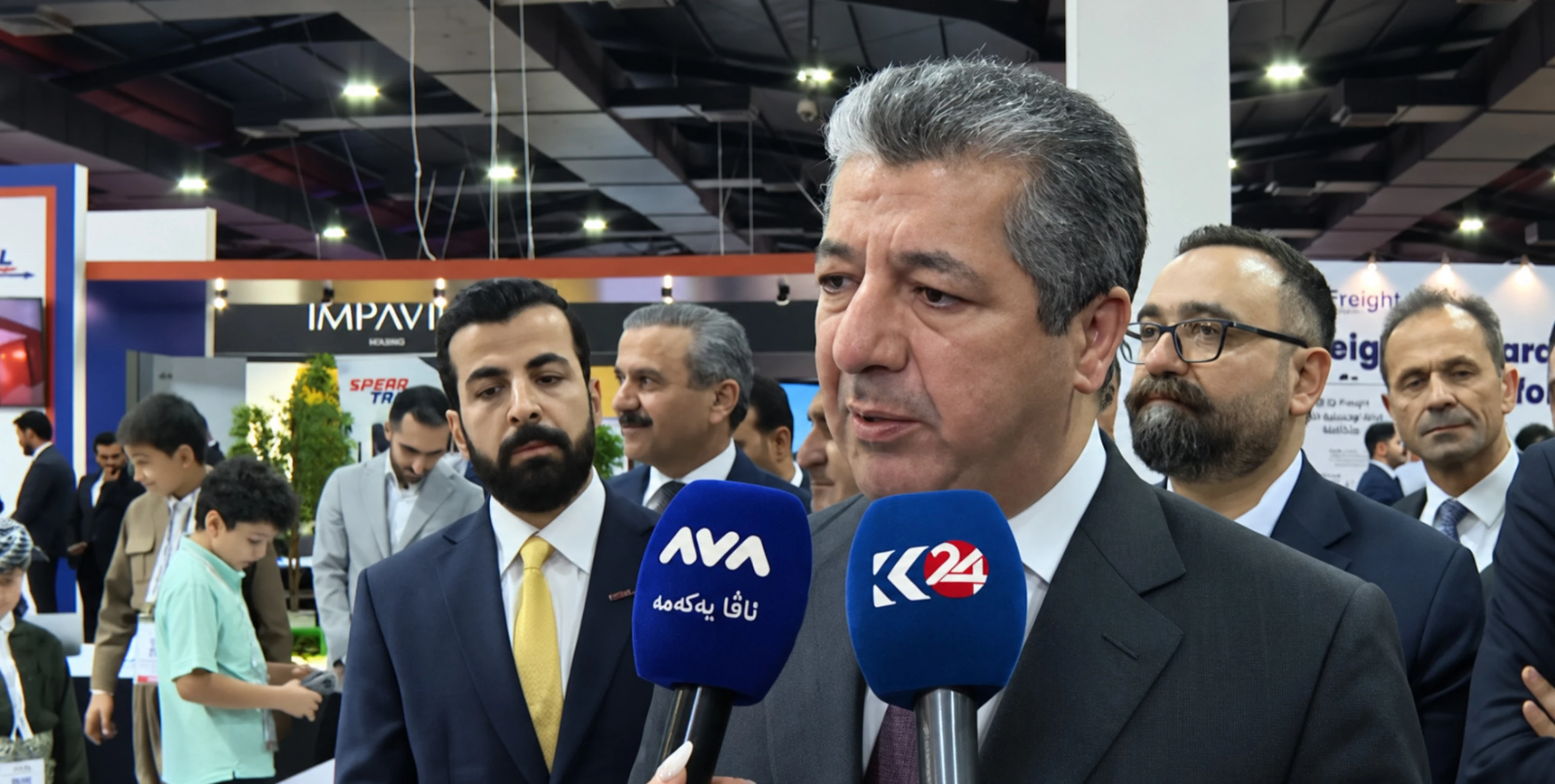
ERBIL, Kurdistan Region of Iraq – Kurdistan Region Prime Minister Masrour Barzani on Tuesday stressed the importance of acquiring air defense systems following the US-led global coalition’s withdrawal from the country.
“The only important point for us is acquiring air defenses, which is where we will need more help from our allies and talks are ongoing with the federal government,” Barzani told reporters at the seventh annual HITEX technology fair.
The US-led coalition against the Islamic State (ISIS) completed its withdrawal from Iraq and the Kurdistan Region on Wednesday in accordance with an agreement between Baghdad and Washington.
Besides the fight against ISIS, it also played a key role in intercepting drones and missiles launched at Iraq and the Kurdistan Region by Iran and its proxies during the war with the US.
Barzani said that the coalition's presence has been “symbolic” in recent years and that the fighting against ISIS by the Region's Peshmerga and Iraqi forces.
“We do not have the risk of security vacuums,” the premier added.
Kurdish leaders have repeatedly stressed the necesstiy of air defense systems to protect the Kurdistan Region from attacks targeting its soil.
While Iran and Iran-backed armed groups claim the attacks chiefly target US interests in the Kurdistan Region, vital infrastructure has also been struck, including oil and gas facilities and residences of the Region’s leaders.
The attacks and the coalition’s withdrawal have also prompted Baghdad to scramble to acquire air defenses.
In early September, Iraqi defense ministry spokesperson Yahya Rasool, told state media that Prime Minister Ali al-Zaid has directed that the timeframe for developing the air defense systems be shortened from six years to three years.
In late September, Mahmoud al-Shammari, a member of the Iraqi parliament’s security and defense committee, told state media that Turkey and France have agreed to supply Iraq with air defense systems.
Barzani reaffirmed that the end of the coalition’s mission does not signal the end of the relations of its member states with Iraq and the Kurdistan Region.
Asked about the reactivation of the Kurdistan Region’s parliament and the formation of its next government, Barzani said that “it is necessary that it [the parliament] be reactivated as soon as possible.”
The Kurdistan Region’s parliament has met only once in two years, amid a political deadlock over the government formation process.
One of the main sticking points remains the distribution of senior government posts and sovereign ministries, particularly the interior ministry, which the PUK is seeking.
“I urge the parliament members not to waste any more time, because even for government formation we need the parliament,” Barzani said, calling the lawmakers’ failure to convene “an evasion of responsibility.”
The Kurdistan Region held parliamentary elections in October 2024, with the KDP winning 39 seats, followed by the Patriotic Union of Kurdistan (PUK) with 23.
Lawmakers were sworn in two months after the elections, but repeated attempts to convene parliament have failed because sessions did not reach the required legal quorum.
 Facebook
 LinkedIn
 Telegram
 X
X