
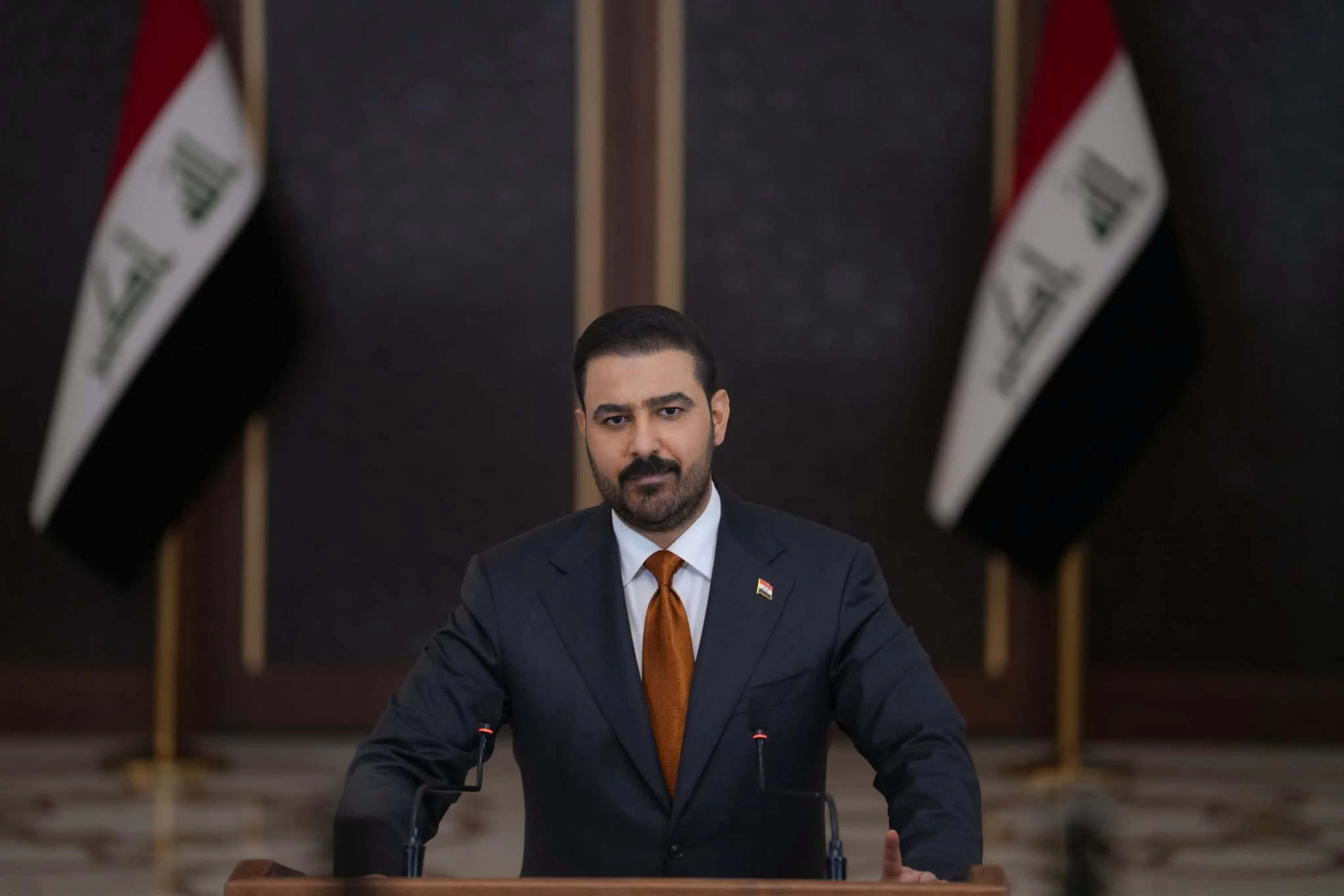
ERBIL, Kurdistan Region of Iraq - Iraq’s parliament is expected to vote on filling the remaining ministerial posts and completing the cabinet of Prime Minister Ali al-Zaidi on Thursday following months of negotiations and delay.
Zaidi on Tuesday called on the parliament to schedule a session on Thursday to vote on candidates for vacant ministerial posts and deputy prime minister positions. The request was swiftly answered by the legislature, confirming the session.
Zaidi assumed his role as prime minister on May 14 following a parliamentary session that saw his program for government and 14 ministerial appointments endorsed. Disputes over some portfolios left nine ministries unfilled.
The incomplete ministries consisted of interior, defense, planning, higher education, labor and social affairs, youth and sports, migration and displacement, the Ministry of Construction, Housing, and Municipalities, and the Ministry of Culture, Tourism, and Antiquities.
Three new ministries are set to be added to the cabinet during Thursday’s session, including an artificial intelligence or digital investment ministry and a state ministry for foreign affairs, while the Ministry of Culture, Tourism, and Antiquities is set to separated be into two different ministries: a culture and antiquities ministry and a tourism ministry.
The exact jurisdictions of the state ministry for foreign affairs, set to be allocated for Iraq’s Turkmens, remain unclear, considering the cabinet already has a Ministry of Foreign Affairs and this new portfolio is set to be a separate entity.
All posts are expected to go through in the Thursday session as part of a political agreement and the ministries will be distributed evenly among top parties, The New Region has learned.
The Kurdistan Democratic Party (KDP), the largest Kurdish bloc in the parliamernt, is set to receive two high-profile posts: One of the deputy prime minister positions will reportedly go to Fars Brifkani, while Rebaz Hamlan is set to assume the role of Minister of Construction, Housing, and Municipalities.
Zaidi’s government emerged from an agreement within the Iran-backed Shiite Coordination Framework, while his rise to the premiership was also strongly backed by influential Shiite cleric Muqtada al-Sadr. The first controls the largest bloc in parliament, while the second wields considerable influence on the streets through his millions of followers.
He was also seen as a compromise figure amid pressure from Washington, with US President Donald Trump himself vehemently rejecting the initial nomination of former Prime Minister Nouri al-Maliki. In January, Trump stressed that Washington will no longer help Baghdad if Maliki became prime minister, criticizing his “insane policies and ideologies.”
Zaidi has enjoyed staunch support from the US since his nomination by the Shiite ruling bloc, and has already met with Trump on two separate occasions since his appointment, including a previously unscheduled meeting on the sidelines of the UN General Assembly in New York in late September.
Washington has also demanded the exclusion of figures belonging to or backed by Iran-aligned armed factions from top executive posts regardless of their parliamentary weight and political entitlements.
In September, Iraqi officials and politicians told The New Region that US officials had threatened to boycott Zaidi’s government and impose economic sanctions against Iraq if such appointments take place.
According to information obtained by The New Region, one of the deputy prime minister positions is set to go to Laith al-Khazali, the younger brother of Qais al-Khazaqli, leader of Asaib Ahl al-Haq (AAH), which is a pro-Iran armed group that is part of the state-integrated Popular Mobilization Forces (PMF).
Laith al-Khazali is under US Treasury Department sanctions.
Qais al-Khazali was among the first faction leaders to publicly respond to Zaidi’s call for disarmament, announcing AAH’s readiness to join the government’s program to restrict weapons to the state.
The move was a natural next step for Khazali to complete his transition to political activity – a process which had begun years earlier-, particularly after the candidates of Sadiqoun bloc, the AAH’s political wing, achieved significant gains in the November 2025 parliamentary elections.
Zaidi’s government had initially set September 30 as the deadline for armed groups to hand over their weapons, coinciding with the coalition’s withdrawal, but later shifted to a phased process extending into July 2027 after several groups rejected the deadline.
Multiple pro-Iran factions rejected the notion of handing arms to the state, leading Baghdad to seek other mechanisms to regulate the factions’ weapons in a manner that would be acceptable to the groups.
 Facebook
 LinkedIn
 Telegram
 X
X