
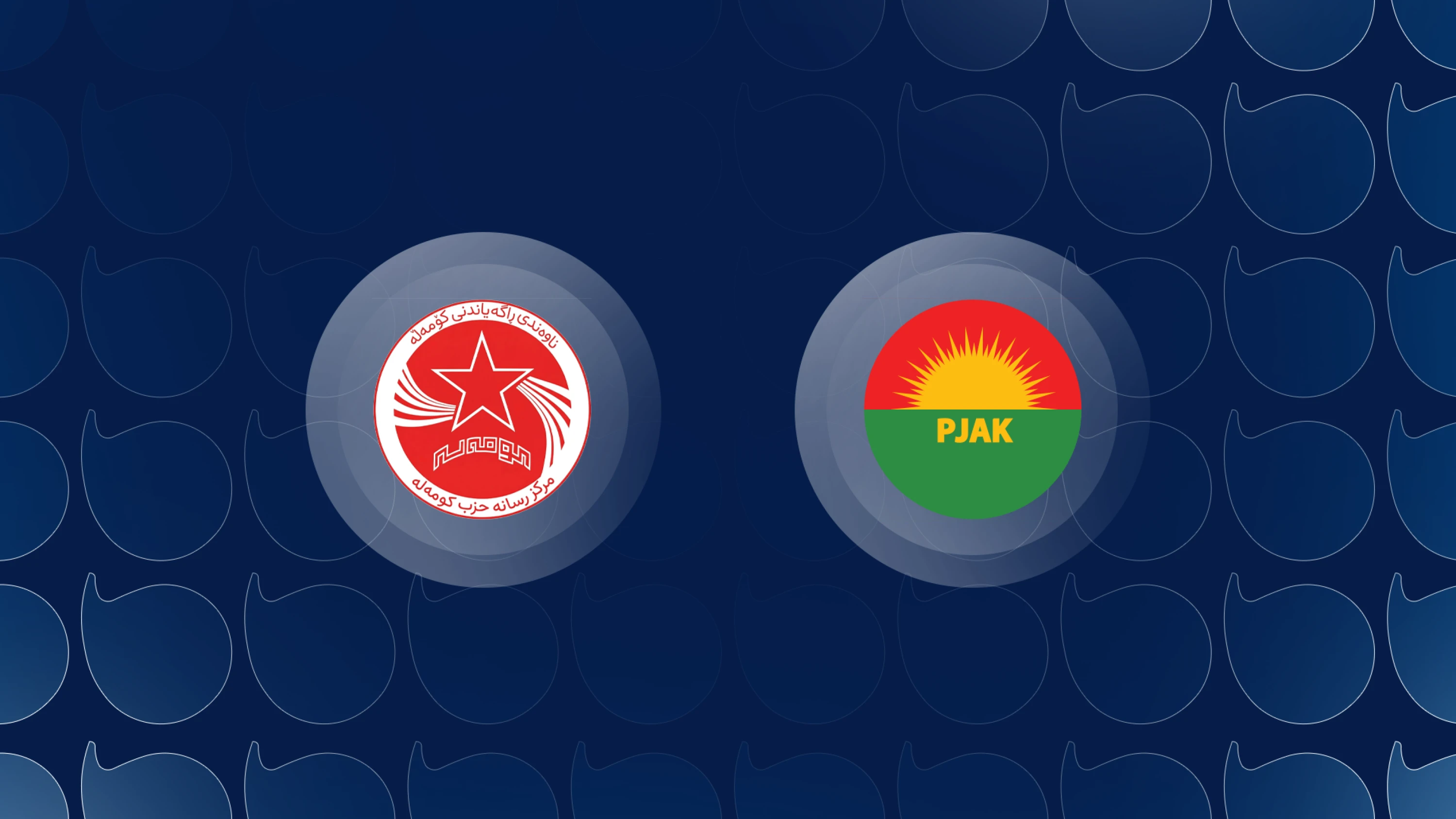
ERBIL, Kurdistan Region of Iraq – A disagreement on “democratic integration” has emerged between Kurdish Iranian opposition parties the Kurdistan Free Life Party (PJAK) and the Komala Party of Iranian Kurdistan (Shorshger), with the former defending it as a way to positively transform the state, while Komala warned it undermines the principle self-determination.
Democratic integration is a political concept that refers to including diverse communities into a shared political system without forcing cultural assimilation or majority dominance.
The PJAK formed in 2004, seeks autonomy for Kurds in western Iran (Rojhelat) and operates along the Iraq-Iran border. The group receives support from the Kurdistan Workers’ Party (PKK) and is considered an ideological extension of the organization.
PKK leader Abdullah Ocalan has used the term “democratic integration” to describe restructuring the state framework so distinct ethnic groups can coexist under shared democratic principles, with his movement having shifted from its initial goal of a Kurdish nation state in the 1970s to the pursuit of “democratic confederalism” within existing states, wherein minority groups secure their rights via decentralized, local democratic institutions.
“Democratic integration should be understood as a conditional and reciprocal process based on the structural transformation of the state, rather than as the unilateral accommodation of an oppressed nation to the dominant order,” the PJAK said in a statement on Friday.
The group added that the term should be “understood as a conditional and reciprocal process based on the structural transformation of the state” rather than accommodating an oppressed nation to “the dominant order.”
“In the case of Iran, advancing such a perspective in no way means accepting the Islamic Republic, endorsing the current constitution or abandoning the struggle against national oppression,” it added.
The PJAK’s statement was in response to Komala’s criticism of the concept during the same day.
Komala argued that democratic integration lacks clear guarantees for Kurdish rights and political representation. It said the concept treats Kurds as a cultural minority rather than a nation with political and national rights.
The party also warned that the term fails to recognise Kurdish right to self-determination and offers no clear framework to federalism or autonomy, adding that the model is intended for diaspora communities and would undermine Kurdish rights in the homeland.
“A primary problem with the concept of ‘democratic integration’ is the vagueness of its concrete content. It talks a lot about the ‘societies’ in Iran, but it is not clear exactly what rights it will guarantee for the Kurds. It does not mention any entity, any position or any legal framework for the future of the Kurds,” Komala said.
“In general, a lot of noise and little content,” it added.
The PJAK is one of the most prominent armed Iranian opposition groups. Iran views the PKK-linked movement as a major security threat in the country’s western and northwestern regions, fearing that the United States and Israel could succeed in their efforts to support Iranian opposition groups and use them to destabilize the country.
However, the group largely refrained from any operations during the US-Israeli war on Iran, though having recently stepped up its targeted of Islamic Revolutionary Guard Corps (IRGC) forces in the country.
The PJAK is belived to have approximately 3,000 fighters, half of them women, based in Iraqi territory, and wields significant influence in Kurdish-majority towns in western Iran, including Saqqez, Sanandaj, Urmia, Mahabad, Sardasht, and Baneh.
Iran has demanded that Iraq remove PJAK from its territory and hand over 37 of its members over their alleged involvement in assassinating Iranian officials, Iraqi security sources involved in recent talks with Iran told The New Region.
Kurdish-Iranian opposition parties in the Kurdistan Region have also been frequently targeted by Iran and its proxies.
In May, Tehran declared the Kurdistan Region a site of “hostile bases” under its security doctrine, making it subject to preemptive strikes.
A missile strike targeting Komala’s base in Sulaimani's Zirgwezala area in the Tanjaro subdistrict killed at least 10 people in July, marking the deadliest attack on the Kurdistan Region since the start of the US-Israel war with Iran.
 Facebook
 LinkedIn
 Telegram
 X