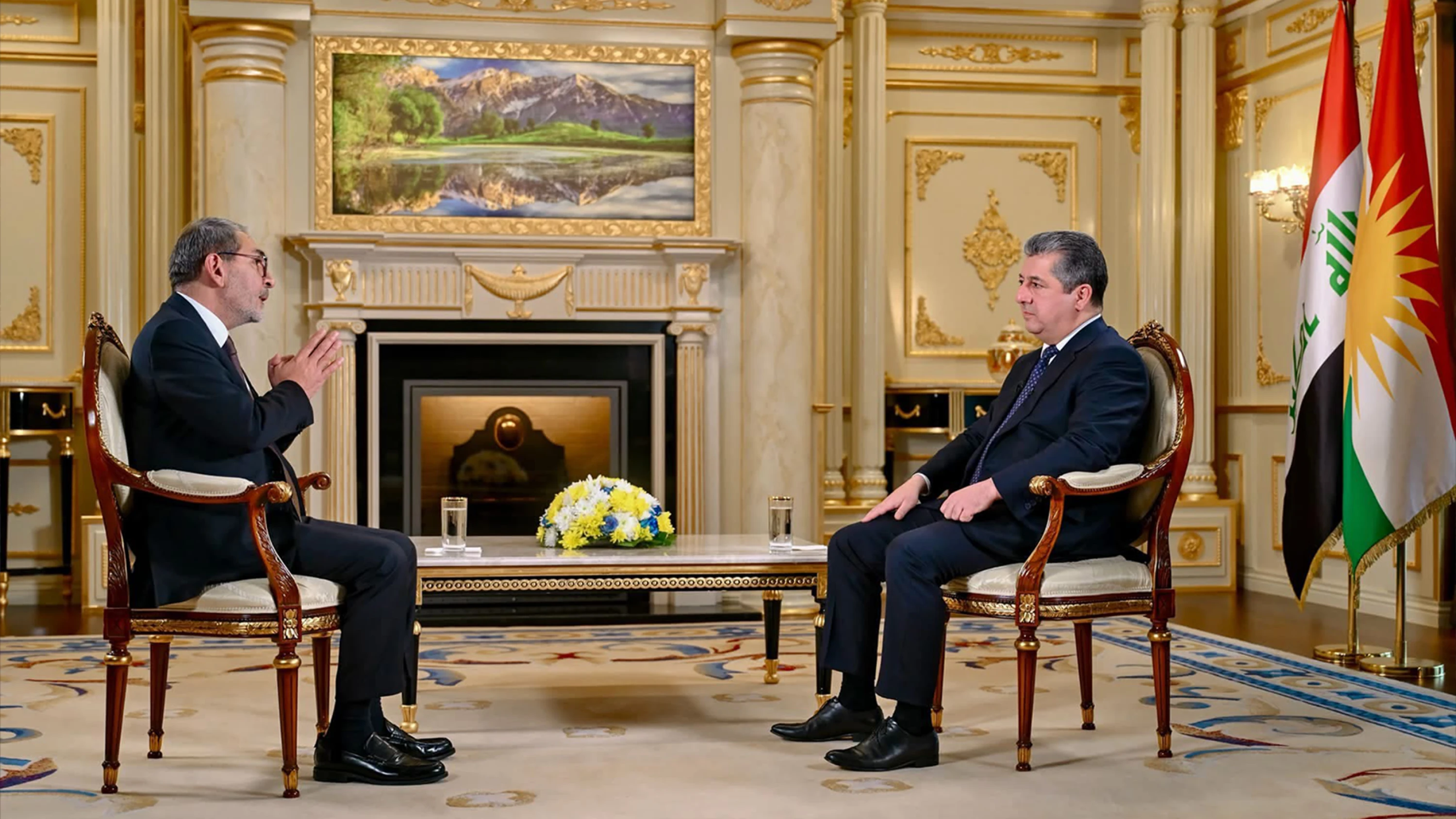
ERBIL, Kurdistan Region of Iraq – Kurdistan Region Prime Minister Masrour Barzani reiterated that efforts to divide the Region will not succeed, warning that political disputes must not undermine the Region’s institutions or threaten its stability.
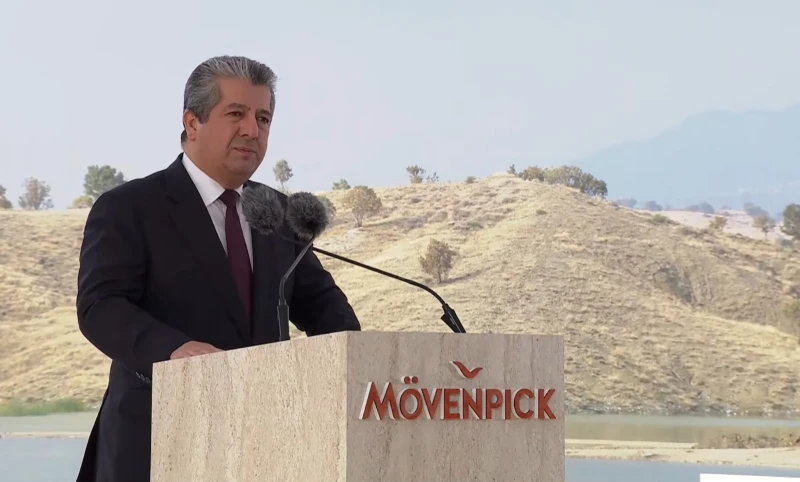
“No one has the right nor the power to divide Kurdistan,” Barzani said in an interview with Shams TV’s Elie Nakouzi, adding that the Region was “the product of the struggle of many years and decades of our people.”
He said negotiations with the PUK remained possible, insisting that his government had not closed the door to cooperation with political rivals.
“There is always hope. We have never closed our door and what we have done has never been against anyone,” he said, referring to reactivation of the Kurdistan Parliament in early November.
KDP-PUK tensions and the parliament dispute
Barzani defended the reactivation of the Kurdistan Parliament after it had remained unable to convene for two years following the 2024 parliamentary election, attributing the deadlock to disagreements over government formation and political posts.
He said the opposition parties had taken the dispute to the Iraqi Federal Supreme Court, seeking the dissolution of the parliament and government. “We were at a stage where our own legitimacy had come into question,” he said.
“We had two options: either to protect the legitimacy of our institutions, or to face the consequences of the irrational reactions of the rivals,” he said.
On November 4, the Kurdistan parliament held its first session in nearly two years, continuing the proceedings of its first session in 2024 and electing the parliamentary presidency board. The KDP attended the session, while the PUK boycotted.
A day later, PUK leader Bafel Talabani announced that the party would withdraw from the Kurdistan Regional Government (KRG) and revealed plans for a potential separate government.
Despite the PUK’s absence, a quorum was reached through the participation of MPs who had defected from the party, as well as lawmakers from other blocs. The participants said restoring the legislature was a public duty.
Barzani described the decision to reactivate parliament as “a national and moral duty,” saying its purpose was to restore the legitimacy of the institutions and allow negotiations over forming a new government to continue.
Barzani also rejected the traditional power-sharing approach under which the KDP and PUK have divided government positions, arguing that election results should determine the distribution of political power.
The PUK is the KDP’s main rival, and the two parties have traditionally governed the Region together. They emerged as the two largest parties in the last parliamentary elections. The KDP won 39 seats, while the PUK secured 23. However, negotiations to form the next cabinet have repeatedly stalled, with both parties blaming each other for the impasse.
“A 50-50 division is not an expression of the nature or essence of democracy as it is,” he said, adding that the KDP had repeatedly been willing to compromise and give rivals a greater share of government positions “for the sake of national unity.”
He said parties that did not win an election should either join a governing coalition or remain in opposition, rather than obstruct the political process.
Barzani, who is also the Deputy President of the KDP, said the party was prepared to be flexible in negotiations and form an inclusive government, but insisted that any agreement must respect election results.
“We are ready to work with them and be very flexible. But certainly everything has a limit and everything must be within an appropriate framework. Certainly the results of the election must be respected,” he said.
The KDP and PUK political bureaus reportedly met in Erbil on Saturday to resolve their disputes and discuss the formation of the KRG’s new cabinet.
The New Region understands that the PUK delegation called for the dissolution of the parliament’s presidency and demanded that three MPs who had defected from the party and attended the session resign and be replaced by its nominees.
The KDP delegation, meanwhile, expressed willingness to discuss PUK representation in the parliament’s presidency.
The meeting came after President Masoud Barzani on Monday called on the PUK to sit down with the KDP to resolve their differences.
Erbil-Baghdad relations
Turning to relations with Baghdad, Barzani said longstanding disputes between the federal government and the Kurdistan Region stemmed primarily from a failure to understand or accept Iraq’s federal system and implement the constitution in full.
He said the Kurdistan Region was a constitutional entity with “defined rights and duties” that must be “fully respected” by the federal government.
“I think the main problem is in the mentality of those people who still do not understand federalism or do not accept it,” he said.
Barzani rejected the notion that federalism amounted to dividing Iraq, describing it instead as a system of shared responsibility that protects the rights of the country’s different communities.
“Federalism is not division; it is not dividing the country. Fundamentally it is about taking on or sharing responsibility,” he said.
He argued that Iraq’s constitution must be respected as a whole rather than selectively applied by political actors.
“You cannot choose, at your own whim, the parts and articles of the constitution that serve one side and ignore the others. It is a package. It is a package of compromise,” he said.
On his relationship with Iraqi Prime Minister Ali al-Zaidi, Barzani expressed support for his government’s efforts to resolve problems. He said, however, that the Region’s financial entitlements and other outstanding constitutional issues remained unresolved.
“Our intention is very clear: supporting a prime minister who implements the constitution as it is, and also respecting the rights of the KRG in federal Iraq.”
Barzani’s remarks come amid negotiations between Erbil and Baghdad over the Kurdistan Region’s financial entitlements and its share of the 2027 federal budget. The initial budget draft allocated the Region 12.68 percent of federal spending, while the KRG maintains that its share should reflect its 14.14 percent proportion of Iraq’s population.
Barzani visited Baghdad earlier in November, where he discussed the Region’s constitutional rights, financial entitlements, and budget share with Zaidi and other senior political leaders. He later said Baghdad had “promised” to “provide and guarantee” salaries of the Region’s civil servants.
Attacks on Kurdistan Region amid Iran war
Addressing regional security, Barzani said the Kurdistan Region had come under more than 1,050 missile and drone attacks during the US-Israeli war against Iran, some targeting coalition forces and others striking the Region and camps belonging to Iranian Kurdish opposition groups.
He said that 50 percent or more of the attacks had originated from within Iraqi territory, placing responsibility on Baghdad to prevent armed groups from launching attacks.
“Certainly, we believe this is the responsibility of the federal government to make sure none of these attacks are carried out from inside Iraqi territory,” he said.
Barzani called on the federal government to hold perpetrating groups accountable and bring all armed forces under the rule of law.
“If the federal government has control of these groups, it must hold them accountable. If it does not have control of these groups, then there is a big gap of responsibility and rule of law in this country that we must face and resolve,” he said.
He expressed support for Zaidi’s efforts to bring armed groups under state authority, describing the task as difficult but necessary.
“I hope he can, but it is not easy,” Barzani said.
He clarified that he was referring to armed groups operating outside the constitutionally recognized security institutions, saying the Iraqi army itself was united and that the Peshmerga were also legitimate forces under the constitutional framework.
Barzani also reiterated that the Kurdistan Region would not take part in the conflict with Iran or allow its territory to be used to threaten neighboring countries. “Our official position has been very clear. Kurdistan will not become part of any confrontation. We will not allow Kurdistan’s land to be used against any of its neighbors,” he said.
He described Iran’s attacks on the Region during the war as regrettable and said Tehran had failed to provide a convincing explanation when asked about them. “Unfortunately, Iran’s hostile stance in attacking Kurdistan during this war was very regrettable,” he said, adding that Erbil wanted friendly relations with Iran and all its neighbors.
On the withdrawal of US forces from Iraq in late September, Barzani expressed gratitude for Washington’s support in the fight against the Islamic State (ISIS), but said the Region ultimately wanted its concerns addressed through relations with Baghdad.
He said the Kurdistan Region had played an important role in Iraq’s stability and economic recovery and should be treated as an integral part of the country rather than a foreign entity.
Rojava (northeast Syria) relations with Damascus
Asked about developments in Syria, Barzani said the Kurdish population there must have its rights recognized and that negotiations with Damascus should determine the country's future political arrangements.
He said the Kurdistan Region could not decide which system was best for Syria, adding that the choice should be made by the people of Syria themselves.
“Certainly, the Kurdish people in Syria cannot be denied. They exist and have their rights; they need equality and justice,” he said.
The comments come as Rojava and Damascus continue implementing a January 29 agreement to integrate the Kurdish institutions and their forces into the Syrian state following weeks of clashes. Although the SDF announced its dissolution as an independent force in August, key issues remain unresolved, including constitutional guarantees for Kurdish rights and the status of Kurdish-language education.
The Kurdistan Region’s leadership played a key role in mediating between Damascus and Kurdish authorities during the January conflict.
The premier described efforts by President Barzani to prevent further conflict in Syria as significant and said negotiations between the Kurds and Damascus should be the next step.
He added that Syria’s future political system should guarantee equality not only for Kurds but for all communities in the country.
Private sector development
Barzani also discussed the Region’s economic development, saying investor confidence and cooperation with the private sector had been central to the expansion of infrastructure and services despite financial difficulties.
He said the KRG had faced budget constraints, with federal allocations and salaries not being delivered on time or in full, but had continued to pursue development projects. “Certainly, we have been under punishment continuously. Our budget was never sent on time or in full. Our salaries were not paid. But we did not stop,” he said.
Barzani said his government had prioritized infrastructure, electricity, water, transportation, digital services, education, and health, while seeking to reduce bureaucracy and corruption.
He attributed much of the investment to private companies rather than government financing.
“Many times the question is asked: where do they bring the funds for all these projects? We do not bring them. The private sector does it,” he said.
Barzani said building trust with investors and respecting their rights were essential to attracting private-sector funding.
 Facebook
 LinkedIn
 Telegram
 X