
ERBIL, Kurdistan Region of Iraq – Erbil on Saturday accused successive Iraqi governments of undermining the Kurdistan Region’s constitutional rights through selective interpretation and delays in implementing constitutional provisions, amid heightened tensions between the two governments.
“Evidence indicates that successive federal governments have failed to uphold the Constitution as the state’s supreme and binding legal framework,” since the adoption of the permanent constitution in 2005, the Kurdistan Regional Government’s (KRG) Department of Media and Information (DMI) asserted.
It claimed that successive Iraqi governments had “selectively interpreted, delayed or obstructed constitutional provisions,” to serve “political interests,” driving Iraq towards “greater centralization,” undermining federal partnership, and eroding the Region’s “constitutional rights and political status.”
The report outlines six main accusations, with the first stressing that successive federal authorities have “undermined” institutional foundations relating to the federal power-sharing model, citing a lack of Kurdish representation, marginalization of the Kurdish language, and attempts to restrict the KRG’s legislative and executive powers.
It further accused federal institutions of exceeding their constitutional authority and interfering with each other’s powers, including through the concentration of power in the prime minister’s office and the appointment of senior commanders and officials without parliamentary approval.
The KRG asserted that “successive federal governments have failed” to implement Article 140 of the constitution, “with their superficial interventions raising clear questions about their commitment to the process, at a time when demographic change proceeds.”
Article 140 of the Iraqi constitution requires the reversal of the Baaathist regime’s Arabization policies and mandates a process to outline a clear and definitive boundary in areas disputed between Erbil and Baghdad - including Kirkuk - by introducing a referendum to determine the will of the residents living on the lands.
Kurdish authorities have for years criticized Baghdad and accused the federal government of lacking the political will to implement Article 140.
The report accused Baghdad of using financial pressure against the Region by reducing its budget share, failing to pay public-sector salaries, and imposing conditions on the transfer of the Region’s budgetary share.
It also claimed that Iraqi authorities have undermined constitutional partnerships regarding the management of oil and gas, adding that “the failure to enact a federal oil and gas law has created a legislative vacuum.”
In its final point, the department accused Iraqi governments of failing to enact federal laws, identifying at least 14 areas of “outstanding legislation or incomplete constitutional implementation,” including the failure to introduce a Federation Council law and a Federal Supreme Court law.
Another long-sought demand of Kurds in Iraq has been the implementation of Article 65 of the constitution which dictates the establishment of the “Federation Council” – a legislative council which would include representatives from Iraq’s federal regions and the provinces that are not organized in a region.
The report follows heightened tensions between Erbil and Baghdad following a recent directive by Iraqi Prime Minister Ali al-Zaidi for federal security forces to enter the Region and take control of its border crossings and oil fields in disputed areas.
In a meeting on Wednesday, the KRG called for the full implementation of the 2005 Iraqi constitution, especially Article 140, and the need to establish the Federation Council of Iraq.
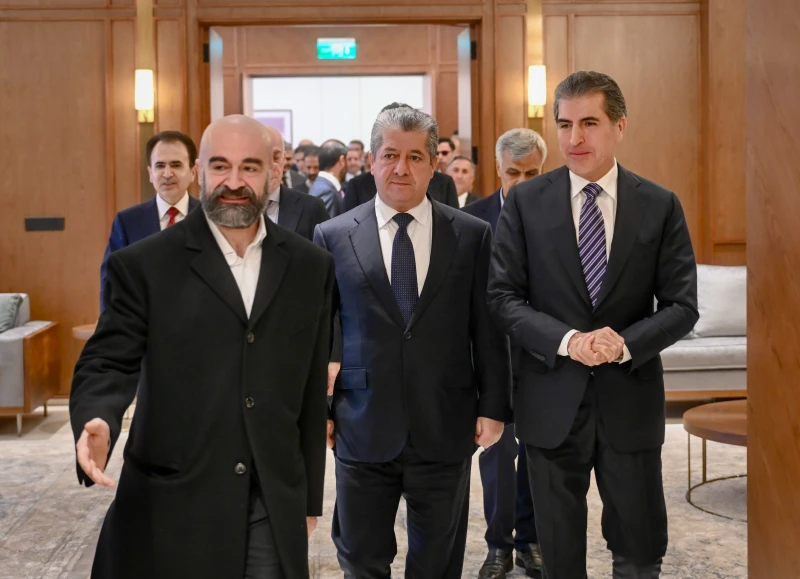
Senior leaders of the Kurdistan Democratic Party (KDP) and the Patriotic Union of Kurdistan (PUK) held talks in Sulaimani on Saturday, ahead of a planned national dialogue in Baghdad aimed at resolving outstanding disputes between the two sides.
Following the meeting, a KDP Politburo source told The New Region's correspondent that the two parties had also agreed to form joint legal and political committees to review relevant constitutional provisions ahead of the discussions in Baghdad.
The parties agreed to adopt a dialogue to resolve outstanding disputes with Baghdad and take a unified position at the national dialogue, according to a joint statement released after the talks.
Kurdish authorities have strongly condemned Zaidi’s directive, describing it as a violation of the Kurdistan Region’s constitutional rights.
Since assuming the premiership, Zaidi has made the expansion of Iraqi state sovereignty a staple of his government, though his directives regarding the Kurdistan Region mark an unprecedented push for control in what is a constitutional entity under Iraq's federal system.
 Facebook
 LinkedIn
 Telegram
 X