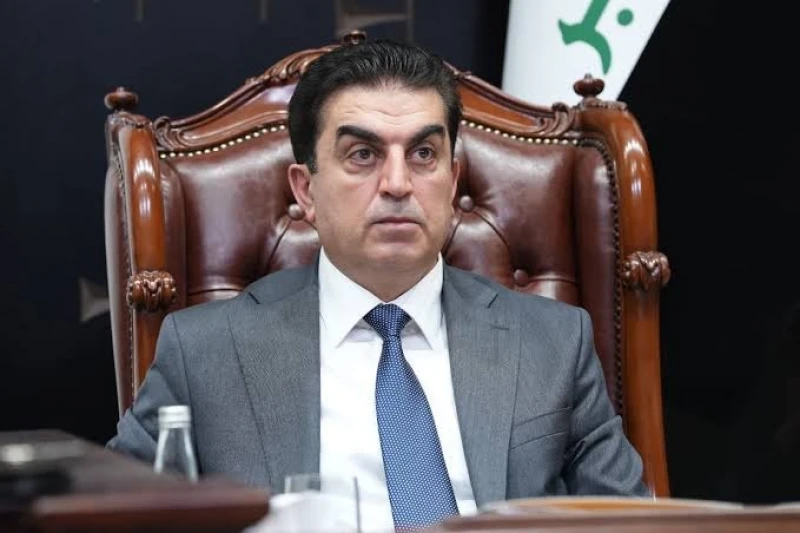

ERBIL, Kurdistan Region of Iraq - Kurdistan Region Prime Minister Masrour Barzani on Sunday said the Kurdistan Democratic Party's (KDP) participation in Iraq’s next government will hinge on Baghdad’s willingness to implement key constitutional articles, stressing that the upcoming cabinet’s agenda “is very, very important,” amid long-running disputes between Erbil and Baghdad over constitutional rights.
Iraq’s constitution has driven years of disputes between Baghdad and Erbil over territorial claims, budget rights, and control over natural resources.
“As a participating side in the government, our program and condition will be: what is the government's agenda in implementing those constitutional articles that are important for all of Iraq, especially for the Kurdistan Region. For us, the agenda of the future government is very, very important," Barzani said, speaking to the reporters on the sidelines of an event that saw the premier lay the foundation stone of a wastewater recycling project in Erbil on Sunday.
Iraq’s constitution has long fueled disputes between the Kurdistan Regional Government (KRG) and the federal authorities, with both sides offering different interpretations of key articles and Baghdad often failing to implement provisions such as Article 140 on disputed territories.
The constitution also formed the basis of a long-standing budgetary dispute between Erbil and Baghdad, as independent interpretations of its provisions led the Kurdistan Region to seek more control over its resources and sell oil independently of Baghdad in 2014, resulting in budget cuts and sanctions on Erbil in the years that followed.
Barzani further underscored the KDP's influence in national and regional politics after surpassing one million votes in Iraq’s parliamentary elections, becoming the first Kurdish party in history to achieve the feat, saying the party remains prepared to offer support to other actors.
“It is very natural for all sides to turn to KDP and ask for assistance,” he said.
Regarding the formation of the KRG’s next cabinet, which was stalled by the Patriotic Union of Kurdistan (PUK) earlier this month, the premier said that “the dialogues have not stopped,” noting that new “circumstances” have emerged and adding, “Based on that, we will continue the dialogue.”
On November 6, KDP stated that it had offered major positions to the PUK to form the tenth cabinet and accused the rival party of deliberately stalling negotiations until after the Iraqi elections.
In a separate event on Sunday, Prime Minister Barzani received British Ambassador to Iraq Irfan Siddiq, with the pair discussing the situation in the country after recent parliamentary elections and the formation of the KRG cabinet.
The talks underscored the importance of the new Iraqi government’s “commitment to the constitution” and the need for a “fundamental resolution of issues between the Kurdistan Region and the Federal Government,” read the KRG statement.
The conflict between Erbil and Baghdad was later resolved in September 2025 after the KRG, in a move to ensure the livelihood of its population, agreed to sell its oil through Iraq’s State Organization for the Marketing of Oil (SOMO).
Baghdad’s measures, however, led to the Kurdistan Region’s civil servant salaries going unpaid for months at a time.
 Facebook
 LinkedIn
 Telegram
 X
X