ERBIL, Kurdistan Region of Iraq – November 26 marked World Olive Tree Day, after being proclaimed at the 40th session of the UNESCO General Conference in 2019. As the agency describes it, “The olive tree, specifically the olive branch, holds an important place in the minds of men and women. Since ancient times, it has symbolized peace, wisdom, and harmony, and as such is important not just to the countries where these noble trees grow, but to people and communities around the world.”
The history of the olive tree and that of the civilizations around the Mediterranean have been intertwined for at least 7,000 years, making it one of the region’s most important and distinctive crops.
Despite it being associated mostly with countries like Italy, Greece, and Spain, the olive tree appeared originally in West Asia and is considered the first plant to have been “domesticated” in what is now Syria.
The olive tree is a remarkably long-lived species, growing slowly over centuries. The oldest known olive tree is believed to stand in the southern hills of Jerusalem, in the village of al-Walaja, where the Palestinian Olive Oil Council estimates its age at more than 5,500 years. In this context, the deep, ancestral bond between people and the land is not hard to understand.
This plant has long been a constant presence in the Palestinian landscape. For its inhabitants, it’s almost sacred: it anchors families to the soil and stands as living proof of a historic connection to the land. Beyond its role as a vital pillar of a fragile local economy, it also serves as a powerful symbol of national identity and resistance to the Israeli occupation.
In a 1974 address to the UN General Assembly, the late Palestine Liberation Organization (PLO) leader Yasser Arafat warned that “even the olive tree became a target of hate.” For many Palestinians today, the intensifying assault on olive groves is seen as an assault on their identity itself. To cut down or burn a tree is not only to destroy a source of livelihood, they say, but to try to erase the story of a people. Every olive tree that survives—still tended, still harvested—is, in their view, a quiet assertion that the land remains lived in, cultivated, and claimed.
More than 500,000 Israeli settlers now live in communities scattered across the West Bank, territory Israel has occupied since 1967. These settlements are deemed illegal under international law.
Many olive trees in the West Bank are centuries old; some are even believed to be as old as 3,000 years. The annual harvest is a ritual that brings together grandparents, parents, and children, reinforcing family ties and keeping a shared memory alive.
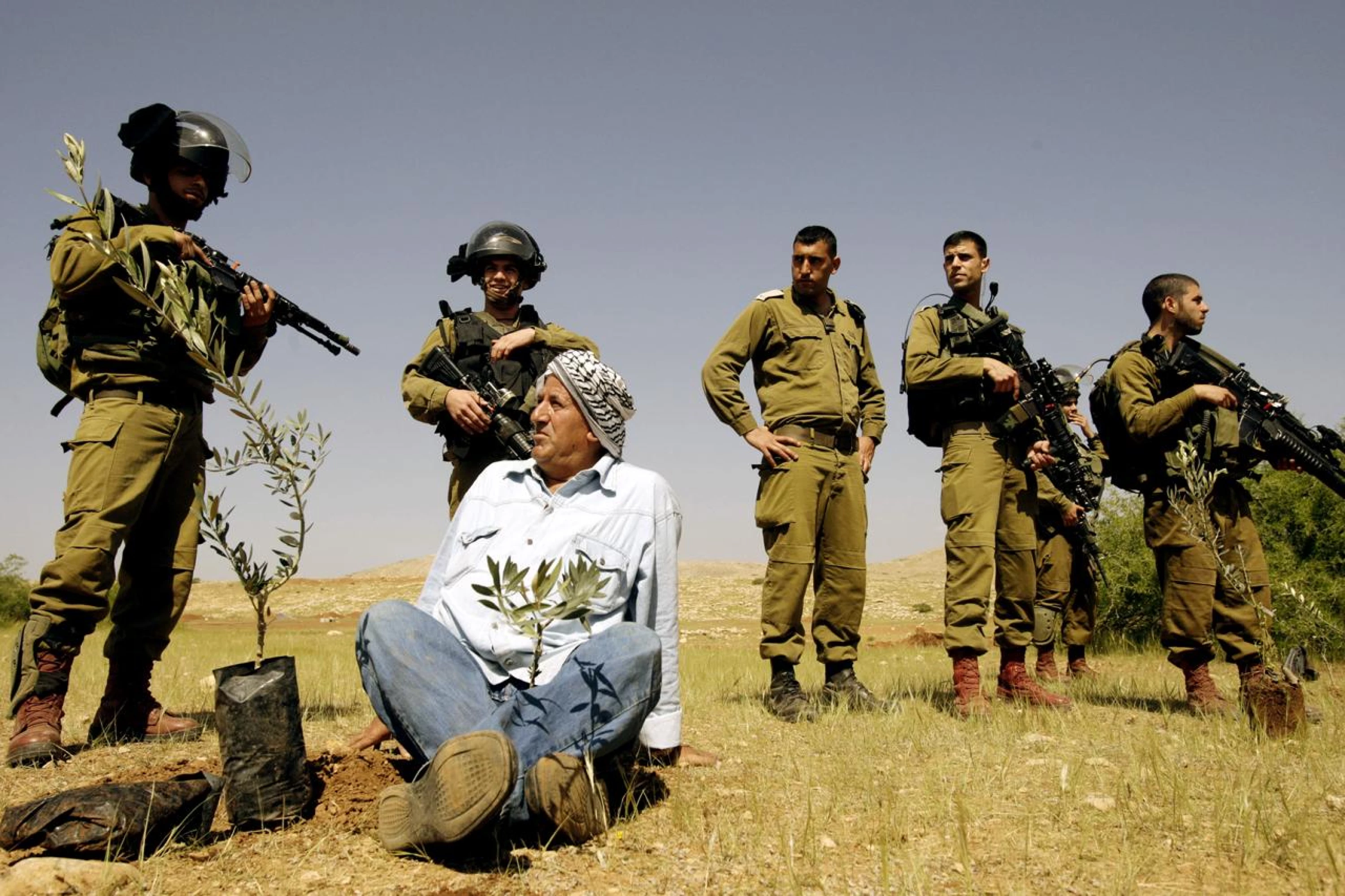
Recently, Israeli settlers have been unfolding systematic attacks across multiple areas of the occupied West Bank, leaving a trail of injuries, arrests, and extensive damage to property. In this context, the surge in settler attacks on olive groves in the area is both deeply symbolic and politically charged. The message the Israeli settler movement wants to deliver is clear: you are not wanted here; this land is entirely ours, and your identity and livelihood are of little concern.
Since Israel’s occupation of the West Bank began in 1967, settlers have uprooted or destroyed hundreds of thousands of olive trees. The UN Office for the Coordination of Humanitarian Affairs (OCHA) says that since 2023 alone, about 52,000 olive trees have been destroyed in the West Bank. In the village of al-Mughayyir, 10,000 trees were cut down or burned in a single wave of attacks in August 2024. In October 2025, the UN registered the highest number of settler attacks since it began keeping systematic records in 2006, with more than 260 incidents—an average of eight per day.
The escalation underscores how the annual olive harvest has become a flashpoint. For many families, olives and olive oil are a crucial source of income; for communities, the harvest is a ritual that binds generations together. Yet in recent years, it has also marked a predictable spike in settler violence. According to OCHA, this year’s harvest season has seen settler attacks reach “unprecedented” levels of organization and frequency: roughly 150 documented incidents, more than 140 Palestinians injured, and over 4,200 olive trees vandalized in 77 villages. In total, the OCHA estimates that settlers have carried out around 1,500 attacks in the West Bank since the start of the year.
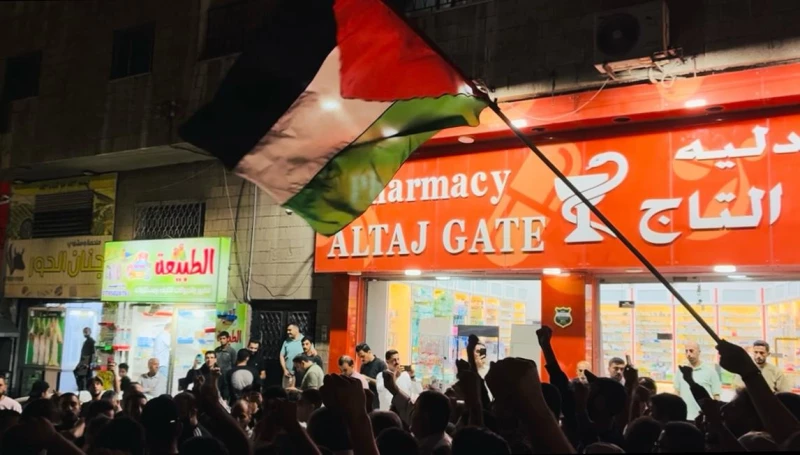
Videos circulating online show groups of masked men on a hill east of Tulkarem, an assault on a Palestinian warehouse in Beit Lid, and trucks set ablaze. In the Bedouin community of Deir Sharaf, tents can be seen burning as women scream in the background. Other content shows dogs and sheep among the targets of settler violence.
Muayyad Shaaban, head of the Colonization & Wall Resistance Commission, has described the attacks as a campaign of “intimidation and terror.” In a rare instance of Israeli law enforcement acting against settlers, the army moved in and arrested “several Israeli civilians,” he said. According to the military, soldiers were then assaulted by settlers who had gathered nearby, and an army vehicle was damaged. Israeli police later said four suspects were detained. On X, Israeli President Isaac Herzog called the incidents “serious and shocking,” blaming “a handful of violent and dangerous individuals” for the attacks.
UN Emergency Relief Coordinator Tom Fletcher has warned that the failure to prevent or punish such assaults “is incompatible with international law,” insisting that “Palestinians must be protected” and that “impunity cannot prevail.”
The human cost is indisputable. Recently, hundreds of mourners gathered in Beita, near Nablus, for the funeral of 13‑year‑old Aysam Mualla, who had reportedly been in a coma after inhaling tear gas fired by Israeli forces while villagers were harvesting olives last month near the Evyatar settler outpost. According to the OCHA, in 2025, one in every five Palestinians killed by Israeli forces in the West Bank, including East Jerusalem, was a child.
Palestinians and human rights organizations have long accused the Israeli army of turning a blind eye to extremist settlers, if not actively shielding them. Yet there are also increasingly more Israeli voices criticizing settler violence and highlighting the complicity of the Israeli army, which allows them to act with impunity. In a scathing editorial, the Israeli outlet Ha’aretz argued that such incidents are possible “because the [Israeli military] stands by and does nothing to repress the violence and protect the people under attack.” The paper reported that among those taking part in some of the raids were armed men in uniform, identified as members of settlement “emergency squads,” who allegedly used the weapons and status provided to them for self‑defense to attack Palestinian farmers “who only want their crops.”
Ha’aretz also dismissed army statements claiming that troops “arrived promptly” to reduce “friction” and restore calm. “There are no frictions or clashes,” the paper wrote, “but pogroms planned and launched from one side against the other.” The latest incidents also come as lawmakers in Israel’s far-right governing coalition advanced a bill in the Knesset to apply Israeli law directly to the West Bank—a step widely viewed by legal experts as a de facto annexation of the territory. The measure has already cleared a first parliamentary hurdle and would further entrench Israeli control over the territory and effectively end any prospect of a negotiated two-state solution.
The deepening violence is feeding chronic insecurity and further eroding trust in Palestinian institutions. Israel’s internal security agency, Shin Bet, has reportedly warned that soaring unemployment, collapsing public services, and rising poverty among the roughly 3 million Palestinians living under Israeli military rule in the West Bank since 1967 could trigger a new cycle of unrest and even the collapse of the Palestinian Authority. The World Bank estimates that the West Bank economy shrank by about 17 percent in 2024, a dramatic contraction for a territory already under severe constraints.
Olive trees cover roughly 45 percent of cultivated land in the West Bank and account for about 80 percent of all orchards, making them a cornerstone of the rural economy. “If the Palestinian economy were to collapse completely, it would not be a win‑win deal for anyone,” US Ambassador to Israel Mike Huckabee said in a recent interview. “It would only lead to further despair, and desperate people do desperate things.”
According to the Palestinian Farmers’ Union (PFU), around 60 percent of olive growers were unable to complete their harvest in 2023 and 2024 due to settler attacks, land access restrictions, and permit denials. This year, projections are even more dire: the union expects that as many as seven in ten olive farmers will be prevented from harvesting their crops. With few alternative sources of income, many families face mounting debt and growing uncertainty about how they will get through the year.
“The economic impact is very negative for everyone, but there is more,” said Abbas Milhem, the PFU’s executive director. “The olive tree for the Palestinians is not just a tree. It is a source of life, a source of peace. We have been growing olive trees in Palestine for thousands of years. It is part of our culture and our existence.”
At the same time, access to land has been progressively limited. Of roughly 10,000 hectares of olive groves, many can only be reached with special permits issued by Israeli authorities. In 2023, almost all of those permits were revoked. The result, according to OCHA and local groups, was the loss of an estimated 1,200 tons of olive oil and about $10 million in income. On paper, the land remains in Palestinian hands. In practice, many owners can no longer reach it.
 Facebook
 LinkedIn
 Telegram
 X
X