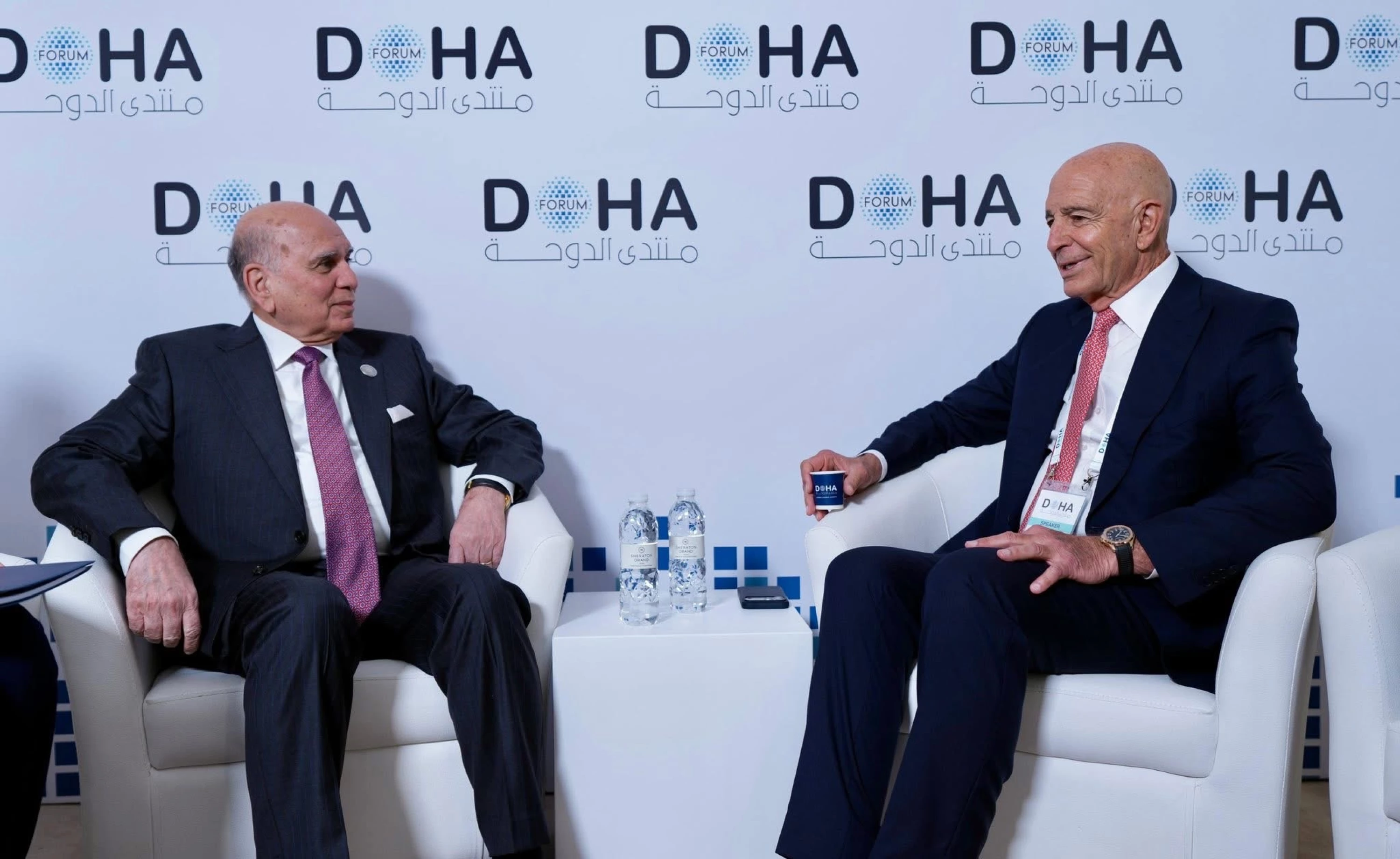
ERBIL, Kurdistan Region of Iraq - Iraqi Foreign Minister Fuad Hussein on Sunday met with US Special Envoy to Syria Tom Barrack, expressing the Iraqi government’s “surprise” over recent remarks made by the envoy in which he claimed that Iran-backed armed groups in Iraq had more power than the parliament.
Speaking to The National on Friday, Barrack criticized past US policies in Iraq, saying Washington helped create a political structure that allowed armed groups to gain more influence than parliament and enabled Iran to fill the resulting vacuum.
“You have a very good prime minister, [Mohammed Shia’ al-]Sudani, who gets elected but has no power. Zero power. Because he can’t form a coalition of this parliament, because the other components, the [Popular Mobilization Forces] PMF, all the representatives in this parliament are blocking the stage,” said Barrack.
In his meeting with the American envoy on the sidelines of the Doha Forum, Hussein reviewed the stages Iraq has gone through since 2003 to consolidate its democratic system and the complex challenges that accompanied those transformations, according to a statement from the foreign ministry.
Hussein stressed that Iraq remains committed to its democratic choice, the building of state institutions, and the rejection of any form of dictatorship that the country suffered from for decades.
Speaking to reporters on Saturday, Barrack stated:
“Decentralization has never really worked anywhere in this region… If you look at what happened in Iraq: We [the US] got frustrated after three trillion dollars and a few hundred thousand lives, and you have decentralization which is now a big issue.”
Hussein expressed the Iraqi government’s “surprise at the recent statements by the US envoy regarding the internal situation in Iraq,” noting that “it was important to clarify the vision in a different way that reflects the reality of the political development and relative stability achieved in Iraq.”
He stressed that the choices of the Iraqi people are respected and that democracy and the federal system are enshrined in the constitution and have become a firm, irreversible path despite ongoing challenges.
The foreign minister also emphasized the importance of joint cooperation between Iraq and the United States and strengthening the strategic partnership between the two countries, praising the role played by the US within the global coalition against the Islamic State (ISIS).
The Iraqi foreign ministry said that Barrack expressed his thanks and appreciation to Hussein for the historical and political perspective he presented regarding Iraq and the period before 2003, adding that the “American administration views the Iraqi experience with respect, and that his [Barrack’s] remarks relate only to the American experience in Iraq.”
The US has ramped up efforts to curb Iranian influence in Iraq, and limit the expanding role of Iran-backed Shiite armed groups in the country who enjoy a similar level of governance and authority as the state forces.
Washington’s concerns however, are often dismissed by Iraqi authorities who claim that Baghdad’s cooperation with Tehran is based on Iraq’s national interests and is an extension of the country making decisions as an independent sovereign state.
 Facebook
 LinkedIn
 Telegram
 X
X