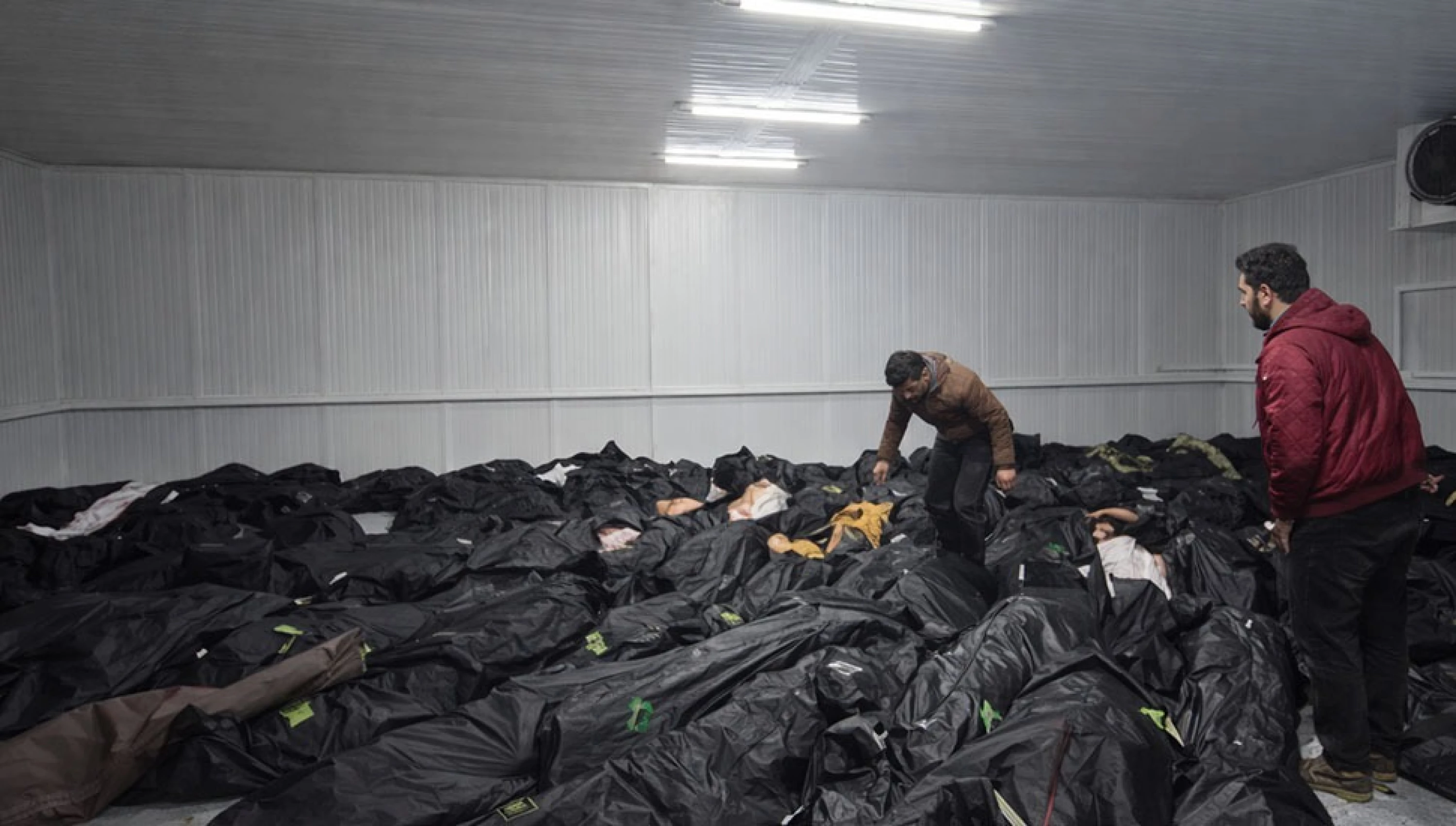
ERBIL, Kurdistan Region of Iraq – Iranian authorities have given families of killed protesters three options to receive the bodies of their loved ones: register the deceased as a Basij member, say they were killed by protesters, or pay more than $2,000 to reclaim the body, amid an intensified crackdown on nationwide protests, a monitor told The New Region.
“Since January 8th and 9th, when the decision for a general intensified crackdown was made, the majority of killed protesters have been shot in the chest, heart, and head,” Arsalan Yarahmadi, founder of the Oslo-based Hengaw Human Rights Organization, told The New Region on Tuesday.
Iran has been rocked by nationwide protests since late last year, which have spread to the majority of provinces and increasingly targeted the government, prompting a violent crackdown from Iranian authorities.
No reliable data is available on the exact number of casualties, but rights monitors estimate it to be in the thousands. The US-based Human Rights Activists News Agency (HRANA) reports that security forces have killed more than 6,100 protesters, injured over 11,000, and arrested more than 41,800.
The monitors argue that the numbers could be higher due to limited access to information.
Since January 8, Iran has intensified its crackdown on protesters, cut communication services and imposed a nationwide internet blackout, a repeated tactic during unrest that has made it significantly harder to obtain information.
Yarahmadi added that, based on information received from Rasht, Kermanshah, Tehran and Isfahan, there have been “several cases” in which an injured person was subjected to direct fire by security forces and “finished off right on the street with a fatal shot.”
The crackdown has been widely condemned internationally. Amnesty International on Friday warned that Iranian authorities are imposing a “suffocating militarization” in a systematic effort to hide protest massacres.
Yarahmadi highlighted a new tactic used by the government to manipulate information, saying families of killed protesters were offered three options: claim the deceased was a member of the Islamic Revolutionary Guard Corps’ (IRGC) Basij paramilitary and register as a martyr family to receive state payments, blame the killing on protesters, or pay hefty amounts to reclaim the body.
“You can say our son or child was a Basij member so we can register you as a martyr’s family and give you the body, or you can say your son or child was killed by terrorist forces and opposition groups,” in which case authorities would return the body without demanding payment, said Yarahmadi.
“They made this request to all the families, in all the cities of Iran, that they must either pay an amount of money, different amounts, from some they requested over $2,000, from some $4,700, and from some over $6,500 in order to return their bodies,” the activist added.
“In all the cities, we have spoken with the families of those killed. They have all confirmed they received these offers.”
Since the blackout, state media have begun airing alleged confession documentaries, including interviews with families of the dead backing up the state’s narratives of the protests, a tactic that rights groups have described and criticized as “forced confessions.”
The alleged confessions and videos are widely believed to be coerced, often obtained under threats, psychological pressure, and in some cases physical torture.
HRANA reported that 245 forced confessions have been broadcast so far.
Yarahmadi also said that since the intensified crackdown, the government has “prevented burials and funerals,” noting they were conducted under “security conditions and with minimal public participation.”
The Islamic republic has labeled the recent protests as a continuation of June’s 12-day war, a move it has used to justify its intense crackdown and mass killings, saying the measures were necessary to confront what it alleges to be US- and Israel-linked elements on the streets.
 Facebook
 LinkedIn
 Telegram
 X
X