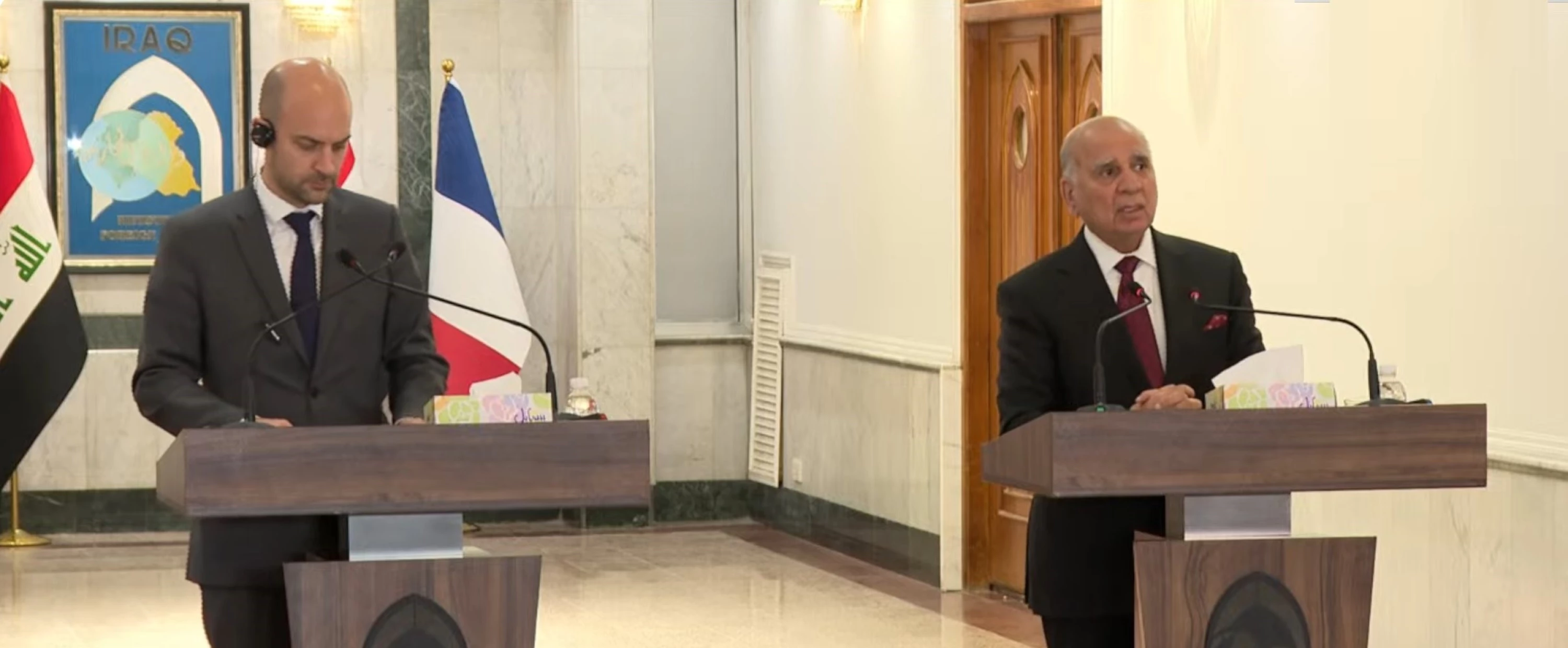
ERBIL, Kurdistan Region of Iraq - French Foreign Minister Jean-Noel Barrot in a presser with his Iraqi counterpart on Thursday warned that tensions are escalating in the region and that there is a “real risk” of military escalations in the region amid simmering US-Iran relations, with both top diplomats urging dialogue.
The French top diplomat arrived in Baghdad following a meeting with Syrian officials in Damascus earlier in the day, and is set to meet with officials in the Kurdistan Region later in the day.
“The region is witnessing tensions, and there is a real risk of a military escalation,” Barrot said, coming amid the continued war of words between the US and Iran.
Tehran on Wednesday issued contradictory reports that indirect nuclear talks between Washington and Tehran would take place on Friday in Muscat, under a similar format to previous negotiations.
The talks were previously expected to be held in Turkey, while Washington has not yet confirmed the location, only expressing willingness to engage in discussions. Iranian foreign minister Abbas Araghchi on Wednesday declared that the talks would be held on Friday in the Omani capital of Muscat.
“Resolving problems should be through negotiations, not violence,” Hussein said, adding, “We support the negotiations scheduled to take place in Oman between Iran and America.”
Iran’s nuclear program has been a longstanding concern of the US, which has repeatedly demanded Tehran curb its uranium enrichment. This, combined with Iran’s violent crackdown on nationwide protests despite US warnings, has prompted an increase in US military presence in the Gulf, dispelling fears of a potential military confrontation.
The French minister arrived in Baghdad following talks in Damascus on the latest agreement with the Kurdish-led Syrian Democratic Forces (SDF) to integrate it into the Syrian ministry of defense following heavy clashes in Rojava (northeast Syria).
Barrot in an X post on Thursday said that he "emphasized the importance of the full implementation of the 29 January agreement, which provides for the integration of the Kurdish component into the security forces and the state apparatus, as well as the presidential decree recognising the linguistic, cultural and educational rights of the Kurds" during his visit.
"This is an important transition on the path towards a united Syria in which each of the components of this plural country feels recognised and strengthened," he continued. "I will have the opportunity to discuss this further with Kurdish leaders in Erbil this evening."
“The instability in Syria is negatively affecting the situation in the region, and particularly in Iraq,” Hussein said during the joint presser.
Earlier in January, the Syrian Arab Army and its affiliated factions launched a violent military campaign on Rojava in a bid to secure Ahmed al-Sharaa’s vision of a centralized Syria, killing hundreds of fighters and civilians in the process, with the attacking Syrian forces violating ceasefires, committing human rights violations, and possibly war crimes in their offensive.
Barrot also reaffirmed France’s commitment to Iraq, stating that Baghdad has entered a “new era” of bilateral relations with Paris. “Stability in Iraq is essential, and the country is witnessing a recovery that gives hope.”
Hussein, for his part, herladed a deal between the Iraqi defense ministry and the French Thales company to purchase military grade radars.
 Facebook
 LinkedIn
 Telegram
 X
X