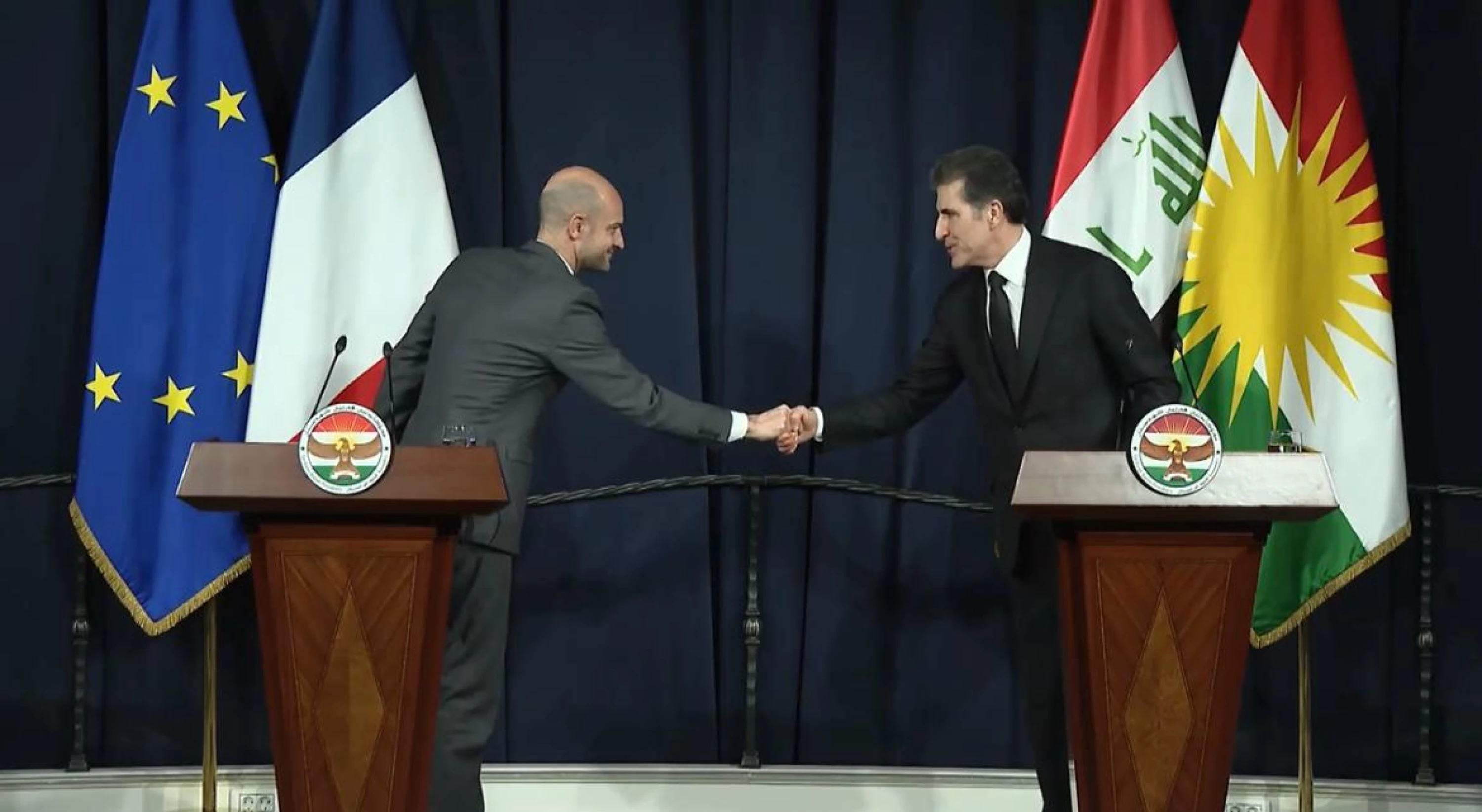
ERBIL, Kurdistan Region of Iraq - Kurdistan Region President Nechirvan Barzani on Thursday received French Foreign Minister Jean-Noel Barrot in Erbil, with the pair discussing recent peace efforts in Rojava (northeast Syria), regional tensions, and what Barrot called "the strength of our historic bond."
“We value the concern and compassion of France, the important role of President Macron for a ceasefire in Syria and the continuation of negotiations between Damascus and the SDF, as well as the support to Kurds and components in a constitutional way,” Barzani said in a joint presser with the minister.
“I reiterate our appreciation and recognition to President Macron for always backing the Kurdish people and their constitutional rights; the Kurdish people will never forget this,” he added.
On January 29, a ceasefire and integration agreement between the SDF and Damascus was announced by the Kurdish-led force, aiming to enable a phased integration process of the Kurdish-led forces into the Syrian state, after weeks-long clashes.
For his part, the French top diplomat thanked Barzani for "personally" playing a "decisive role" in bringing about the accord, with reports having emerged showing that the Kurdistan Region president was one of the key interlocutors in facilitating the end of hostilities.
The agreement follows weeks of clashes between Damascus-affiliated factions and Kurdish-led forces, which saw Syrian government-linked groups advance on Kurdish-held positions in Rojava, raising concerns over Damascus's treatment of Kurds.
“As France also worked tirelessly on mediation efforts, with the personal involvement of the President of the Republic, I want to thank you for the close coordination we have maintained over the past weeks. That coordination helped avert a bloodbath, made a ceasefire possible, and facilitated the conclusion of an agreement on January 29,” Barrot said.
"This agreement ends the fighting and must be fully implemented to provide political and security guarantees for integrating the Kurds into a united Syria. It must be fully implemented, just as the presidential decree recognizing their linguistic, cultural, and educational rights must be fully implemented. Recognizing Kurdish identity is a condition for Syria’s recovery, just as it was in Iraq," he continued.
Jihadist threats
The two also discussed the threat of Islamic State (ISIS) in the region and the need to prevent its resurgence.
“We agreed that ISIS remains an immediate threat to the harmony and stability of the region, that is why the duty of the international coalition against ISIS, terror, and extremism must continue,” Barzani said.
"Everyone remembers the common fight by French forces and the brave Peshmerga... but also by the Syrian Democratic Forces to stop ISIS at the doors of Erbil and Kobane,” Barrot said. "France will continue its commitment alongside the Kurds to support the region’s security and stability, something we know is closely tied to our own."
The top diplomat noted that he had visited French troops deployed in the region under the auspices of the Global Coalition to Defeat ISIS, saying that they are "being reorganized in response to the evolving terrorist threat, which we remain firmly committed to confronting side by side, as we have for years."
US-Iran tensions
Barzani and Barrot stressed the need for dialogue and deescalation in the region, as tensions between the US and Iran peak.
“We are attentive to the worrying internal situation [in Iran] and the risk of regional escalation,” Barrot said, while slamming Iran’s brutal crackdown on nationwide protests.
Iran has been rocked by nationwide protests since late last year, which have spread to the majority of provinces and increasingly targeted the government. The US-based Human Rights Activists News Agency (HRANA) has reported that Iranian security forces have killed more than 6,800 protesters and arrested over 50,000.
Washington and Tehran are set to hold talks on shaky grounds in Oman on Friday as military movement increases in the Gulf from both sides.
Barzani stressed that “all efforts must be made” to resolve issues in the region through dialogue, while Barrot affirmed that Paris will keep Kurdish interests in mind when dealing with Iran and the US.
“In times of trial, France and Kurdistan have always stood together. Even today, as tensions involving Syria and Iran shake the Middle East, we are gathered to demonstrate our close coordination and our joint mobilization,” Barrot stated.
The pair hailed their historic relations and reiterated their readiness to continue cooperation in both domestic and regional matters.
“The solidarity and friendship that have bound us for so long. As far back as 1967, [Mullah] Mustafa Barzani wrote to General [Charles] de Gaulle the following words: ‘Know that you represent for us, a people whose existence is denied and threatened, victims of a long and cruel war, the only international authority capable of providing the elements of a just and peaceful solution,’” Barrot said.
The French minister said that he will meet President Masoud Barzani on Friday to "discuss the many challenges facing the region and how we can address them together."
 Facebook
 LinkedIn
 Telegram
 X
X