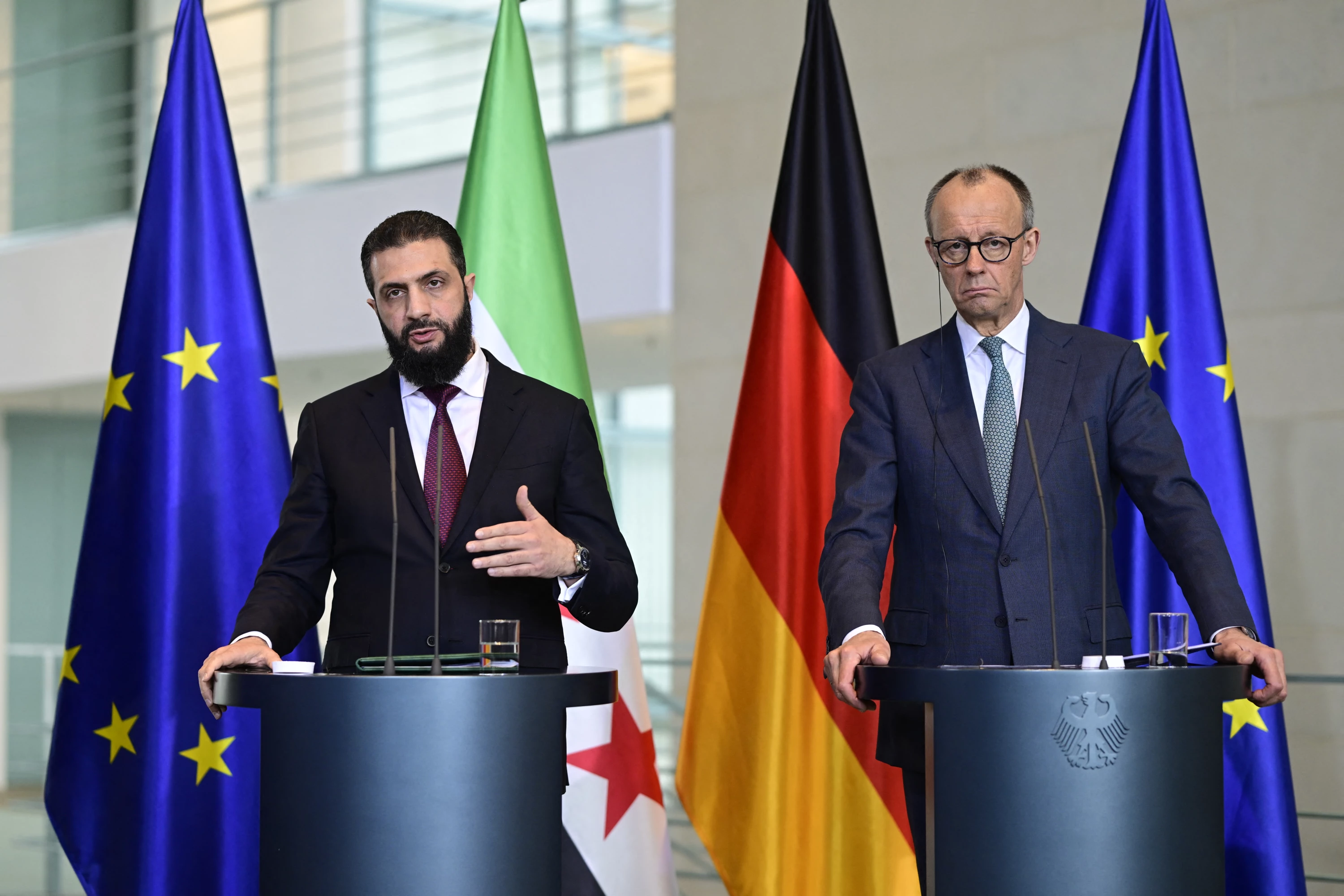
ERBIL, Kurdistan Region of Iraq – Syrian interim President Ahmed al-Sharaa on Monday reiterated Damascus’ stance on a centralized Syria, saying it will not tolerate “statelets within the state” or any weapons outside official military and security institutions.
“We will not accept statelets within the state, and we will not allow any weapons to exist outside the military and security institutions,” Sharaa said during a press conference with German Chancellor Friedrich Merz in Berlin.
Merz echoed the president’s remarks, stating that “weapons must be exclusively in the hands of the state; this is our understanding of the rule of law.”
Sharaa’s stance reflects his administration’s strong insistence on maintaining a centralized governance structure in Syria, where all administrative and military institutions respond to and fall under the central government.
The position clashes with the minorities’ call for federalism and decentralized governance, often citing the government’s failure to protect and represent them.
“I understood from him that the rights of minorities are protected,” the German chancellor said during the presser.
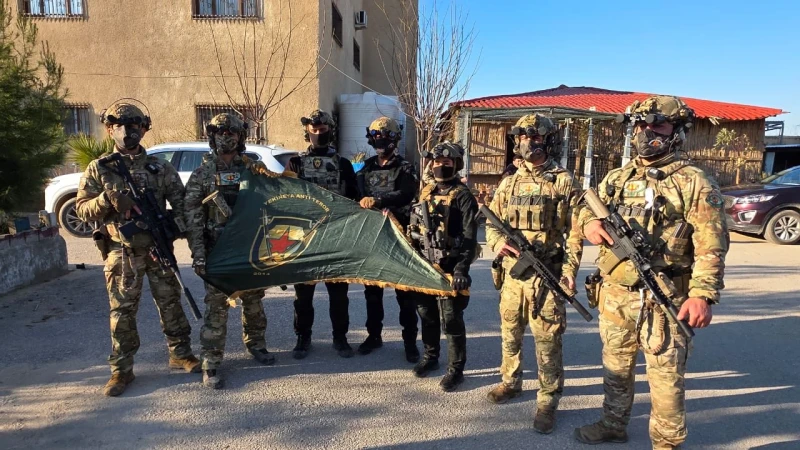
Calls for decentralization have been largely pushed for by the Kurds, which has long exercised a degree of autonomy through a self-administered governance structure and its own military forces.
Under a January agreement reached after a period of violent clashes in Kurdish-held areas, these structures are now being integrated into the central government.
“I thanked President al-Sharaa for his ability to reach an understanding with the Kurdish factions,” Merz said, noting that “Kurdish forces will be integrated, and security will not be fragmented.”
According to the German state-funded broadcaster, Sharaa’s visit to Berlin has “stirred resentment” among Germany’s Kurdish population, who accuse the president of “human rights violations.”
The January military operation launched by Damascus into Rojava (northeast Syria) sparked widespread condemnation over war crime accusations and ethnically targeted violations, prompting large protests across Kurdish-populated areas in the Middle East as well as among diaspora communities in Europe.
Return of Syrians
The two sides also discussed potential cooperation to facilitate the return of Syrian refugees from Germany and rebuild the country after years of civil war and destruction.
Germany hosts the largest number of Syrian refugees in the European Union, with more than one million, most of whom arrived during the former regime’s deadly crackdown on the opposition.
“We are working with our friends in the German government to establish a ‘circular’ migration model,” Sharaa said, noting that the initiative would allow Syrians to help reconstruct the country “without giving up the stability and lives they have built here, for those who wish to stay.”
For his part, Merz said he and the president are “working jointly towards enabling more Syrians to return to their homeland.”
Before the fall of the regime, Syrians made up one of the world’s largest refugee populations. A UN report published in March estimated that since 2011, “more than 14 million Syrians have been forced to flee their homes in search of safety.”
The refugee crisis began in 2011 following the government’s violent crackdown on opposition protesters, triggering a civil war that lasted more than a decade until the regime’s collapse in December 2024, when armed groups took control of Damascus.
 Facebook
 LinkedIn
 Telegram
 X
X