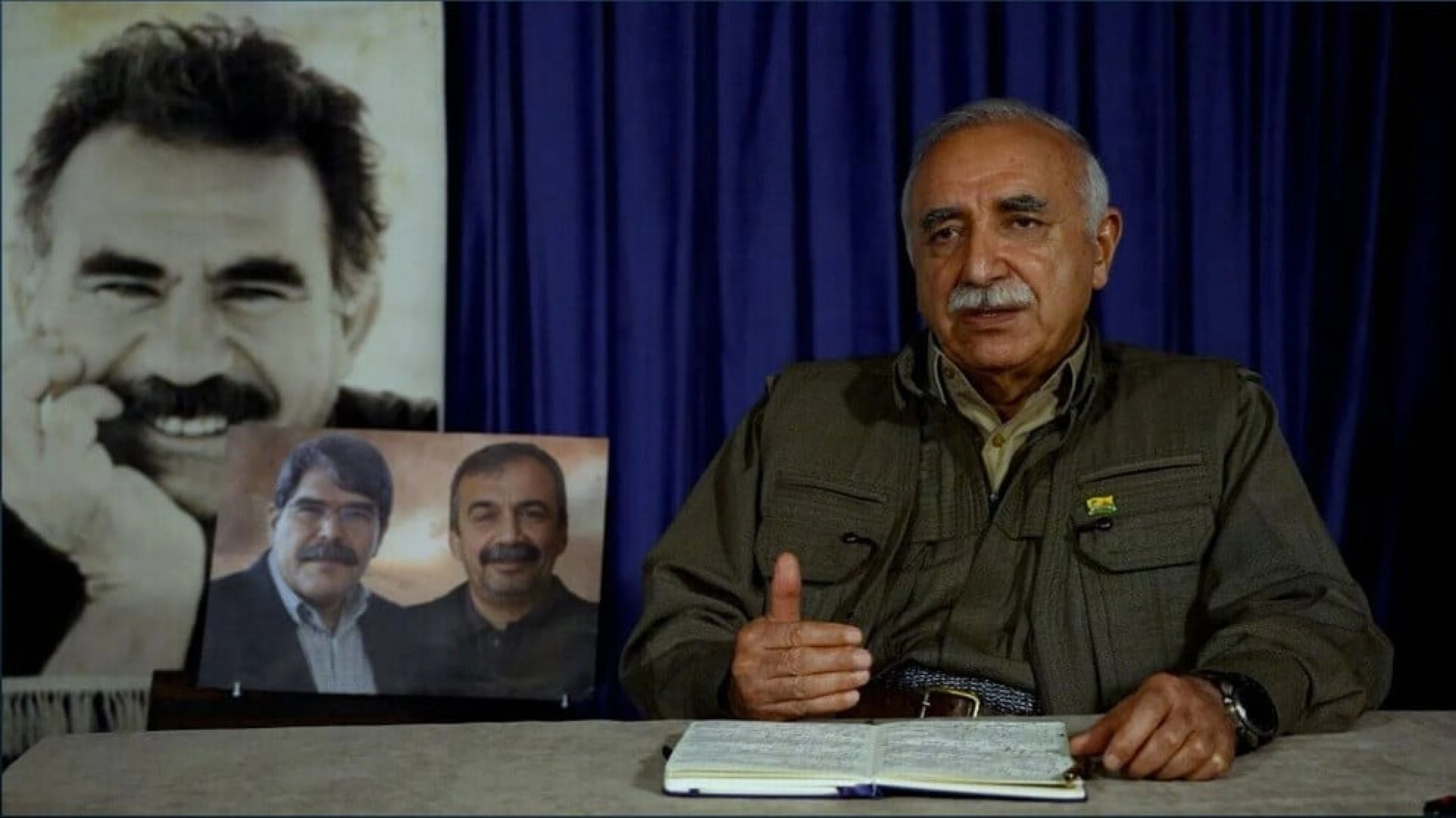
ERBIL, Kurdistan Region of Iraq – Senior Kurdistan Workers Party (PKK) commander Murat Karayilan on Friday stressed the importance of Kurdish Language Day, saying the language is “under attack” by what he described as nation-state policies that seek to promote a single identity and language, especially in Turkey.
Referring to the occasion of Kurdish Language Day, Karayilan said the occasion holds “great importance,” stressing that Kurdish culture and language are “under threat,” he said in an interview with Medya Haber-affiliated media on Friday.
He added that such occasions should be seen as opportunities for “new beginnings” in advancing the struggle for language development.
“Our language is under pressure and attack. Our language is our existence, the existence of our nation. If the language disappears, our national existence will also be endangered,” he added.
Linguistic rights for Kurds spread across several countries vary widely, with only a portion having access to education in their mother tongue. A strong undercurrent of frustration has been seen in recent protests in Rojava (northeast Syria), where, despite a presidential decree vowing to protect Kurdish linguistic rights, Kurds fear that the primacy the language enjoyed during autonomous rule is subsiding.
Kurdish authorities lament that the announced rights have yet to be constitutionalized, and are largely not implemented on the ground, with the Rojava administration asserting that rights cannot be guaranteed through temporary measures, calling for the decree to be inserted in the constitution.
A notable incident occured in Hasaka, where the Kurdish language signage on the city's Justice Palace was replaced with an Arabic version, leading to angered locals repeatedly taking down the new sign.
“The Kurdish language has survived longer” than other languages in Turkey, Karayilan said, noting that because “there was both physical resistance and a national struggle, and the language itself resisted,” while warning that other minority languages in Turkey are on the verge of extinction.
The Kurdish language has long faced severe repression in Turkey, with Turkish officials in the past having banned the use of the language in public, closed Kurdish-medium schools, and Turkified Kurdish surnames.
“Languages are banned in places where nation-states exist,” Karayilan said, criticizing nation-states and stating that they have fostered “hostility towards nations.”
“The Republic of Turkey, established after the Ottoman Empire, considers itself a nation-state and seeks to make Turkish dominant throughout the region; therefore, it bans other languages,” he added.
He added that the prevailing mentality has “banned and destroyed languages,” while arguing that “languages have always survived throughout human history.”
“If a language is not made the language of education, it means that language is being destroyed,” Karayilan said, referring to it as “a long-term policy of destruction.”
“Therefore, education in the mother tongue is very important for the existence of that language and that nation.”
Crackdowns by successive Turkish regimes on the use of the Kurdish language by Kurds in Turkey have led to a majority of Kurds abandoning their native language in favor of Turkish.
Despite Ankara's lifting of the prohibition of public use of the language, a publication by the Human Rights Foundation (HRF) in 2024 asserted that Turkey has been “actively repressing” Kurdish, pointing out “persistent efforts to discourage and eliminate the use of the Kurdish language.”
The HRF article, citing a May 2024 study by the Socio-Political Field Research Center, found that only 42.2 percent of Kurds in Turkey use Kurdish regularly at home, while nearly 40 percent of children of Kurdish descent between the ages of 12 and 17 "cannot speak their Kurdish mother tongue."
Of the 1,267 people sampled across 16 provinces, "64.8 percent of the participants indicated that they primarily used Turkish at home," the report added.
 Facebook
 LinkedIn
 Telegram
 X
X