ERBIL, Kurdistan Region of Iraq - The European Union on Thursday imposed sanctions on seven Israeli settlers and affiliated entities over their "systematic violence" against Palestinians and the expansion of illegal settlements in the occupied West Bank.
“Those listed are extremist Israeli settlers and organizations which support them, and are responsible for serious and systematic human rights abuses against Palestinians in the West Bank, including abuse of the right of everyone to enjoy the highest attainable standard of physical and mental integrity, the right to property, the right to private and family life, to freedom of religion or belief, and the right to education,” a statement by the 27-nation bloc read.
More than 500,000 Israeli settlers now live in communities scattered across the West Bank, territory Israel has occupied since 1967. These settlements are deemed illegal under international law.
The measures include blocking travel and freezing financial holdings, while also barring any EU citizen or company from conducting business or making funds available to the sanctioned individuals and organizations.
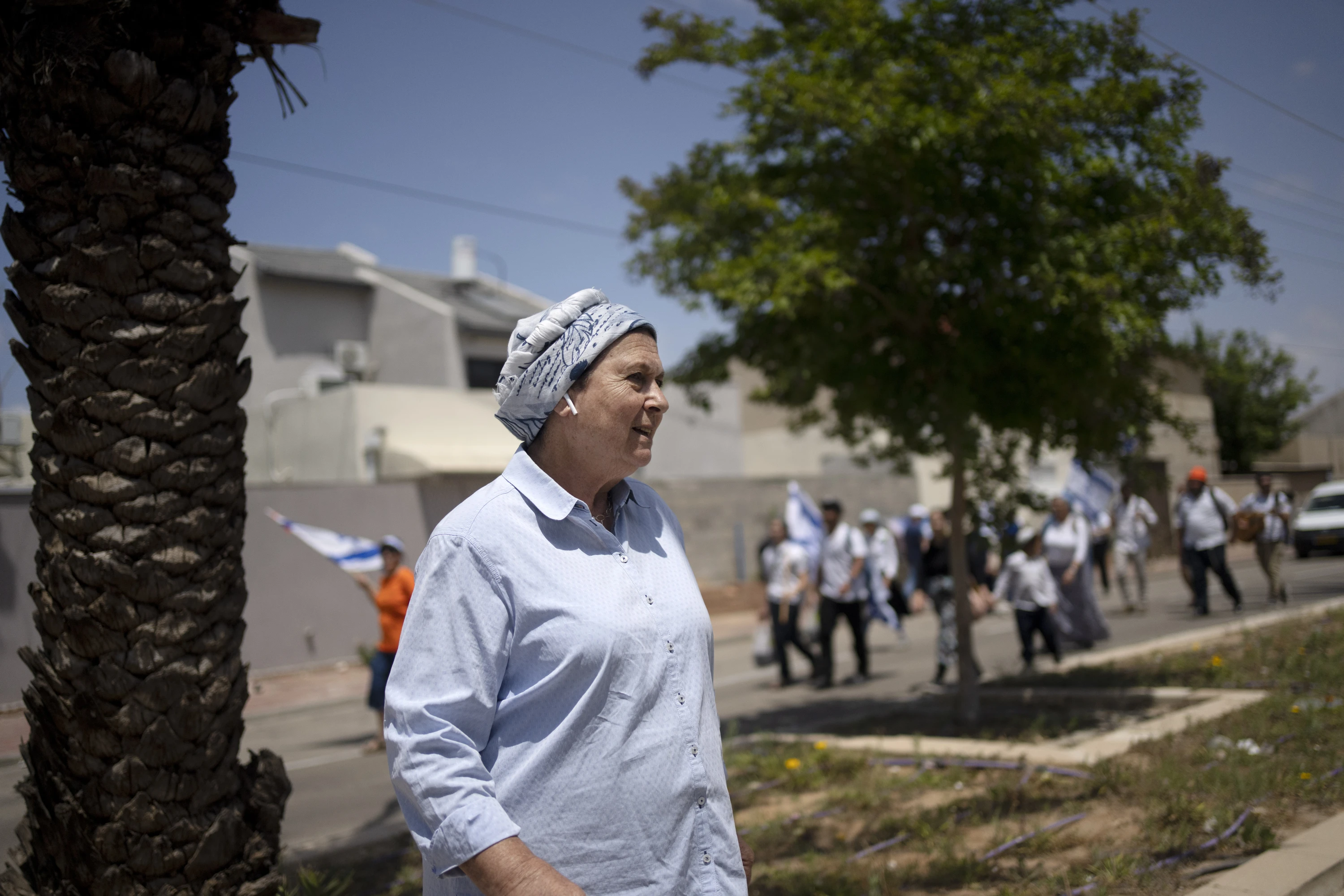
Daniella Weiss, a leading figure in the settler movement known for her inflammatory far-right stance against Palestinians, figures among the individuals targeted by the new sanctions.
She is the founder and leader of the movement Nachala – “heritage” in Hebrew – which has been previously sanctioned by the United Kingdom alongside Australia, Canada, New Zealand, and Norway for systematic violence committed against Palestinians. The group’s top political allies include National Security Minister Itamar Ben-Gvir and Finance Minister Bezalel Smotrich, both of whom represent the far-right religious Zionist political wing.
According to the EU statement, Nachala “encourages and facilitates coercive acts” resulting in the forced displacement of Palestinians. The movement's outposts, built frequently on private Palestinian land, serve as “persistent sources of settler violence” by obstructing access to agricultural and grazing fields. As for Daniella Weiss, the EU alleges that as director, she actively “plans, directs, and publicly supports” these operations.
“We wanted to completely destroy Gaza, and Trump stopped us from doing it. It’s a shame. Trump really made a big mistake. This isn’t what you expect from a friend. What Trump did was unfair. He could have given us another month to destroy Gaza,” Weiss stated following the announcement of the October 10 ceasefire between Hamas and Israel, which was brokered by US President Donald Trump.
In the logic of the settlers, an outpost is the first step toward the construction of a full-scale settlement.
“We’ve worked very hard over the past two years organizing groups of families – more than a thousand – who are ready to move immediately and permanently into the Gaza Strip. We’ve learned from our experience in Judea and Samaria that when you physically occupy the land, your chances of success are much greater. Because it’s not just about making a declaration or expressing an intention – it’s about taking action,” she added.
It is a widely used practice among Israeli nationalists to refer to the West Bank by its biblical names, “Judea and Samaria” – known in Arabic as al-Diffah al-Gharbiyya, which derives its name from its position along the western side of the Jordan River – in order to reinforce their territorial claims and delegitimize Palestinians' indigeneity.
Speaking at an Israeli settlement in the occupied West Bank on Thursday, Israeli Prime Minister Benjamin Netanyahu said that his army now controls 60 percent of the Gaza Strip and is moving toward 70 percent next, adding that "we squeeze them from all sides."
His words come a day after his government launched an online system for the registration of territories in the occupied West Bank, a move meant for de facto annexing Palestinian-owned lands.
The measure was harshly criticized by prominent legal expert Itay Epshtain, specializing in international criminal justice and the law of armed conflict, who clarified that “a land registry presented as bureaucratic modernization is, in substance, an instrument for the consolidation of unlawful territorial acquisition.”
He argued that “an occupying power” is forbidden from annexing territory or permanently appropriating property, “this is precisely what is now occurring, in broad daylight, through administrative and technological means designed to render unlawful presence increasingly irreversible.”
Violence across the West Bank has surged alongside Israel’s genocide in Gaza, which has seen over 70,000 Palestinians killed since October 7, 2023 – a figure widely believed to be an undercount – according to local health authorities.
Palestinians and human rights organizations have long accused the Israeli army of turning a blind eye to extremist settlers, if not actively shielding them. Yet there are also increasingly more Israeli voices criticizing settler violence and highlighting the complicity of the Israeli army, which allows them to act with impunity. In a scathing editorial, the Israeli outlet Ha’aretz argued that such incidents are possible “because the [Israeli military] stands by and does nothing to repress the violence and protect the people under attack.”
The latest incidents also come as lawmakers in Israel’s far-right governing coalition advanced a bill in the Parliament to apply Israeli law directly to the West Bank – a step widely viewed by legal experts as a de facto annexation of the territory. The measure has already cleared a first parliamentary hurdle and would further entrench Israeli control over the territory and effectively end any prospect of a negotiated two-state solution.
The deepening violence is feeding chronic insecurity and further eroding trust in Palestinian institutions. Israel’s internal security agency, Shin Bet, has reportedly warned that soaring unemployment, collapsing public services, and rising poverty among the roughly 3 million Palestinians living under Israeli military rule in the West Bank since 1967 could trigger a new cycle of unrest and even the collapse of the Palestinian Authority. The World Bank estimates that the West Bank economy shrank by about 17 percent in 2024, a dramatic contraction for a territory already under severe constraints.
 Facebook
 LinkedIn
 Telegram
 X
X