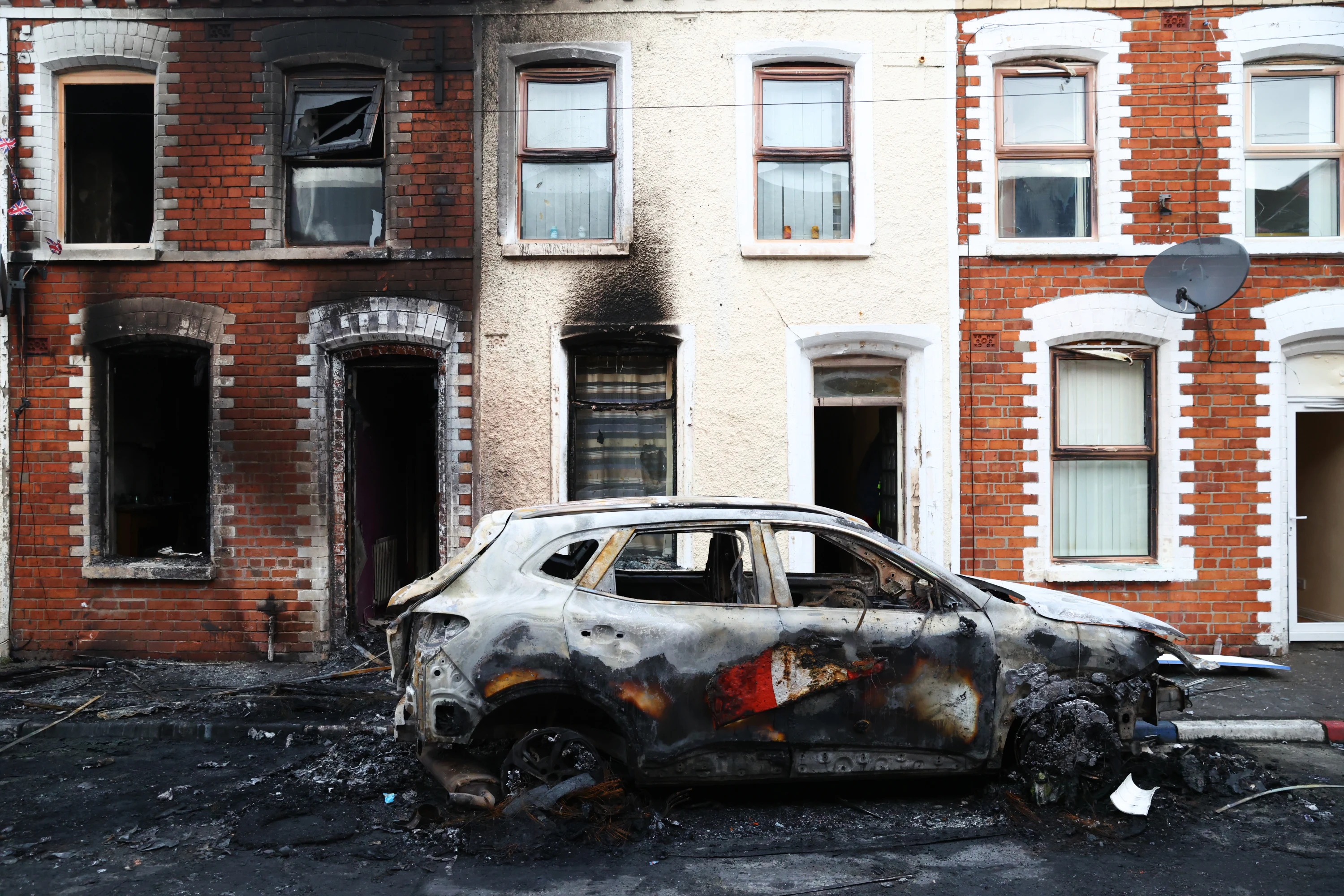
ERBIL, Kurdistan Region of Iraq - Harrowing scenes of streets in flames and mobs hunting foreign nationals door-to-door in Belfast have flooded the news after a Sudanese man mutilated a local with a knife, marking a flashpoint in Europe's debate, ongoing and polarizing, about migration and demographic change. Yet for Northern Ireland, such horrors are by no means novel - they mark the latest manifestation of a society wracked by intercommunal violence for centuries.
The incident that sparked the vigilantism was, indeed, appalling. Graphic footage from late Monday night showed Hadi Alodid, a 30-year-old from the northeast African nation, kneeling atop Stephen Ogilvie with a kitchen knife and slashing him, a slow, drawn-out horror that took place as onlookers feared he was seeking to behead the Northern Ireland native before one intrepid individual intervened with a hurl, a wooden bat used in the Irish sport of hurling.
The backlash was rapid. Mass protests and riots erupted the day after, with businesses and public transport shutting down in anticipation of violence. For other cities in Europe that have experienced bursts of anti-migrant violence, developments are normally spontaneous and are met with surprise by authorities. Not in Belfast.
A history of ethnic violence
To call Northern Ireland divided would be an understatement - even the name itself cannot be agreed upon. For nationalists, the largely Catholic component that wishes to unite with their Irish counterparts in the 26-county, independent Republic of Ireland, it is 'the north of Ireland,' 'the six counties,' or simply 'the north.' For unionists, the predominantly Protestant population that seeks to remain part of the United Kingdom, it is 'Northern Ireland' or 'Ulster.'
The history is at once complex and painfully simple. In the 17th century, the English monarchy sought to bolster its control over its island neighbor by implementing a large-scale colonisation project in Ulster, the Irish province that the present day Northern Ireland is located. At this point, despite having an administrative foothold in Dublin, much of the island of Ireland operated outside of the crown's control, with Ulster being overwhelmingly Gaelic in language, culture, law, and customs.
To this end, tens of thousands of Anglophone, Protestant English and Lowland Scots were 'planted' in Ulster, being offered generous land allocations that were stripped from local Gaelic chieftans. The effects were enduring, and it is to this historical juncture that most Northern Irish Protestants today trace their lineage.
The centuries that followed saw sporadic efforts by Irish nationalists to sever the chain with Britain, culminating in the 1920s war of independence that saw 26 of Ireland's 32 counties detach from the United Kingdom, with a Protestant-majority state being carved out in Ulster and titled Northern Ireland.
Oppressed and politically excluded, Northern Ireland's Catholic population took up arms once again in the 1960s, initiating a 30-year-long guerrilla campaign spearheaded by the Provisional Irish Republican Army (IRA) against the British state and seeking to rejoin their southern compatriots, further enhancing the division between the Catholic and Protestant communities who, for the bulk of the conflict, lived in a sort of self-imposed segregation.
It is this palimpsest of violence that reappeared once more in the past week's developments - the so-called 'Troubles' of the 20th century saw extensive paramilitary violence by both sides, with sectarian attacks resulting in the deaths of thousands of civilians through bombings, shootings, and deliberate targeting of individuals in majority-Catholic or Protestant areas. A divided geography took shape, with where you lived, your name, and even the way you pronounced certain letters or stored mundane household items (the, largely true, stereotype being that Protestants keep their toaster in the cupboard) offering subtle hints as to your ethno-political background. It is these residual scars that persist in Northern Ireland, a society where to this day such affiliation is omnipresent in normal life.
So, what bearing does this have on migrants, who have no stake in the traditional conflict? Though the United Kingdom has seen a surge in anti-migration politics with the rise of Nigel Farage's Reform UK party, one may expect that in a statelet whose constiutional future as a component of the Kingdom is deeply questionable (Sinn Féin, the Irish nationalist party that was originally the political wing of the now-disbanded Provisional IRA, is the largest party in Northern Ireland's devolved administration) their situation would be better when compared to the mainland.
However, this is not the case. Myriad studies have shown the link between the 'siege mentality' of Loyalist society and negative racial perceptions, a fact that becomes self-evident when examining the flashpoints of last week's pogrom-esque violence - riots overhwelmingly occurred in stauch Loyalist neighborhoods. Visceral fears of culture loss and abandonment have become accentuated by Sinn Féin's post-Good Friday Agreement political ascent, resulting in momentum toward unification and the ascension of those whom the Unionist community would deem as terrorists to the halls of power. This fact, coupled with an increasingly indifferent Westminster, results in a great hostility to change among the fringe ends of the Loyalist spectrum, living in disadvantaged areas with a strong tradition of paramilitary violence, manifested in the recent outburst of rage against newcomers.
An uncertain future
This is not to say that the Unionist community is inherently discriminatory or prejudiced against migrants, nor that there is a dearth of political condemnation for the violent scenes. Parties from both ends of the constitutional question have urged calm, and the family of Ogilvie, the man whose attack sparked the backlash, have issued a public statement lamenting racialized violence. What is clear, however, is that Northern Ireland's unique past as the sole Western European environment to experience a long-term insurgent conflict of such scale influences the scope of backlash such incidents give rise to. Dublin, which experienced an outburst of violence following the stabbing of a child by a migrant in late 2023, does not have the same post-colonial divisions as its northern metropolitan neighbor, where violence is organized and tied to paramilitary groups that still wield power.
As the question of Northern Ireland's existence as an entity continues to loom over the streets of Belfast, the threats to migrants and people of color persist regardless of any prospective constitutional shake-up. The demons of the territory's past remain latent and unexorcized - an ugly shadow that manifests in the present day against new targets with no connection to its bloody backdrop.
 Facebook
 LinkedIn
 Telegram
 X
X