ERBIL, Kurdistan Region of Iraq - US President Donald Trump on Wednesday said that the memorandum of understanding (MoU) agreed with Iran is likely to be signed in the next two days and that he "might" appear in person for the ceremony, coming as US officials unveiled its contents to journalists for the first time shortly after the president's G7 address.
Senior US officials on Wednesday dictated the text of the US-Iran MoU to journalists, which includes provisions for a total ceasefire in all theaters, including Lebanon, refraining from violations of sovereignty, and both sides seeking to negotiate a final agreement within 60 days, according to AFP.
The text further states that the US will begin to lift its naval blockade immediately upon signing, Iran will allow vessels to pass the Strait of Hormuz free of charge for 60 days, Iran will received a $300 billion economic rehabilitation package, and the US will lift all sanctions on Iran.
The text does not discount the possibility that Iran may charge fees for transit in the strait following the initial period.
Furthermore, Iran vows not to procure a nuclear weapon, the US will allow Iran to export its oil reserves and issue licenses, and Iranian assets are to be unfrozen.
Islamabad announced early Monday that Tehran and Washington signed the first phase of the MoU, with the second and final phase set to be signed in Geneva on Friday.
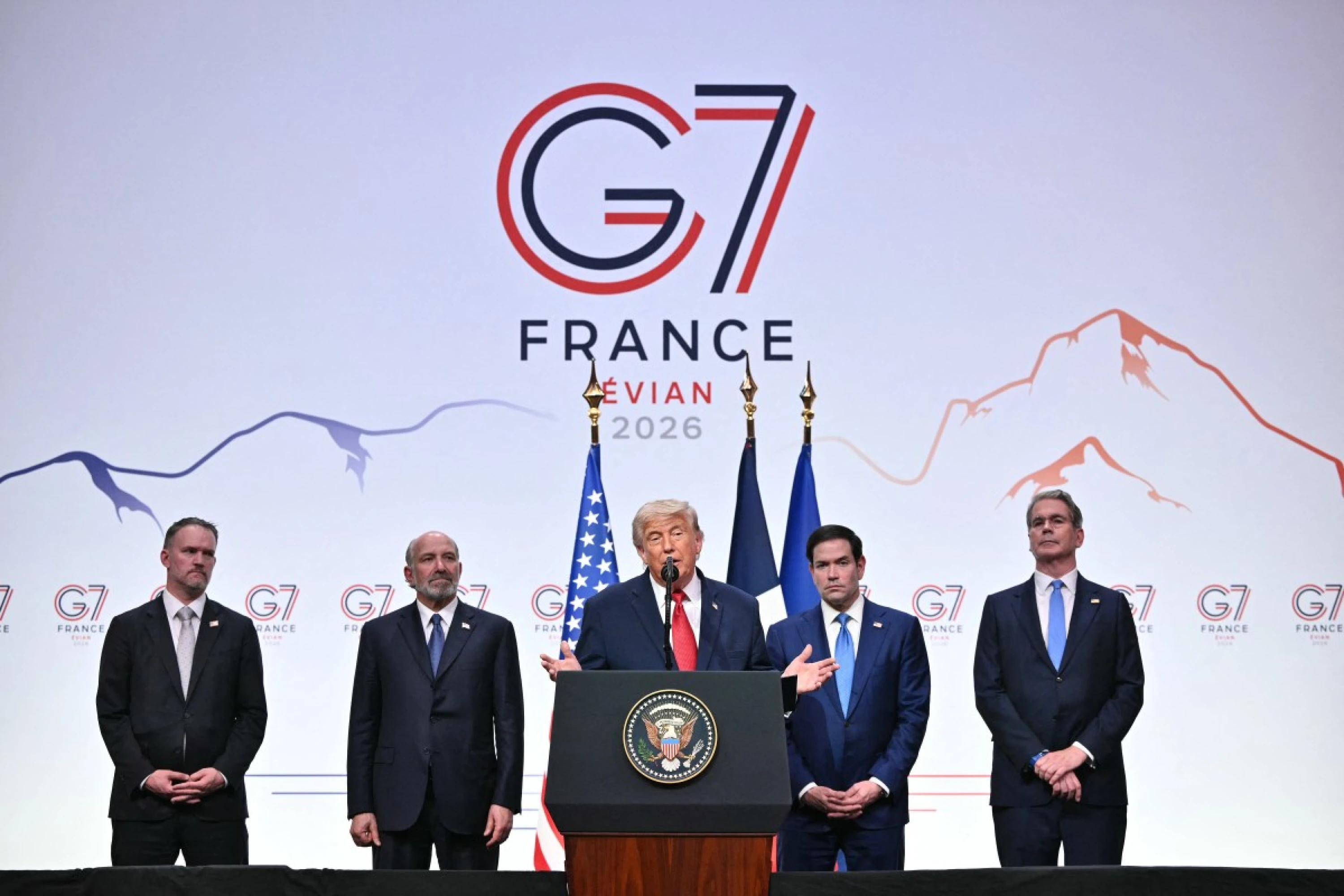
Referring to the MoU, Trump said the deal we reached with Iran “will be signed shortly, tomorrow, maybe the next day,” speaking at the G7 summit in France on Wednesday.
With the White House having previously said that Vice President JD Vance would attend the in person signing ceremony, Trump shocked the crowd when he announced that he "might" attend himself, later joking that perhaps it was better that Vance goes in his stead such that if the deal proves enduring, he may claim credit, and that if it's not, he can blame his deputy.
Soon after, Iranian foreign ministry spokesperson Esmaiel Baghaei said that Tehran is considering the possiblity of Trump and Iranian President Masoud Pezeshkian meeting face-to-face to ink the accord, which would mark a significant departure from earlier Iranian statements that it would be signed remotely.
Trump also stressed that “a copy” of the agreement has been sent to Israel, who he criticized during his G7 address for their continuation of strikes against Hezbollah in Lebanon. The president speculated that Syrian President Ahmed al-Sharaa might prove a better ally against the Shiite militia, noting that they are an "enemy of his."
"I don't know if people want that, maybe they don't. Maybe Lebanon doesn't, we have to be guided a little bit by Lebanon."
Iranian leadership
The US President also claimed that Iranian leadership is now in the hands of “a new group of leaders,” whom he described as “smart and far less radicalized,” following the strikes starting in February, which resulted in the killing of top Iranian leaders, including the Supreme Leader Ayatollah Ali Khamenei.
Trump also stressed that he believes the absence of previous leaders represents a “regime change” in Iran and claimed, “I think they will behave differently.”
The developments come as Khamenei’s son, Ayatollah Mojtaba Khamenei, who was elected as the new supreme leader, has not made any public appearances since assuming the position. Only written statements and letters have been published under his name.
Earlier this week, when asked if Mojtaba Khamenei had approved the deal, Trump said: "I understand the answer is yes."
An Axios report on Monday said Iran’s parliament speaker, Mohammad Bagher Ghalibaf, signed the accord on behalf of Tehran, while from Washington, President Donald Trump and Vice President JD Vance electronically signed the recent MoU with Iran.
Meanwhile, several top allies, including Hezbollah Secretary-General Naim Qassem, congratulated Ghalibaf on Iran’s achievement, as the presence of the new supreme leader has drawn more attention.
Ghalibaf has been Tehran’s top negotiator, leading Iran’s delegation during talks with the US in Islamabad shortly after the months-long war, sparking outrage among some Iranian hardliners who accused the official of taking a leading role in determining the country’s political future.
Non-nuclear elements
Trump, during his Wednesday speech, also said that Washington and the Gulf states will work with Iran on non-nuclear issues, including Iran's ballistic missiles and proxy allies across the region, over the coming period.
"They gotta have some [missiles]," Trump said, deriding those who wish to strip Tehran of its full arsenal. "Missiles aren't the problem."
The MoU follows an April ceasefire, where the two warring sides agreed to halt direct military hostilities for the most part, while exchanging several proposals to permanently end the war.
 Facebook
 LinkedIn
 Telegram
 X
X