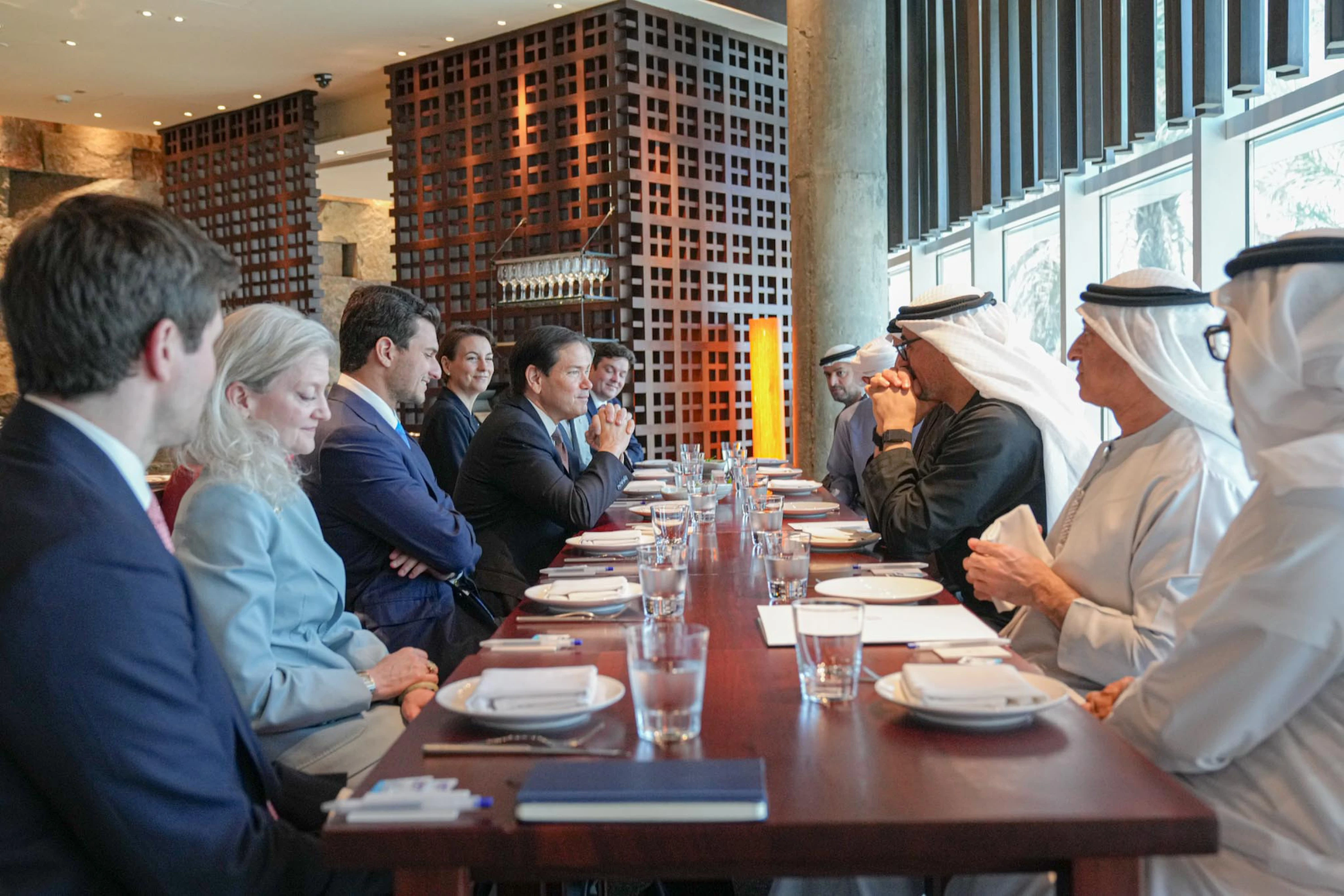
ERBIL, Kurdistan Region of Iraq - US Secretary of State Marco Rubio met with UAE President Mohamed bin Zayed on Wednesday during a Gulf tour, discussing the US-Iran peace agreement and reaffirming Washington's commitment to the security of the Emirates.
"Met with UAE’s President [MBZ] in Abu Dhabi, where we discussed President Trump’s MOU with Iran, efforts to secure full and safe transit through the Strait of Hormuz, and regional stability," Rubio posted on X.
"I thanked the UAE leadership for their unparalleled support, praised their courage and resilience in the face of Iran’s attacks, and reaffirmed our commitment to Emirati security and to our strong bilateral partnership."
The US and Iran signed a memorandum of understanding (MoU) last Wednesday to end hostilities, the first point of which calls for the immediate and permanent termination of military operations on all fronts.
Throughout the conflict, Iran concentrated its strikes on the UAE more than on any other regional state, including Israel, regularly invoking its cooperation with Israel and the presence of US military bases on its territory as rationale.
Emirati defense ministry figures show that the country sustained more than 2,800 missile and drone attacks during the war.
During his trip, Rubio firmly rejected recent suggestions that Iran may charge "costs" for passage through the Strait of Hormuz, asserting that it is inadmissible for any nation to impose tolls on the vital energy corridor.
"It's an international waterway. No country is allowed to charge tolls or fees on an international waterway. That's existing international law," he stated upon his arrival in Abu Dhabi on Tuesday.
After his meeting with Sheikh bin Zayed, Rubio departed for Kuwait to continue his Gulf tour. His itinerary continues on Thursday in Bahrain, where he will take part in a Gulf Cooperation Council summit to address rising maritime tensions.
Earlier in June, Reuters, citing several regional sources, reported that the UAE had agreed to release Iranian frozen assets worth more than $10 billion. One source said more than $3 billion had already been delivered to Iran, while another asserted that the move was agreed in exchange for a halt to Iranian attacks on the UAE.
The Emiratei foreign ministry responded by labeling the allegations as “entirely false and unfounded,” stressing that no frozen Iranian funds have been released, transferred, or facilitated through the UAE.
Longstanding tensions between Iran and the UAE escalated again in May after Israeli Prime Minister Benjamin Netanyahu’s office disclosed he had held a “secret” meeting with the UAE President in the Emirates during the US-Israeli war on Iran.
The developments prompted Iranian warnings that those who collaborated with Israel would be held “accountable,” although the UAE later denied the visit occurred.
Abu Dhabi and Tel Aviv first tied the knot of an official, normalized relationship with the 2020 Abraham Accords signed during US President Donald Trump’s first term, and their defense partnership has deepened since — making the UAE one of Israel's most operationally valuable Arab partners.
Iranian lawmaker Ali Khezrian announced in May that the UAE had been classified as hosting “hostile bases” under the Islamic Republic’s security doctrine, adding that the same designation applies to the Kurdistan Region as well.
In Iranian defense doctrine, such a designation allows Tehran to conduct preemptive strikes on actors that could pose a threat to its security, generally encompassing foreign military facilities and, in the Kurdish case, dissident armed groups.
 Facebook
 LinkedIn
 Telegram
 X
X