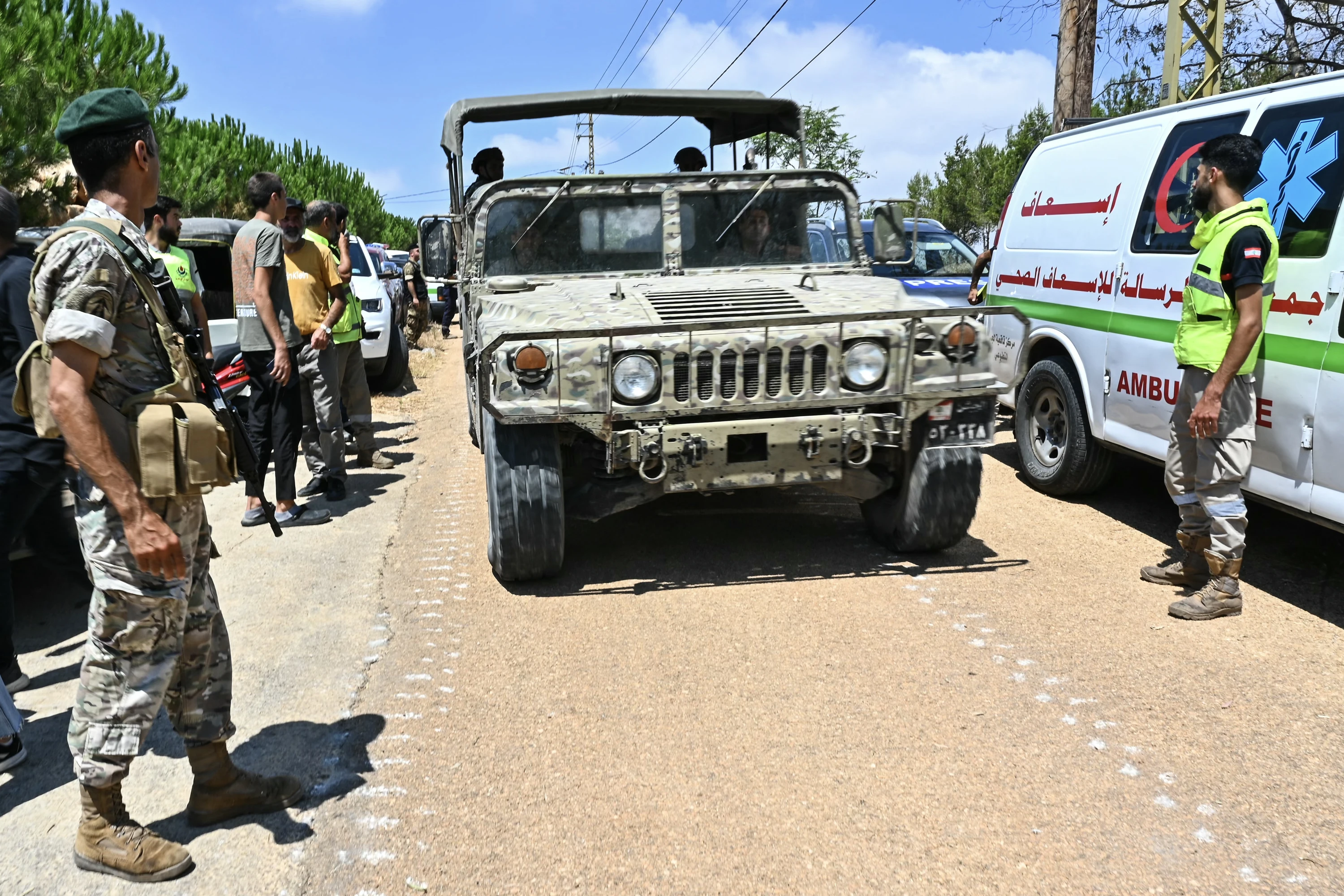
ERBIL, Kurdistan Region of Iraq – The Lebanese army said Israeli troops opened fire near its soldiers as they deployed in a “pilot zone” on Tuesday from which Israel was set to withdraw under a recent US-brokered bilateral agreement.
The infraction occurred in the southern village of Zawtar al-Gharbiya, where Israeli forces "opened fire in the vicinity of these units," the army said, adding that "the attack will hinder the implementation of deployment in the pilot zones."
Under the provisions of the framework, the Lebanese Armed Forces are expected to restrict Hezbollah activity in the zones in question, with Israel and the US have repeatedly stressed that monitoring mechanisms are in place to ensure this takes place.
Zawtar al-Gharbiya is a small, Shiite-majority village near Beaufort Castle in Nabatieh province, long regarded as a Hezbollah stronghold. As a political, economic, and social hub for Lebanon’s Shiite community, Nabatieh serves as a critical artery connecting the south with the Bekaa Valley and the capital.
Just a few hours earlier, the Lebanese army announced it had started moving into one of three "pilot zones" established under a deal with Israel, coinciding with Lebanese President Joseph Aoun’s scheduled meeting with US President Donald Trump in Washington.
"Military units began deploying this morning to Zawtar al-Garhbiya," the army said in a statement.
The US State Department said Monday that the Lebanese army had begun securing Froun, Srifa, and Zawtar al-Gharbiya, with Israeli forces absent from the first two villages bordering the security zone but deployed on the outskirts of Zawtar al-Gharbiya.
Notwithstanding the announcement, AFP reported Monday that Israeli forces continue to restrict access to parts of southern Lebanon, stopping a convoy of journalists near the coastal town of Naqura. At the edge of the Israeli-declared “security zone,” a soldier ordered the group – which was visiting inhabited villages in the occupied territory alongside a Christian NGO – to "turn around" as they did not have "permission to pass," according to the report.
Hezbollah leader Naim Qassem has repeatedly criticized the framework with Israel, calling it a "humiliation, shame, and a surrender of sovereignty" in late June.
Lebanon’s future sovereignty remains uncertain, with no formal Israeli withdrawal timetable having been announced as Israeli officials have repeatedly vowed to maintain a 10-kilometer-deep “security zone” along the frontier as long as Hezbollah remains armed.
The peace process in Lebanon is inextricably linked to the state of US-Iran relations, with Tehran having included a cessation of Israeli hostilities in its northern neighbor as a core element of the now-shattered memorandum of understanding it signed with Washington.
Even with a nominal truce between Hezbollah and Israel, Lebanon remains deeply unstable as continued Israeli strikes have driven the death toll from the onslaught to more than 16,000 since March 2, including more than 4,300 killed and over 12,200 wounded. The conflict has also displaced more than one million people amid widespread infrastructure damage and the continued Israeli occupation of parts of southern Lebanon.
 Facebook
 LinkedIn
 Telegram
 X
X