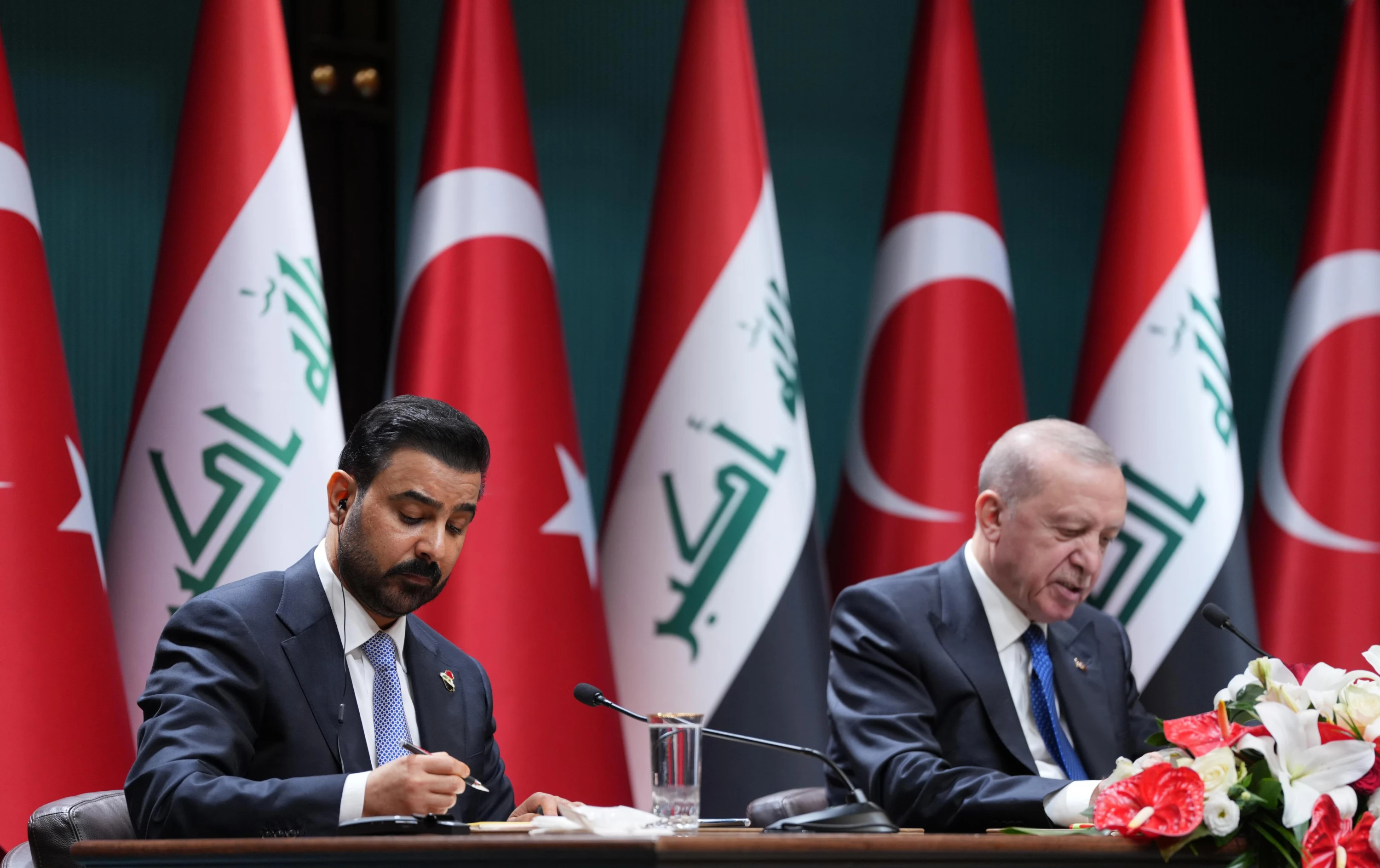
ERBIL, Kurdistan Region of Iraq – Iraqi Prime Minister Ali al-Zaidi and Turkish President Recep Tayyip Erdogan on Tuesday oversaw the signing of several memoranda of understanding between the two countries, emphasizing their shared desire to strengthen bilateral ties in the fields of industry, transport, education, and security.
Zaidi arrived in Ankara on Tuesday alongside his accompanying delegation, and was received by Erdogan at the presidential complex in Ankara.
The two leaders discussed bilateral ties, regional developments, and other issues of mutual interest, agreeing to strengthen strategic cooperation through new agreements and enhanced collaboration in sectors including energy, water, trade, agriculture, transportation, defense, and education, according to a joint statement following the meeting.
Both sides also emphasized the implementation of previously signed deals.
Iraq and Turkey in 2025 signed an agreement to address Iraq’s worsening water crisis, which up to that point had been exacerbated by upstream dams constructed by Ankara along the Tigris and Euphrates rivers.
During a presser following the meeting, Zaidi stated that Iraq “shares geography, energy, and water resources with Turkey,” stressing that his visit is “a sign of strengthening relations that date back centuries.”
The two oversaw the signing of three MoUs: An MoU relating to cooperation in industrial planning between the Iraqi planning ministry and the Turkish industry ministry, an MoU on academic cooperation between both countries’ respective police academies, as well as an addendum to a pre-existing MoU on cooperation in youth and sporting affairs between the relevant ministries.
Developing Kirkuk oil fields
Earlier in the day, Ankara obtained the right to develop major oil fields in Kirkuk after Turkish Petroleum Corporation (TPAO) acquired a 15 percent stake in BP Energy Company of Kirkuk Limited (BP ECKL).
“In the Kirkuk [oil] production field operated by British Petroleum, a partnership stake has been granted to Turkish Petroleum (TPAO),” Erdogan said during the presser, describing it “as a historic step” in Iraq-Turkey relations.
The deal would supply Turkey with one million barrels of oil per day, according to Erdogan and Zaidi.
British energy giant BP and Iraq signed a deal in October 2025 to develop four oil fields in Kirkuk and rehabilitate gas facilities, with initial production set at 328,000 barrels per day.
Earlier in July, BP announced that it had reached an agreement with ConocoPhillips for the American energy giant to acquire a 42 percent interest in BP ECKL.
Security
Zaidi and Erdogan also discussed the importance of combating terrorism through “political unity,” with Ankara expressing appreciation for Iraq’s support in the peace process with the Kurdistan Workers’ Party (PKK), the joint statement added.
Erdogan said during the presser that Turkey is in “close dialogue” with Baghdad on initiatives related to the peace process “to ensure that our process becomes a reality.”
“God willing, we will permanently remove this issue from our agenda, which has exacted such heavy costs on both our countries," the president said in a subsequent statement.
In May 2025, the PKK held a landmark congress in the Kurdistan Region, where it decided to self-dissolve and disarm, ending a four-decade armed campaign against the Turkish state that has resulted in tens of thousands of casualties. Two months later, several commanders of the group burned their weapons in a symbolic ceremony in Sulaimani.
A year later, the Turkish parliament’s commission tasked with finalizing the peace process has yet to propose a legal framework for the next steps.
In February, the Turkish parliament approved a report drafted by the committee. The report called for the reintegration of PKK members who gave up their weapons back into society, in addition to calling for avoiding “terrorism” labeling for non-violent actions and practices of freedom of expression.
 Facebook
 LinkedIn
 Telegram
 X
X