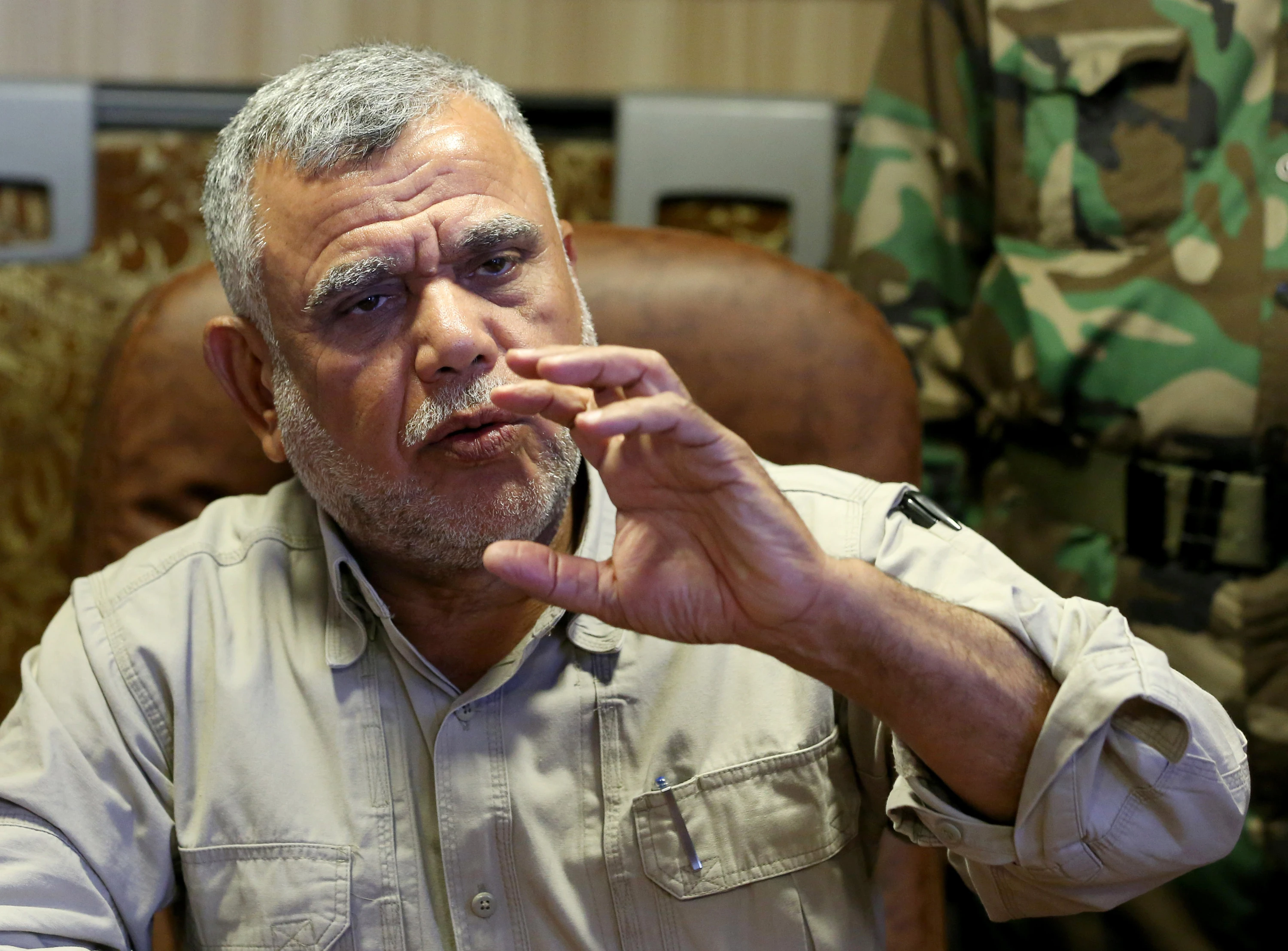
ERBIL, Kurdistan Region of Iraq - The leader of the pro-Iran Badr Organization on Tuesday urged against "escalating tensions" amid the current regional environment, insisting that Baghdad's campaign to restrict arms to the state must not allow external actors to "extend their hegemony" and usurp Iraqi decision-making.
Secretary-General of the Badr Organization Hadi al-Amiri in a statement called upon all parties "to adopt a language of moderation and calm, to avoid escalating tensions... and to reject all that could create divisions and fuel discord."
Iraq has faced extensive disruption amid the US-Iran war and its regional ripples, with Tehran and its Iraqi proxies having repeatedly bombed US bases and energy infrastructure in the country. On Monday, counterterrorism forces in Erbil announced that Iranian drones had targeted the office of Kurdistan Region Prime Minister Masrour Barzani, ushering in a wave of condemnations from Kurdish, Iraqi, and international actors.
In his Tuesday statement, Amiri professed to have faith in the "sound judgment" of both Iraqi Prime Minister Ali al-Zaidi, who has set an end-of-September deadline by which time militias must hand over their weapons to the state, and the "men of resistance."
"We also hope that all those concerned with the 'state monopoly on weapons' file will act with a spirit of national responsibility and not allow external parties seeking pretexts to extend their hegemony, maintain their dominance, and insist on usurping Iraqi decision-making in security, politics, and the economy."
"This file is a purely Iraqi national matter, and any decision made regarding it can only be Iraqi," he continued, asserting that the possession of weapons must only be permitted should they benefit the Iraqi national interest.
The US, whose forces are set to fully withdraw from the country and have long been considered an occupying force by the pro-Iran militias, have ardently supported Zaidi's disarmament initiative.
During a meeting with the US Charge d'Affaires in Baghdad on Tuesday, State of Law Coaliton leader Nouri al-Maliki said that Iraq's ruling Coordination Framework "has formed a committee that will begin its work soon, in coordination with the government, to find appropriate mechanisms for implementing" the weapons restriction process.
The activities of Iran-backed militias have also hampered relations with neighboring countries, culminating in joint US-Saudi airstrikes on Popular Mobilization Forces (PMF) bases across Iraq, with Riyadh claiming that Iran-aligned factions within the nominally state-controlled PMF were responsible for drone attacks on Saudi oil infrastructure.
In messages conveyed to Iraqi Prime Minister Ali al-Zaidi through mediators, Saudi Arabia accused the Badr Organization and Kataib Hezbollah, the most influential and organized Iran-backed Iraqi Shiite armed groups, of being behind the attacks targeting the country’s oil facilities in recent weeks, senior PMF officials told The New Region.
Amiri has reportedly “vehemently” rejected the accusations.
The Badr Organization chief emerged as a moderate voice among the Shiite militias in the wake of the Saudi strikes that killed at least 20 PMF fighters, appealing to the so-called Islamic Resistance at the time "to postpone any reaction against the American-Saudi aggression that targeted Iraq, and to bear the pain for the sake of Iraq’s higher interest."
The Badr Organization’s armed wing was integrated into Iraq’s security forces after 2003 and later formed the backbone of the Popular Mobilization Commission (PMC), established in 2014 as a government body covering volunteers and armed factions that fought the Islamic State (ISIS) alongside Iraqi security forces.
Despite its deep and public ties to Iran’s IRGC, the organization and its leadership have been careful to keep their fighters from playing any overt role in operations attributed to other Iranian-backed Iraqi armed factions against US forces and interests in Iraq and the region.
 Facebook
 LinkedIn
 Telegram
 X
X