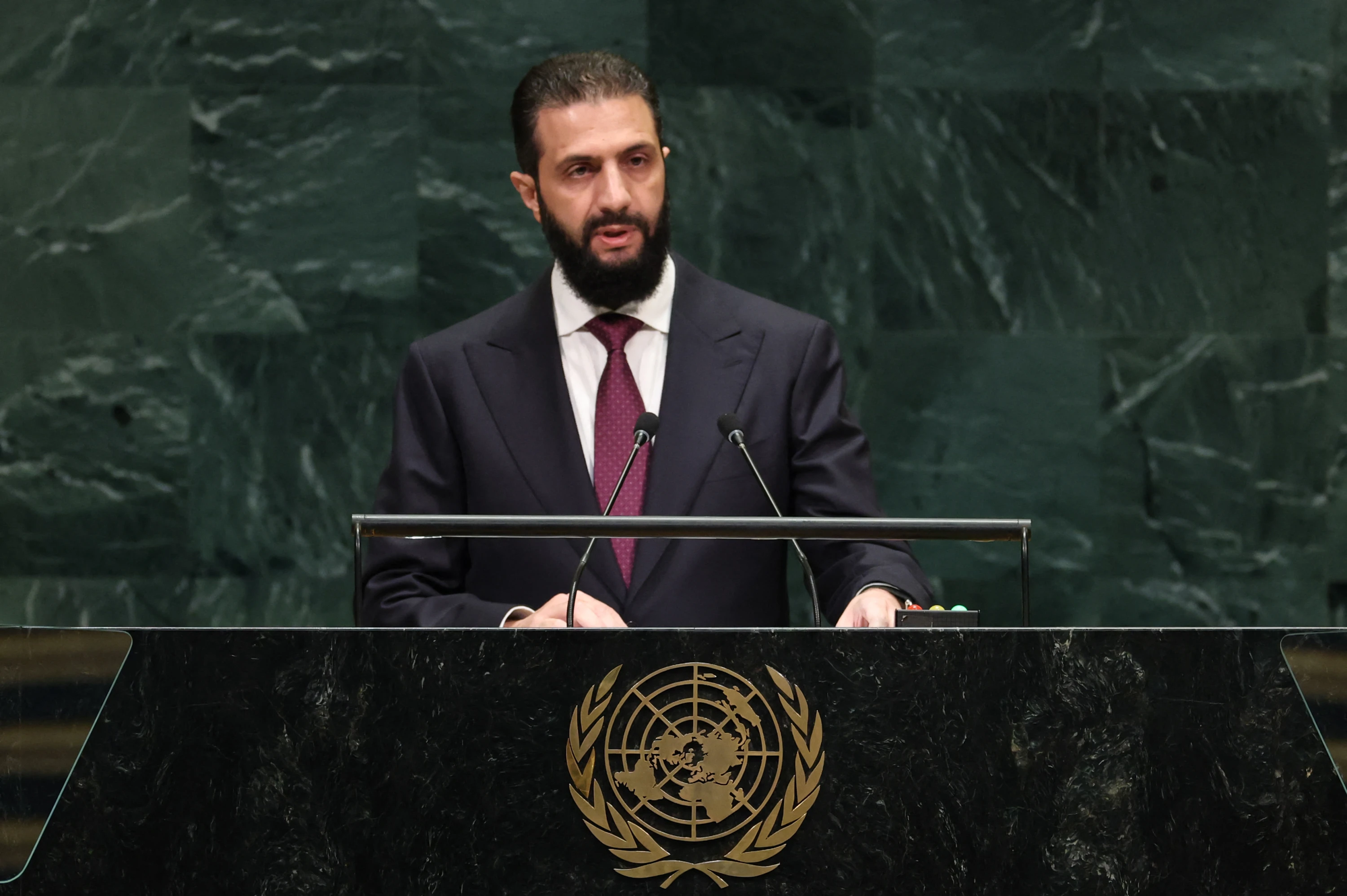
ERBIL, Kurdistan Region of Iraq – Syrian President Ahmed al-Sharaa on Wednesday rejected the ongoing Israeli attacks on Syrian territory at the 81st session of the UN General Assembly (UNGA), stressing that the occupied Golan Heights will remain a part of the Syrian state.
“We thought that [the attacks] were from an era that was gone. We reject the Israeli aggression that undermines our peace and security,” the Syrian president said during his UNGA address in New York, slamming ongoing Israeli incursions on Syrian land.
“We have consolidated our values. We have consolidated the rule of law. Any attempts to violate our sovereignty will be stopped," he added.
The leader stressed that the Golan Heights, currently under Israeli occupation, will “remain Syrian territory.”
He also stressed the new Syrian government's efforts to strengthen the country's security sector and transform Syria from a country of “crisis to opportunity.”
Also on Wednesday, the Syrian foreign ministry thanked the countries that voted in favor of a UN resolution adopted a day earlier, which deemed Israel’s occupation of the Golan Heights illegal, demanding its withdrawal to the 1967 line.
The Egypt-initiated resolution received 123 votes in favor, seven against, and 41 abstentions.
In June 1967, Israel emerged victorious in a war against Arab states, named the Six-Day War, seizing the West Bank, including East Jerusalem from Jordan, the Golan Heights from Syria, and the Gaza Strip and Sinai Peninsula from Egypt.
Since the new authorities in Damascus toppled Bashar al-Assad in December last year, Israel’s Defense Minister Israel Katz ordered the Israeli forces to complete the takeover of the 1974 buffer zone in the Golan Heights, separating the two states, claiming that the 1974 Disengagement Agreement was void until order was restored in Syria.
“We are committed to the 1974 agreement; we call for the withdrawal of Israeli forces to the line of the 8 of December 2024,” Sharaa said.
Israel has repeatedly launched attacks against Syria since the fall of Assad’s regime, nominally to destroy weapons caches and protect the minority Druze community that has been the target of sectarian massacres at the hands of Damascus-affiliated armed forces.
According to Sharaa, Syria has been subject to 500 airstrikes, more than 1200 incursions, and 300 detentions since the coming of the new government to power.
Reconstruction efforts
The Syrian president highlighted reconstruction efforts carried out by the new Syrian government following the toppling of the Baath regime, stressing that in its journey “between good and evil, the bloodshed was stopped, destruction was stopped, Syria started the journey of reconstruction of recovery.”
Highlighting achievements of the new Syrian government, Sharaa stated, “We controlled arms, we rebuilt military and civilian institutions, sanctions were lifted, projects for reconstruction have continued.”
Following the overthrow of Assad, Syria regained a part of its position on the international stage, as it moved to overcome crippling past political and economic sanctions, with more than 60 diplomatic missions operating in the capital, according to the president.
"We appreciate all the countries that have raised their flags in Damascus, and we thank all the international countries that believed in us," he said.
A coalition of rebel forces led by the jihadist Hay’at Tahrir al-Sham (HTS) marched into Damascus on December 8, 2024, and overthrew Syria’s longtime ruler Assad, sending him fleeing to Russia after lightning rebel advances from the north.
In the wake of Assad’s fall, HTS and affiliated groups dissolved, and its membership took up the reins of governance in Syria, forming a transitional government led by Sharaa as the country’s interim president.
 Facebook
 LinkedIn
 Telegram
 X
X