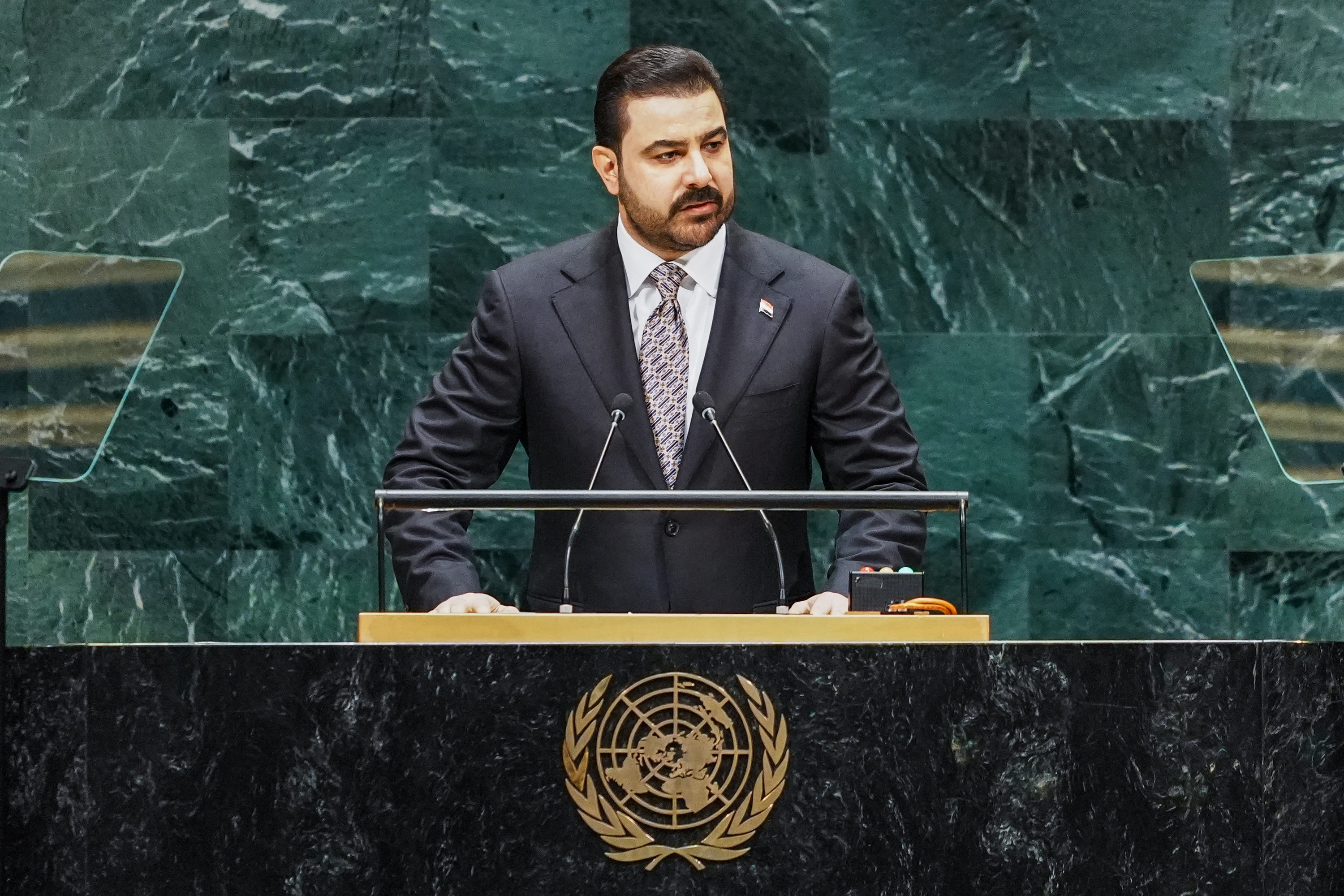
ERBIL, Kurdistan Region of Iraq – Iraqi Prime Minister Ali al-Zaidi on Friday addressed the UN General Assmebly, reaffirming his government’s commitment to consolidating weapons under state authority and fighting corruption.
The Iraqi premier arrived in New York on Monday to attend the annual UN event and present Iraq’s stance to the international communtiy.
“Our vision, at this stage, is based on our national will, to restore the sanctity of the law, enhance state institutions, and strengthen citizens’ trust in them,” the Iraqi prime minister said in his address to the UN General Assembly.
Zaidi said that the Iraqi government, under his leadership, wants to ensure that “the state is the ultimate decision-maker in matters of peace and war,” adding that the law “must be the final authority.”
He reiterated his government’s commitment to ensuring that “weapons and tools of power remain in the hands of its constitutional institutions.”
Since assuming office in May, bringing weapons back under the control of the Iraqi government and fighting corruption have emerged as Zaidi’s cabinet’s most notable goals.
Many pro-Iran armed groups have long used the US-led coalition’s presence in the country as a reason to maintain their weapons. These groups initially helped defeat ISIS but then shifted to also attacking American personnel and interests as tensions soared between Washington and Tehran in the following years.
While several pro-Iran armed factions have announced their willingness to hand over their weapons and integrate into the state security apparatus, others have expressed skepticism.
The premier noted that the end of the anti-Islamic State (ISIS) Global Coalition’s mission on September 30 marks a “new phase” in Iraq’s relations with its international partners.
In a meeting with US Secretary of State Marco Rubio on Monday, the Iraqi premier reiterated Baghdad’s “determination to fulfill sovereign obligations and proceed with measures to restrict the possession of arms to the state,” his office said.
The Iraqi prime minister’s anti-corruption campaign has been another hallmark of his tenure thus far, with several high ranking and senior officials having been arrested in what started with a raid of Baghdad’s Green Zone in late June, which led to the arrest of at least 21 people.
“Our government is fighting a battle against corruption, and for the protection of public funds,” Zaidi said.
He noted that Baghdad is “moving forward with sustainable core solutions, in order to increase performance efficiency, and improve providing services.”
By late July, Iraq had seized over $125 million and 380 kilograms of gold and jewelry hidden in various places in a corruption case involving Adnan al-Jumaili, the detained oil ministry undersecretary for refining affairs.
The premier said Iraq is working toward a "renaissance" of economic activity by attracting international investment in various sectors
He invited global powers and foreign companies to “invest in Iraq,” noting that the country’s vision is “based on contributing to the region's transition from conflict to integration and from competition to cooperation.”
"Iraq's exceptional geographic location, which connects its economy to the world, is a major positive," he asserted, adding that Baghdad aims to “diversify our oil export ports and develop energy lines and corridors linking Iraq, Turkey, Jordan, and Syria.”
Zaidi has met with several world leaders, including US President Donald Trump, Syrian President Ahmed al-Sharaa, Turkey’s President Recep Tayyip Erdogan, and President Masoud Pezeshkian of Iran, on the sidelines of the General Assembly.
Zaidi met Trump on Tuesday, with the pair discussing strengthening bilateral ties and political, economic, and investment cooperation.
“They also reviewed regional developments and the joint efforts taken by Iraq and the United States to enhance regional and international security and stability,” read a statement from Zaidi’s office.
Zaidi’s first visit after becoming prime minister was to the US in July. A meeting with Donald Trump was the center of the visit, during which the US president praised him and congratulated him on taking office.
 Facebook
 LinkedIn
 Telegram
 X
X