
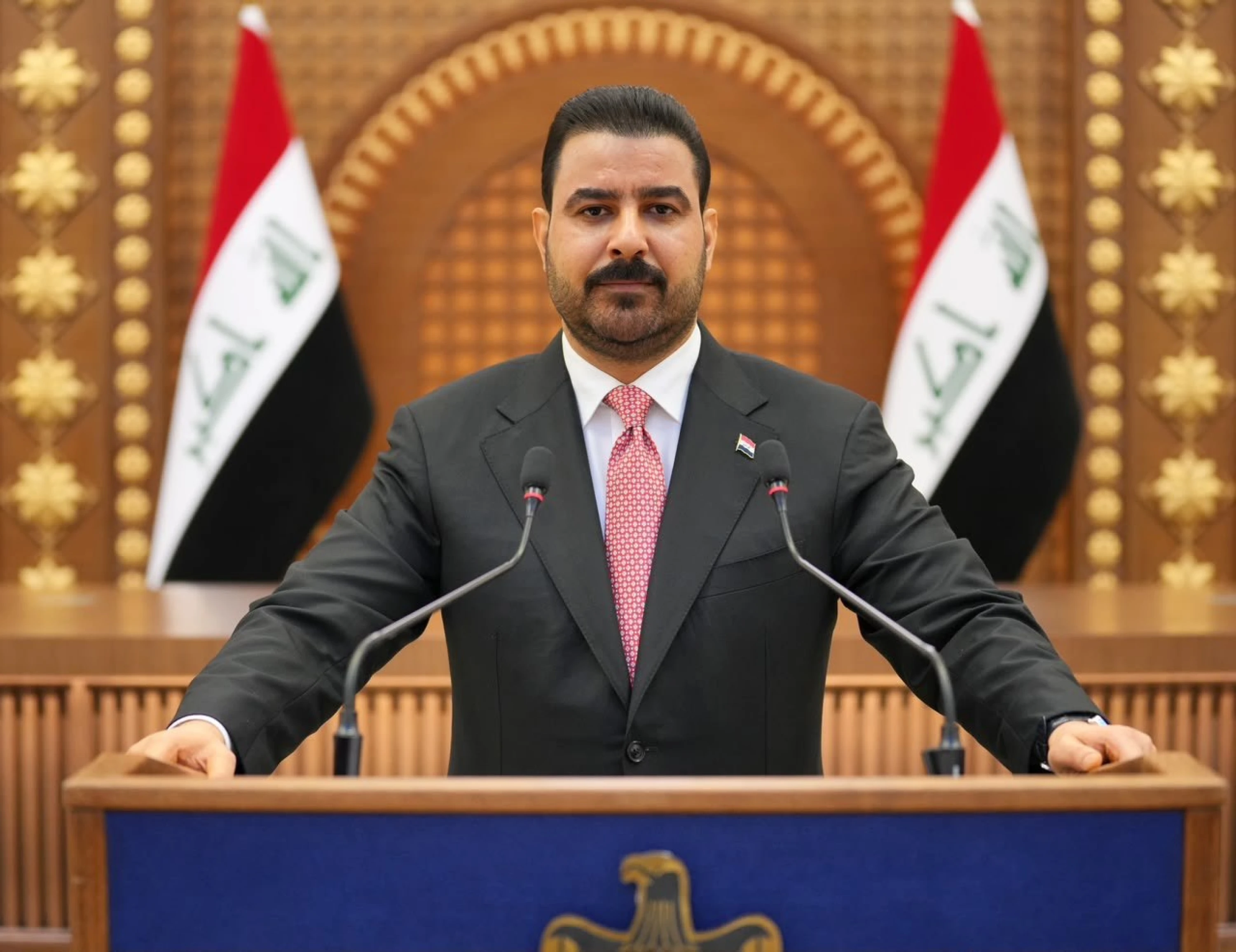
ERBIL, Kurdistan Region of Iraq – Baghdad will work to disarm all non-Iraqi armed groups present on Iraqi soil, Prime Minister Ali al-Zaidi announced on Thursday, adding that it will also formalize the Popular Mobilization Forces’ (PMF) status within the national security apparatus.
“The government will work to fully disarm all non-Iraqi armed groups present on Iraqi soil, thereby safeguarding the country’s security and stability and ensuring the control of its borders,” Zaidi said in a statement.
He further stressed that Baghdad rejects the use of its territory and airspace as a launching pad for attacks on neighboring countries, while also rejecting any attacks on Iraq.
Zaidi’s remarks come a day after the US-led coalition against the Islamic State (ISIS) completed its withdrawal from Iraq and the Kurdistan Region. The coalition’s withdrawal was a key demand of several political forces and many Iran-backed Iraqi militias, with the armed groups saying the coalition had to leave before they could consider disarming.
“October 1, 2026 marks a serious beginning for addressing the issue of weapons outside state control,” the prime minister said, confirming that Baghdad has set a June 30, 2027 deadline to disarm all armed groups.
The Iraqi government “will also enact the Popular Mobilization Forces law and formalize the PMF’s status within the security apparatus as an integral component under the command of the commander-in-chief of the armed forces,” Zaidi stressed.
On Tuesday, the Council of Ministers voted in favor of the controversial PMF law and referred it to parliament for voting.
When integrated into the state in 2016, the law did not spell out issues such as structure, institutionalization, retirement, benefits, or compensation for the families of fighters killed in battle. The new law aims to fill those gaps and put PMF personnel on equal footing with members of other security institutions.
The bill, however, is heavily opposed by Washington, with the US concerned that it would legitimize armed groups with strong links to Iran, including some responsible for attacks on US interests and the killing of American personnel.
The PMF, known as Hashd al-Shaabi, was formed upon a call by Iraq’s top Shiite authority Ayatollah Ali al-Sistani soon after the Islamic State (ISIS) took over large swathes of territory in Iraq. The force has been officially incorporated into the Iraqi armed forces, enjoying similar privileges as the Iraqi army.
The bill, which further signals long-term integration for the network, would give them greater autonomy from the defense ministry.
Several non-Iraqi armed groups exist on Iraqi territory, including Iranian Kurdish opposition groups that are hostile to Tehran and have long drawn calls on Iraq from the Islamic republic to be disarmed.
The Kurdistan Workers’ Party (PKK) is also present on Iraqi territory. However, the PKK and the Turkish state are currently engaged in a peace process that would see the Kurdish group disarm.
In March 2023, Iraq and Iran signed a security agreement aimed at addressing Tehran’s concerns over Iranian Kurdish opposition groups. Under the agreement, implemented in coordination with the Kurdistan Regional Government (KRG), the groups were required to disarm, vacate positions near the Iranian border, and relocate to camps further inside the Kurdistan Region.
Throughout the ongoing US-Iran conflict, the Islamic republic has repeatedly carried out missile and drone strikes on bases of the opposition groups in the Kurdistan Region.
 Facebook
 LinkedIn
 Telegram
 X
X