ERBIL, Kurdistan Region of Iraq – An Iran-backed party and its allies are lobbying Iraqi Prime Minister Ali al-Zaidi to maintain the party’s grip on the migration ministry, despite losing its majority among Christian lawmakers in the latest parliamentary elections, an Iraqi Christian alliance told The New Region.
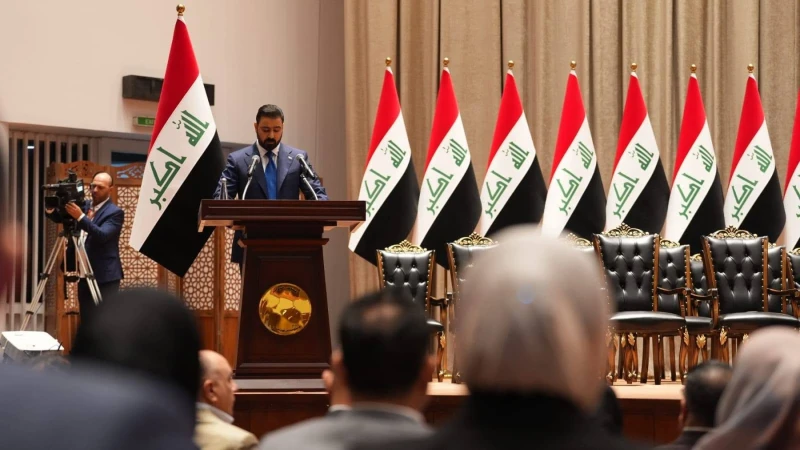
The Iraqi parliament is set to convene on Thursday to vote on the remaining vacant ministries. Among them is the Ministry of Migration and Displaced, which has been held by the country’s Assyrian and Chaldean Christians since 2020.
The ministry has long been controlled by the Babylon Movement, an Iran-backed pseudo-Christian party and militia that is linked to the Islamic Revolutionary Guard Corps (IRGC). The party has long been accused of winning its parliamentary seats by amassing hundreds of thousands of Shiites from southern provinces to vote for their candidates – which run under the legislature’s five quota seats for Christians.
The Christian Soyana bloc, an alliance of Assyrian and Chaldean Christian lawmakers that holds three of the five quota seats after Babylon lost the quota majority in the 2024 parliamentary vote, is vying for the migration and displaced ministry, controlled by Babylon for over six years.
But Rayan al-Kildani, the notorious leader of Babylon, and Qais al-Khazali, leader of Asaib Ahl al-Haq (AAH), another powerful Iran-backed group, are behind a pressure campaign launched to compel Zaidi to permit Babylon’s continued control of the ministry, a Soyana lawmaker told The New Region.
“These maneuvers are backed by Rayan al-Kildani and Sheikh Qais al-Khazali of Asaib Ahl al-Haq to appoint an ‘independent’ candidate who is in reality controlled by Babylon,” said Kaldo Ramzi Oghanna, head of Soyana’s bloc in the Iraqi parliament.
Dina Sabah Yalda, the allegedly independent candidate proposed for the ministry, is Secretary-General of Iraq’s Federal Supreme Court, a position she assumed as part of the judiciary’s designated Christian quota.
“They claim that she is an independent candidate, but we know the truth. We have her portfolio and she is a failure, somebody who is linked to Rayan and is not of the stature for the ministry,” Oghanna stressed.
“We refuse to accept her appointment under any circumstance.”
The lawmaker further stressed that any request for the bloc to show flexibility must be “matched by a clear acknowledgement” from Shiite, Sunni, and Kurdish political forces of the need to reform the election law and restrict voting to quota community members.
“This would ensure that the selection of the Christian community’s representatives truly reflects the will of the Christian people themselves,” he said.
He further asserted that Soyana has demonstrated flexibility “by proposing qualified, independent figures to the prime minister – individuals who are broadly accepted – free from political maneuvering,” the lawmaker explained.
A lawmaker from Sadiqoun – the political bloc of AAH – told state media on Thursday that “there is a proposal” to put forth Evan Faek Gabro of the Babylon Movement, the incumbent minister for migration and displaced persons, to retain her position “because she is acceptable to everyone.”
Oghanna, however, stressed that Soyana “completely and categorically rejects the appointment [of Gabro] and any other candidates affiliated to Babylon.”
“The Christian community is no longer prepared to bear the costs of partisan conflicts and narrow agendas, nor will it accept the imposition of tutelage over its representation,” he asserted.
“We will not accept ‘independent’ figures who, in reality, serve as proxies for partisan factions seeking to retain control over the ministry.”
The Babylon Movement is the political arm of the Babylon Brigades, an Iran-backed pseudo-Christian militia operating mainly in Iraq’s northern Nineveh Plains, historically home to numerous Assyrian and Chaldean Christian villages and towns.
The Babylon Brigades, led by Rayan al-Kildani, have been accused of illegally seizing historic Christian land and church properties in Nineveh after the Islamic State (ISIS) was driven out of the area. The group has also been repeatedly criticized for land grabs of the properties of Christians in Baghdad.
Iraq’s Christian community has been devastated over the past decades, with sectarian violence following the US-led invasion of 2003 prompting followers of the country’s Christian denominations to flee. Attacks by ISIS in 2014 pushed a greater number toward exodus.
Fewer than 300,000 Christians remain in Iraq today, a drastic fall from the nearly 1.5 million before 2003, according to data obtained by The New Region from Erbil’s Chaldean Archbishop Bashar Matti Warda.
The lack of fair and equal representation in the Iraqi parliament and government positions has pushed even greater numbers of Christians to flee.
New ministries
Zaidi assumed his role as prime minister in May following a parliamentary session that saw his program for government and 14 ministerial appointments endorsed. Disputes over some portfolios left nine ministries unfilled.
The incomplete ministries consisted of interior, defense, planning, higher education, labor and social affairs, youth and sports, migration and displacement, the Ministry of Construction, Housing, and Municipalities, and the Ministry of Culture, Tourism, and Antiquities.
Thursday’s parliament session is also expected to include votes on three newly created ministries. The New Region understands that the titles of the new ministries have yet to be finalized due to disagreements between political blocs.
An artificial intelligence ministry has reportedly been scrapped in favor of the Ministry of Digital Economy and Governance.
The Kurdistan Democratic Party (KDP) has also objected to the creation of the Ministry of State for Foreign Affairs, arguing that it undermines and interferes with the role of the Ministry of Foreign Affairs, which is led by the KDP’s Fuad Hussein, according to The New Region’s Baghdad correspondent.
A proposal has been submitted to replace it with the Ministry of State for Minority Affairs, which will be given to the Iraqi Turkmen Front (ITF). The Turkmens have put forward Mehmet Seman, leader of the ITF and Governor of Kirkuk, as their candidate.
Daroon Malanaji contributed to this report from Baghdad.
 Facebook
 LinkedIn
 Telegram
 X
X