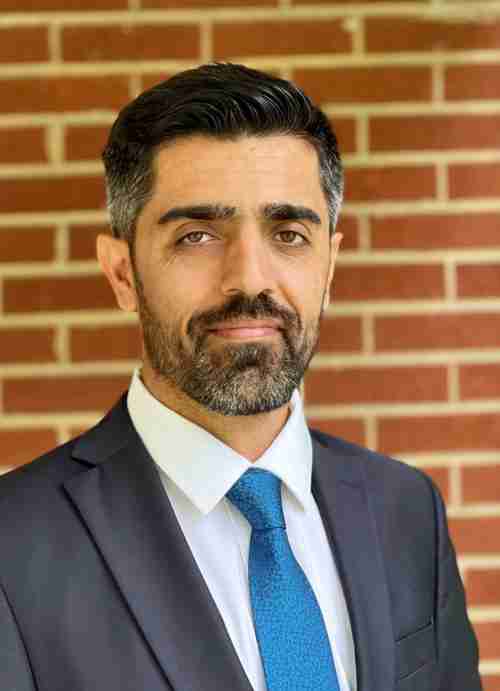
In the latest episode of The New Region’s GeoSpace, host Mohammad A. Salih spoke with Victoria J. Taylor, director of the Iraq Initiative in the Atlantic Council’s Middle East program, about the future of power in Iraq following the recent elections, Washington’s continued push to curb Iranian influence, and the issue of armed factions in the country.
The November elections and the government formation process
The process of forming Iraq’s next government is underway, with the country’s top political parties continuing talks on filling the top posts in Baghdad following the November parliamentary elections.
At the Shiite camp, the negotiations over who will fill the prime minister post have stalled, with the November election’s main victor, the Reconstruction and Development Alliance, describing the current situation as “a political deadlock.”
Taylor, who visited Iraq shortly after the recent vote, said that during her discussions with representatives of the Shiite parties, there was “already a fairly firm consensus among the Shiite political leaders affiliated with the [Coordination] Framework that they did not support a second term for Prime Minister [Mohammed Shia’ al-]Sudani.”
Sudani has served as the prime minister of Iraq since October 2022. He is one of the nine names that the ruling Shiite Coordination Framework has been contemplating for Iraq’s next premier.
“[There was] a growing consensus that the Framework was going to choose a prime minister who had no political base. Who had no political party, and who would need to pledge not to have a political party,” said Taylor.
In addition to Sudani, the Framework’s list of potential nominees for the premiership includes several other well-established names, such as former prime ministers Nouri al-Maliki and Haider al-Abadi, intelligence chief Hamid al-Shatri, and National Security Advisor Qasim al-Araji.
However, the list also includes a few less prominent and relatively unknown figures, such as Justice and Accountability Commission Chairman Basim al-Badri, Minister for Youth and Sports Abdul Hussein Abtan, Former Planning Minister and MP Ali al-Shukri, and head of the Defense Industries Commission Mohammed Sahib al-Daraji.
“It was very clear, even at that point, that the vision for the next prime minister is one who is going to implement the Framework’s agenda. But who is not going to play a leading role in developing that agenda,” Taylor asserted.
The career diplomat noted, based on her conversations during her recent visit, that the Kurds and the Sunnis also appear to be against the idea of Sudani getting a second term, or anyone else for that matter, citing the poor experience of Maliki’s second term.
While the Shiites continue talks on the prime minister pick, the Sunnis are engaged in their own discussions on selecting the Speaker of Parliament, a task the top Sunni political forces need to complete before the parliament holds its first session in less than a week from this writing.
Taylor said she sensed “a lot of fragmentation” inside the Sunni camp during her November visit, and said she remains “a little bit skeptical that they are going to be able to unite and form a consensus in the same way that the Framework has,” despite the formation of the National Political Council - an umbrella group of Sunni parties, Modeled after the Shiite Coordination Framework.
A meeting of the National Political Council on Sunday ended without resolving outstanding issues as disagreements continue between the Taqadum Party and the Azm Alliance over the nomination for the speakership.
Azm Alliance leader Muthanna al-Samarrai and Taqadum Party leader Mohammed al-Halbousi appear to be the most likely candidates for the speaker of parliament post.
The negotiations over the country’s Presidency appear far less intense, as the Kurdistan Region’s two main parties, the Kurdistan Democratic Party (KDP) and the Patriotic Union of Kurdistan (PUK), have met far less frequently to discuss the top post, unlike their Sunni and Shiite counterparts.
The Kurdish rivaling parties are currently at a tumultuous point in their relationship, having failed to reach agreements on forming the new cabinet of the Kurdistan Regional Government (KRG) over a year after the Region held parliamentary elections.
“In Kurdistan… I did not get a sense that the KDP and PUK were really any closer to forming the Kurdistan Regional Government, nor to selecting the president. So, I think we could see quick movement between the Shiite political parties to select a prime minister, but perhaps a slower process among the Sunnis and the Kurds,” Taylor noted.
The PUK has continuously held the Iraqi Presidency since 2005. The KDP opposes the notion that the post is guaranteed for its rival party, arguing instead that the post is reserved for Kurds and therefore should be decided in accordance with the electoral gains.
The KDP remains the top Kurdish party in both the Kurdistan Region and Iraq by a considerable margin.
US engagement in government formation
Taylor, a career diplomat who served as deputy assistant secretary for Iraq and Iran in the State Department’s Bureau of Near Eastern Affairs between 2023 and 2025, ruled out active participation from Washington during the current Iraqi government formation process.
“I think the days of the very active US role in [Iraqi] government formation, such as in 2010, are over. I think while the US may lay down some clear markers, in terms of policy direction and on certain issues, I don't see this administration as being so deeply engaged on Iraq that they're ready to pick the winner,” she said.
Taylor said that she believes the US is prepared to “use a veto” if the Shiite political leadership and the Coordination Framework were set to select a prime minister that would be “problematic” to Washington, but stressed that the Framework will also most likely not pursue a nominee that would be problematic.
“I've not seen really an indication more broadly across the US government that they have a favorite candidate,” said Taylor, noting that while there appears to be “an openness” from Washington to Sudani, “I don't see the US as taking steps that would actually move to put Prime Minister Sudani in place, nor do I think it's really possible for the United States to engage in such a way that would really shift the direction of that conversation within the Shiite political elite.”
Militia disarmament
From the onset of Donald Trump’s second administration, the US government has intensified calls on Iraq to curb Iranian influence, pushing Baghdad to dissolve all armed factions which Washington deems to be proxies of Iran.
US Special Envoy to Iraq Mark Savaya has repeatedly highlighted the need for the Iraqi government to bring weapons under state control and ensure state institutions are protected, stating: “No economy can grow, and no international partnership can succeed, in an environment where politics is intertwined with unofficial power.”
Taylor said that she views the comments from the US administration as “a broad statement of intent,” arguing that while “there may be an element of disarmament… I think it's likely to be a much more complicated approach.”
Regardless, the career diplomat stressed that “certainly it's a conversation that needs to continue within the Iraqi government and between the Iraqi government and the United States about how you would effectively deal with the militias.”
Faiq Zidan, President of Iraq’s Supreme Judicial Council, on Saturday announced that the leaders of some armed factions have adhered to his call to cease military action and confine weapons to the state.
Asaib Ahl al-Haq, Kataib Hezbollah, and Harakat al-Nujaba, three US-designated Iran-backed Iraqi militias, have already rebuffed the disarmament calls, saying they maintain the right to “resistance” as long as there are foreign forces present in the country.
The US strongly opposed a bill in the Iraqi parliament that seeks to organize the Popular Mobilization Forces (PMF) similarly to other Iraqi state security and military agencies, saying the draft law would undermine Iraqi sovereignty and risk increasing Iranian influence in the country. The Iraqi government withdrew the bill in August.
Many factions within the PMF are reportedly backed by Iran.
 Facebook
 LinkedIn
 Telegram
 X
X