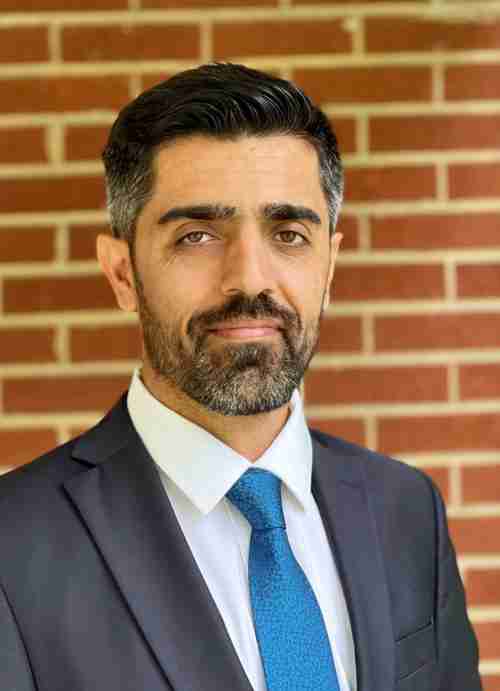
On the latest episode of The New Region's GeoSpace podcast, Mohammed A. Salih hosted Lawk Ghafuri, a political analyst specializing in Iraqi affairs and the country's role within the broader Middle East. The two discussed how the February 28 launch of the US-Israeli military campaign against Iran has triggered an intense barrage of attacks on Kurdistan Region, exposing both the power of Iran-backed militias in Iraq and Baghdad's inability to control them.
Speaking from Erbil, Ghafuri described unprecedented conditions on the ground. "Every day there's multiple attacks, and everyone in Erbil specifically can hear it and can feel it," he said. The frequency has been staggering — 16 attacks the first day, 23 the second, and 28 on the third day alone. "We have never witnessed such a huge amount of attacks in a single day, or even in 3 days. It's, like, it's crazy out here, to be honest."
"This is the most intense aerial campaign against Erbil and the Kurdistan Region in recent memory, as far as one can remember," responded Salih.
The attacks, primarily carried out by Iran-backed militias in Iraq using drones, have targeted Erbil International Airport, US bases, and concerningly, Kurdish Peshmerga forces. One attack on a Peshmerga unit between Erbil and Sulaimani injured a fighter, raising questions about whether civilians and Kurdish forces are being deliberately targeted beyond American interests.
"The attacks, if it intensified, or in the coming hours, I don't think they will only target the same areas again, because if there's no impact, they're gonna actually try to target somewhere else, which will have an impact," Ghafuri warned, suggesting economic infrastructure like power plants and oil fields could be next.
Ghafuri explained the complex structure of these militias, which operate both within and outside Iraq's official Popular Mobilization Forces (PMF). Groups like Saraya Awliya al-Dam, Kataib Hezbollah, and Asa'ib Ahl al-Haq maintain facade units to carry out attacks while remaining officially part of Iraq's defense apparatus.
"[The] PMF is an organization which is purely, purely financial for the Iran-backed armed groups," Ghafuri stated bluntly. With a budget of approximately $2.8 billion, the PMF serves as "a bank for them" rather than an effective security force. "Baghdad has no control over them. Iraq cannot actually try to even stand against them."
The government's paralysis became evident when Ghafuri noted that while Iraqi security forces seized a truck preparing to launch rockets on Baghdad, no similar action has been taken against groups attacking Kurdistan. "Baghdad is afraid of these groups, because these groups are capable of doing a lot to harm the Iraqi government," he explained.
This dynamic has completely halted government formation in Baghdad. Former Prime Minister Nouri al-Maliki's nomination has stalled following US pressure, with Special Envoy Tom Barrack reportedly telling Maliki to withdraw. "The war has completely stopped Baghdad from functioning. There's no debate on the Prime Minister, the Cabinet, or the government formation. It's completely off the table," Ghafuri observed.
Yet Ghafuri suggested Maliki's real goal may not be the premiership itself but control over the selection process. "What he has done so far, it was, like, there's one achievement in it, which is sidelining Sudani," he said, referring to the current prime minister Mohammed Shia' al-Sudani.
On prospects for disarming these militias, Ghafuri was skeptical. "Iraq cannot disarm these groups on its own. There's no way," he stated. "These groups are not being eliminated by a war. These groups have the ideology." He argued only regime change in Tehran would remove the pressure enabling these groups to operate with impunity.
The situation has also exposed Kurdish disunity as a critical vulnerability. The ongoing deadlock between the Kurdistan Democratic Party (KDP) and Patriotic Union of Kurdistan (PUK) over government formation has cost the Kurds positions in Baghdad, including the chief of staff of the Iraqi military. "If this continues, you will lose more in Baghdad, to be honest," Ghafuri cautioned.
Regarding reported US contact with Kurdish leaders about Iranian Kurdish opposition groups entering Iran, Ghafuri was blunt about the risks. "Having these groups of Iran-positioned forces to go into Iran and have an uprising with an AK-47, this is absolutely a suicide project, a suicide operation," he said. "Using the Kurds to do a fight, and then leaving them, just like happened in Syria, this is kind of a gamble. And the Kurds should be very careful with it."
Ghafuri concluded that Iraq's political future hinges entirely on the outcome of the Iran conflict. "It all depends on the Iran war," he emphasized, suggesting only significant damage to Iran's regime would free Iraqi politics from Tehran's grip.
 Facebook
 LinkedIn
 Telegram
 X
X