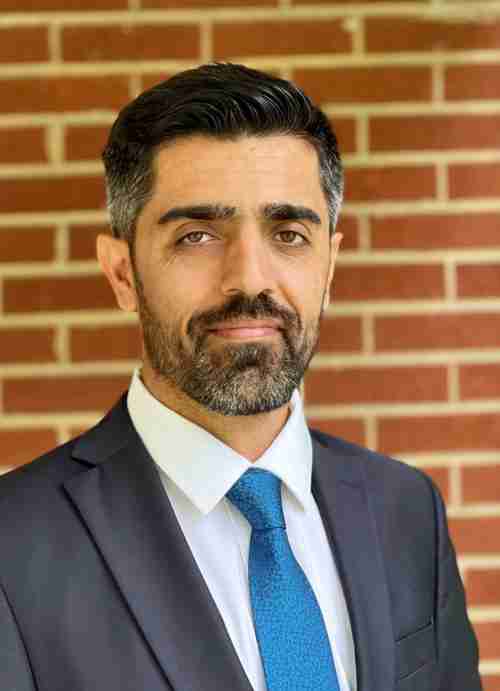
On the latest episode of The New Region’s GeoSpace podcast, Mohammed A. Salih hosted Shivan Fazil, an expert on Iraq and Kurdish affairs and a PhD student at Boston University. The discussion examined Iraq’s growing entanglement in the US–Israel–Iran war, the intensifying wave of attacks on the Kurdistan Region, and what these developments reveal about state authority, militia power, and the future of Iraq’s political order.
Several weeks into the conflict, Fazil described the situation in Iraq—and particularly in the Kurdistan Region—not as a peripheral spillover but as a deliberate and escalating front. “To describe the attacks on the Kurdistan Region as a spillover… is an understatement,” he said, arguing that the pattern of strikes reflects “a broader and calculated and deliberate plan” by actors operating beyond effective state control.
The scale of the violence underscores this shift. Nearly 1,000 attacks have been launched from or within Iraq since late February, with more than 500 targeting the Kurdistan Region alone. These have included strikes on military sites, diplomatic facilities, energy infrastructure, and civilian areas. Fazil noted that such attacks, many carried out by groups formally embedded within the Popular Mobilization Forces (PMF), blur the line between state and non-state actors, raising serious questions about sovereignty and accountability.
For Fazil, the Kurdistan Region’s response has been defined by caution and strategic restraint. Kurdish authorities have sought to carefully calibrate their messaging to Baghdad, domestic actors, and international partners while avoiding escalation. At the same time, the region faces a dual reality of insecurity and resilience. While uncertainty about the trajectory of the war remains high, public panic has so far been limited, reflecting a population shaped by decades of conflict.
Militarily, however, Kurdistan remains highly constrained. Fazil emphasized that the Region lacks advanced air defense systems capable of intercepting incoming projectiles, leaving critical infrastructure and civilian areas exposed. Retaliation is also not a viable option.
“This would basically mean escalating the war,” he warned, potentially triggering internal conflict between Erbil and Baghdad. Instead, both governments face what he described as a shared threat from armed groups acting outside—or even against—the state’s broader interests.
Fazil identified two main drivers behind the sustained targeting of the Kurdistan Region. The first is internal Iraqi politics. Ongoing disputes over government formation and fragmentation within the Shia political bloc have created space for armed actors to use violence as a tool of political signaling. Attacks on Kurdistan, he suggested, are partly aimed at shaping Kurdish alliances in Baghdad’s power struggles.
The second driver lies in the Kurdistan Region’s external relations. Its longstanding ties with the United States, growing partnerships with Gulf states, and ability to attract foreign investment have made it a strategic focal point. “It’s no secret” that these relationships distinguish Kurdistan from the rest of Iraq, Fazil noted, making it both an asset and a target in the broader regional confrontation.
The economic implications of the attacks are particularly severe. Beyond military and diplomatic targets, strikes have increasingly hit energy infrastructure, industrial facilities, and foreign investments. This comes at a time when Iraq is already facing fiscal strain and disrupted oil exports. Fazil highlighted the irony that the Kurdistan Region, which currently offers Baghdad a partial economic lifeline through oil exports, is simultaneously being undermined by attacks that damage the country’s broader economic prospects.
“These kinds of investments take years to bring to fruition,” he said, warning that instability could quickly reverse recent gains in attracting international companies. The long-term consequences could include reduced foreign investment, weakened industrial development, and lost opportunities to diversify away from oil dependence.
The ongoing violence also raises deeper questions about the Kurdish position within Iraq. Fazil argued that post-2003 Kurdish security rested on two pillars: the dismantling of Saddam-era authoritarian structures and the stabilizing presence of international coalition forces. Both, he suggested, have eroded. In their place, powerful militias have emerged, often acting independently of the state and, at times, in opposition to it.
On the question of militia behavior, Fazil offered a nuanced view. While some groups operate autonomously, others are embedded within Iraq’s political system. What unites them, he argued, is a growing sense of existential threat tied to the broader regional war. With their political futures closely linked to Iran, these groups increasingly see the conflict as a battle for survival—driving more aggressive and less restrained actions.
This dynamic has exposed the limits of state authority in Iraq. While the government has publicly condemned attacks, its responses have largely been confined to statements and limited investigations. “You cannot leave them in the gray area,” Fazil stressed, arguing that Baghdad must move beyond ambiguity.
He outlined several non-military steps the government could take, including publicly identifying perpetrators, pursuing accountability, leveraging parliament to pass deterrent measures, and cutting funding to armed groups.
Finally, Fazil addressed the role of the United States and its relationship with the Kurdistan Region. While political and diplomatic ties remain strong, they have not translated into enhanced defensive capabilities on the ground.
Washington’s continued adherence to a “one Iraq” framework, combined with global competition for military resources, has constrained support to Kurdistan. As a result, the relationship remains largely short-term and security-focused, without providing the level of protection needed to address current threats.
Taken together, Fazil’s analysis paints a picture of a country at a critical juncture. Iraq faces the risk of deeper entanglement in a regional war, the erosion of state authority, and the loss of fragile economic and political gains. For the Kurdistan Region, the challenge is even more acute—balancing resilience with vulnerability in an environment where both internal dynamics and external alignments increasingly make it a central battleground.
 Facebook
 LinkedIn
 Telegram
 X
X