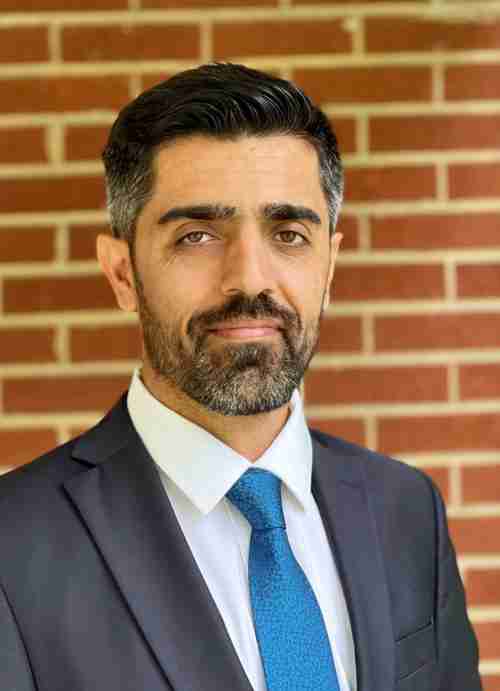
On the latest episode of The New Region's GeoSpace podcast, Mohammed A. Salih hosted Dr. Kamran Bokhari, Senior Director of the New Lines Institute for Strategy and Policy and Senior Fellow at the Middle East Policy Council. The two discussed the prospects for a US-Iran deal following their 39-day war, the logic behind American military engagement despite anti-interventionist rhetoric, and the emerging regional architecture centered on burden-sharing among US allies.
Following the ceasefire that began on April 22, high-level US-Iran negotiations in Islamabad have marked the most significant diplomatic engagement since Iran's 1979 revolution. Bokhari assessed that both sides' imperatives point toward a deal, though implementation challenges remain substantial.
"If you look at what the Americans want, when you look at what the Iranians want, it looks like we're getting there," Bokhari observed, noting that US objectives remain unchanged: no enrichment on Iranian soil, capped missile capabilities, and an end to support for armed militias in the Arab world. For Iran, "their imperative is regime preservation, now more than ever before."
Bokhari explained that Iran's leadership has been eliminated, its military capabilities severely degraded, leaving Tehran desperate for both a permanent end to hostilities and sanctions relief. "They need a pathway to recovery," he stated, emphasizing that regime security has been the Islamic Republic's obsession since 1979, now intensified by its weakest moment.
Addressing why the Trump administration engaged in military action despite "America First" rhetoric, Bokhari detailed a strategic logic rooted in burden-sharing and retrenchment. "The United States is retrenching from the Eurasian landmass," he explained, describing an 80-year global security architecture created to address post-World War II realities that no longer exist.
"For 80 years, the United States has been engaged in spending its resources, its economic and financial resources, using its military resources to maintain order in the world. And that is not sustainable," Bokhari said. The current strategy represents adaptation to a world where the Soviet threat has disappeared for over 30 years and European integration has transformed regional dynamics.
The war itself resulted from Iranian miscalculation. "The Iranians were not budging, because they thought that this president is saying, I don't want forever wars. So, they're not going to come and make war against us," Bokhari explained. Washington conducted the limited 12-Day War in June to signal seriousness, then another round when Iran still refused to negotiate. "Now they've forced their hand onto the negotiating table. The Iranians didn't come to the negotiating table because all of a sudden they changed their mind, they've been compelled."
On who benefits from the conflict, Bokhari identified Turkey as the clear winner. "If I had to identify one actor, I would say it's Turkey. Because Turkey has the wherewithal. Turkey is a player at a different level," he stated. With both Iran and Russia weakened, pathways have opened across Syria, Iraq, and the South Caucasus that were previously blocked.
"Until 2024, for many, many decades since the 80s, Iran was blocking Turkey's path in the Middle East," Bokhari noted. With Iran ejected from Syria following Assad's fall and weakened influence in Iraq, "a pathway opens up for Turkey." However, he cautioned about Turkish limitations: "Does Turkey have the economic engine? And does it have the political stability and continuity at home to continue to push into these various regions?"
Bokhari detailed how burden-sharing operates in practice. Turkey has been given responsibility for Syria, the US wants Saudi Arabia to lead on the Palestinian issue through the Abraham Accords framework, and Pakistan has been brought into the equation through last fall's Strategic Mutual Defense Agreement with Saudi Arabia to help manage the post-Iran, post-direct US engagement regional order.
"Everybody can't do everything. Every partner and ally must be responsible for certain specific things," Bokhari explained, describing a division of labor replacing 80 years of American heavy lifting.
Regarding Hezbollah's disarmament—a key US demand indirectly tied to Iran negotiations—Bokhari emphasized the organic linkages. "What we don't want for you is to have support for armed groups. So, help us disarm Hezbollah," he said, describing how Iran must choose between continuing costly proxy support or preserving Hezbollah as a social and political movement without weapons.
On minority communities' futures, Bokhari expressed cautious optimism. "In the long run, the minorities, particularly the Palestinians and the Kurds, will probably fare better," he said, pointing to Turkey encouraging Syrian Kurdish autonomy and power-sharing similar to the Iraq model, and US opposition to Israeli annexation of the West Bank despite refusing to promise a two-state solution.
Bokhari concluded by addressing whether Russia and China could exploit the situation to weaken US standing. He noted all three adversaries currently need deals with Washington to solve their own problems. "Each one of those actors needs to do a deal with the United States to achieve its imperatives," he observed, describing Russian weakness in Ukraine, Chinese economic struggles, and Iranian desperation for sanctions relief as creating an advantageous moment for American strategy.
 Facebook
 LinkedIn
 Telegram
 X
X