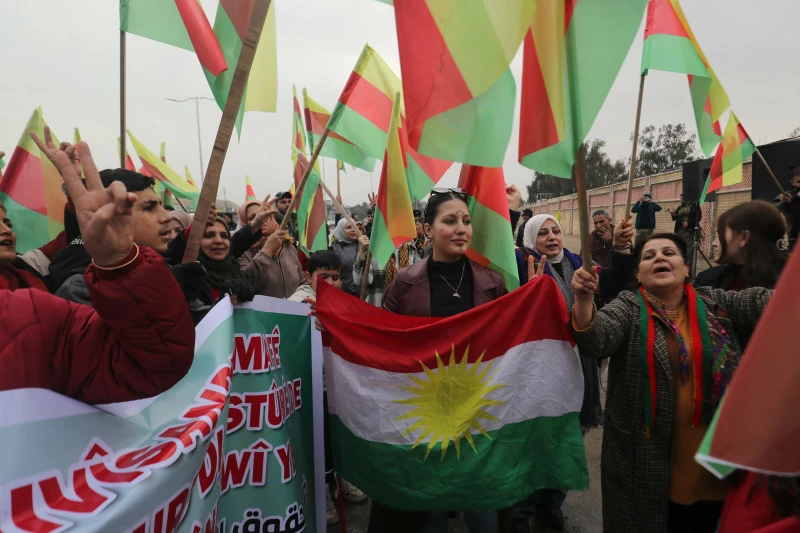
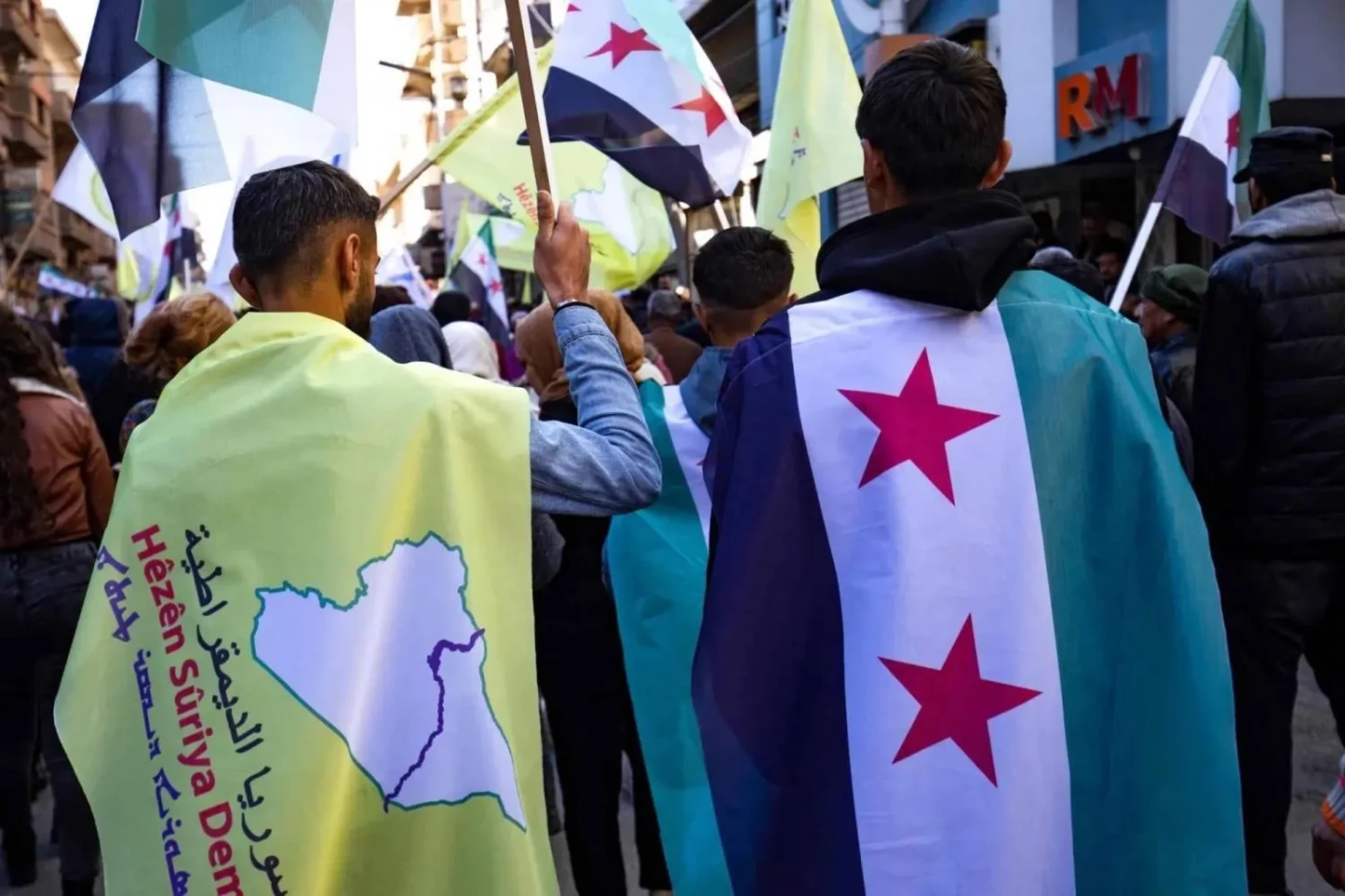
The situation in Syria exploded again last week. Forces affiliated with the Syrian Transitional Government (STG) and rebranded as the “Syrian Arab Army” attacked the Kurdish-majority neighborhoods of Sheikh Maqsoud and Ashrafiyeh on the northern edge of Aleppo on January 6. After around several days of clashes, government forces took control of both areas on January 10. The military outcome was never in doubt. Kurdish fighters were surrounded on all sides, and have had most of their heavy weaponry and experienced units redeployed elsewhere since April. Only several hundred members of internal security forces remained, equipped largely with light and medium arms. They probably decided to fight just to make a political point that even with basic weapons they could fight for days—compare that to how the entire Assad regime backed by Russia and Iran crumbled in 11-12 days.
The battle in Aleppo however, is significant on a number of fronts. It came shortly after Syria and Israel concluded an agreement in Paris under the auspices of the US. Barring secret clauses, the official readout of the deal conveyed a distinctly capitulatory tone on the Syrian side. It made no mention of Israel’s extensive military presence in southern Syria since the fall of the Bashar al-Assad regime in December 2024, nor did it reference the Golan Heights— a territory under Israeli control since 1967 and historically central to Syrian claims, at least rhetorically.
That a regime now ruling Damascus—of Islamist jihadi and Arab nationalist character, both ideologies whose central rallying cry for decades has been the liberation of Palestinian lands from Israel—would sign such an agreement does not reflect positively on its credibility. As reflected in some media commentary and social media discourse, there was little escaping the impression that the government of Ahmed al-Sharaa had effectively relinquished claims of sovereignty over parts of four southern provinces where Israeli forces operate freely, in exchange for an opportunity to retake two Kurdish neighborhoods in Aleppo. Not a good look.
This context is essential to understanding the Aleppo campaign. Launching the operation immediately after the Paris agreement effectively deflected from and overwhelmed the emerging debate about the agreement’s implications. Under normal circumstances, such a deal would have generated major controversy. The deal not only seemed to accept Israel’s de facto control over Syrian territory but also failed to call for a halt to future Israeli operations inside Syria. Instead, it merely invoked vague notions of “communication” and “coordination” with Damascus. Since January 6, Israeli operations inside Syria have continued, with no public indication that any such coordination has occurred.
The agreement also served a more immediate purpose for Damascus and its regional backers, particularly Turkey and certain Gulf states: it was likely designed or accepted to preempt Israeli military intervention during the Aleppo operation. Israel had intervened in July when Druze areas came under attack by Syrian forces, and Damascus was clearly intent on avoiding a repeat. The timing further reflected a calculated reading of regional dynamics. With Israel and the United States intensely focused on the ongoing unrest in Iran and the prospects of regime collapse, Syrian authorities understood that neither actor had the bandwidth or appetite to become deeply involved in a limited operation against an isolated Kurdish pocket in a predominantly Arab city.
More important than context is perhaps the implications of the Aleppo campaign and what may follow—across humanitarian, military, political, and regional dimensions. First and most urgently, there is a real risk of humanitarian abuse in Kurdish areas of Aleppo city and the broader province now under the STG control. The record is troubling. Abuses by STG forces did not begin with the massacres of Alawites in March or Druze in July 2025. They date back to the civil war years, when many factions that now form the core of the rebranded Syrian Arab Army were implicated in systematic violations against Kurds and other communities.
So far, the government has restricted access to Aleppo for independent journalists and human rights organizations. Nonetheless, videos showing abuse and mistreatment have already begun to circulate. Lists are also circulating online by Kurdish activists alleging the disappearance of hundreds of local Kurds, most of them civilians. Preventing further violations is not only a moral obligation but a political necessity for the STG if it seeks any measure of legitimacy and trust with minority communities. Turkey and the United States, as key regional and international backers of the transitional authorities, also bear responsibility for prevent such abuses and ensuring that such behavior does not go without accountability.
Beyond Aleppo, the greater danger lies in the possibility of further military operations—particularly east of the Euphrates, where territory is controlled by the Kurdish-led Syrian Democratic Forces (SDF). Buoyed by a relatively swift victory in Aleppo—a battle the Kurds were bound to lose—and with Israel and the United States laser-focused on Iran, the STG may conclude that similar outcomes are achievable elsewhere. That would be a serious miscalculation. Unlike in Aleppo, the SDF, east of the Euphrates, is a deeply entrenched force numbering in the tens of thousands, well-trained, well-armed, and operating with open logistical lines. With the exception of a few districts west of the river, this is not terrain where Damascus could expect a quick or low-cost victory, if any at all.
Politically, such a move would almost certainly collapse the March 10 agreement between STG President Ahmed al-Sharaa and SDF Commander General Mazloum Abdi. That agreement was widely hailed as a roadmap toward post-Assad stabilization, offering a framework for integrating SDF forces and the roughly one-third of Syria they control into a reconstituted Syrian state. Any significant military action beyond Aleppo would render that framework meaningless. Washington, in particular, has a strong interest in preventing this outcome given its consequences for Syrian stability.
The most dangerous scenario, however, lies beyond Syrian-Kurdish dynamics. Continued STG efforts to push the envelope risk turning Syria into a theater of broader regional confrontation. This is not alarmism but a realistic assessment of regional fault lines. Acting under Ankara and some Gulf states’ strategic umbrella, further STG operations could draw Israel directly into the conflict. Israeli officials have been explicit about their distrust of the current authorities in Damascus, citing their ideological background and close ties to Turkey and certain Gulf actors. Israel views the STG largely as a Turkish client regime and is alarmed by prospects of military cooperation, including permanent Turkish deployments and the transfer of advanced weaponry.
Israel has already committed itself to protecting the Druze. More broadly, it has a strategic interest in a decentralized Syria where minorities such as the Druze and Kurds retain control over their areas and enjoy meaningful representation in Damascus. From Israel’s perspective, such arrangements act as a check on both Damascus and Ankara. These factors make limited but forceful Israeli intervention plausible should Damascus move against the core of SDF-held territory.
Other actors could follow. If the Iranian regime survives the current wave of popular unrest, it might seek to intervene in Syria, in the event of an all-out war between the SDF and STG, through allied armed factions in Iraq bordering the SDF territory. Inside Turkey, renewed large-scale operations against the SDF could derail ongoing talks between Ankara and the Kurdistan Workers’ Party (PKK). None of these trajectories would serve regional stability or regional actors such as Damascus and Ankara. On top that, all this would undermine US efforts to stabilize Syria and contain escalation.
Against this backdrop, the least costly and most sustainable path forward remains political rather than military. A stable Syria remains a core US objective—one shared by the Kurds and other minority communities as well. The US should recognize that such an approach does not go against its objective of a stable Syria open for business put forward by President Donald Trump’s administration. Returning to negotiations and forging a fair settlement that meaningfully protects Kurdish and minority rights, while granting a degree of local self-rule, offers the best chance for stabilizing Syria. This realistic approach has to be embraced by all sides in the interest of Syria and Syrians.
 Facebook
 LinkedIn
 Telegram
 X
X