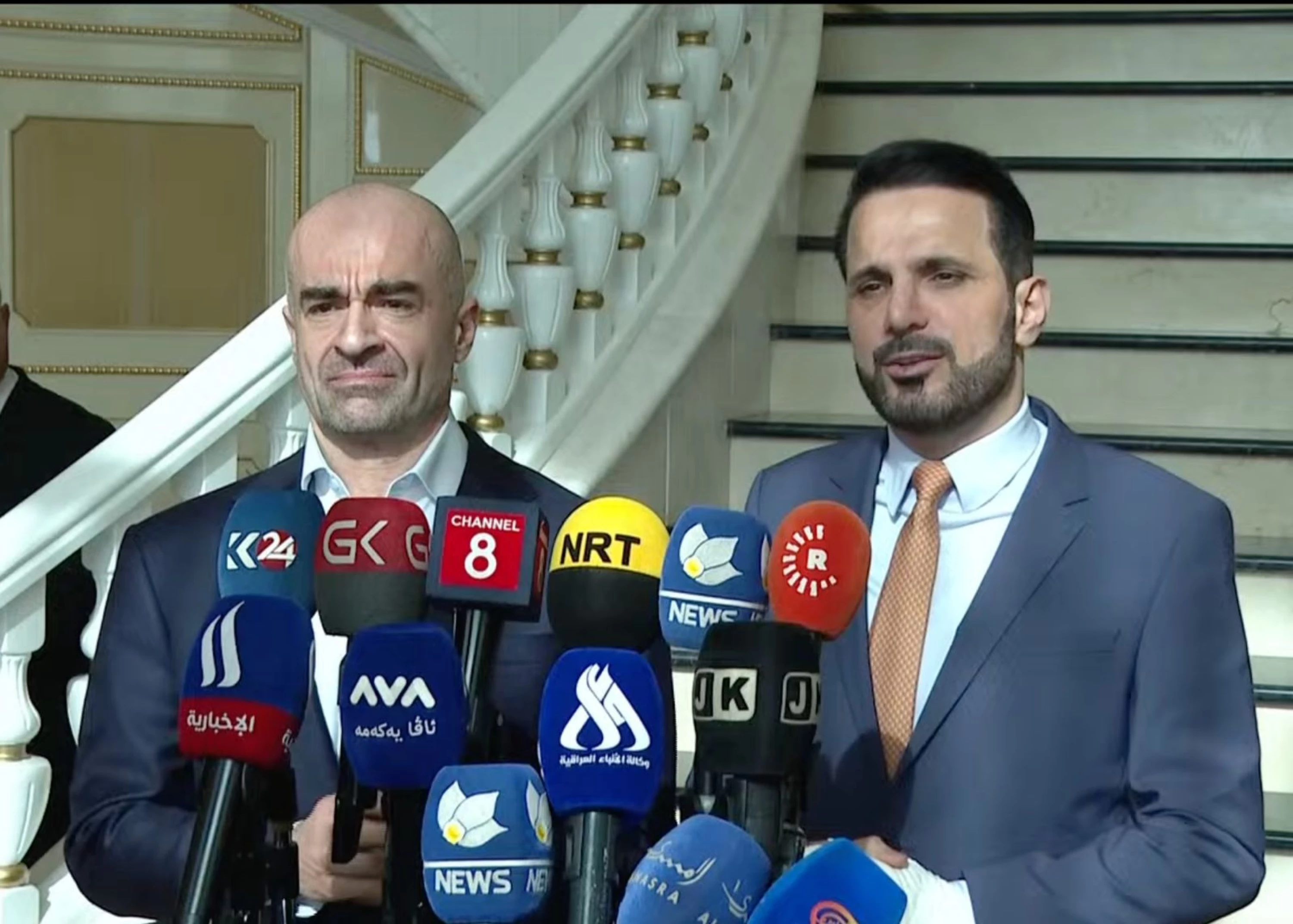
ERBIL, Kurdistan Region of Iraq – The leaders of the Patriotic Union of Kurdistan (PUK) and the New Generation Movement (NGM) on Saturday announced reaching preliminary agreements to form a united front to challenge the ruling Kurdistan Democratic Party (KDP) and aim to form the Region’s next government.
A PUK delegation headed by the party’s leader Bafel Talabani visited NGM leader Shaswar Abdulwahid on Saturday to discuss a potential alliance in the Kurdistan parliament. The PUK and the KDP has been engaged in talks to form the next government for over a year, but the negotiations have yielded no results.
“We have agreed with The New Generation that our visions for serious change in the Kurdistan Region are very similar, and agreed to unite our blocs. We must now hold discussions with all other parties on what kind of government to form, and of course the KDP will be one of those parties,” said Talabani at a presser alongside Abdulwahid following the meeting.
The KDP emerged as the clear victor from the October 2024 Kurdistan parliamentary elections, securing 39 out of 100 seats in the legislature. The PUK, 23, and NGM, 15, have 38 seats combined, meaning that even if their coalition were to proceed, they are still one seat shy of the KDP.
In response to a reporter’s question on whether the parties can form a government without the KDP, Talabani answered: “It is too early to answer that question, but in principle: yes, why not?”
The PUK and NGM have been fierce rivals in Sulaimani for years. The recent development comes days after Abdulwahid was released from prison after serving five months on defamation charges.
“A year ago, we were thinking differently from different aspects, and we had more conviction that the KDP was serious about forming the government and reach agreements,” said the PUK leader.
“If this agreement between us and the PUK enters implementation and we agree on all the terms, the first objective is restoring balance in the Kurdistan Region,” said Abuldwahid, noting that their demands include a Kurdistan Region budget law and transparency in the Region’s oil, border crossing, and domestic revenues.
“We would like to see a change in the Kurdistan Region, to have another prime minister [outside of KDP],” the NGM leader added.
Traditionally, the KDP and the PUK have run the Kurdistan Regional Government (KRG) side by side, despite the KDP consistently outperforming its rival in both regional and federal elections.
The New Region has learned that the KDP has offered the PUK several top posts during their negotiations over the past year, including the parliamentary speakership, but the PUK has continued to make “unreasonable” demands, according to well-informed sources from the KDP.
“Our agreement is not targeting anyone. Our agreement is to advance the Kurdistan Region… We are ready for any serious change,” said Talabani, urging other dissatisfied political forces to join their coalition.
Similarly, Abdulwahid also called on other forces to join their alliance, stating: “Were opposition forces not formed to create changes in the country? Well, now we can have 50+1 [in the parliament] if you join.”
“Whoever does not join this agreement, means they are satisfied with this style of governance,” Talabani stated, noting that although there has been no agreement with KDP after a year of negotiations, he hopes they can reach an understanding with the ruling party.
Both party leaders were clear that their alliance does not rule out a KDP participation in the next KRG cabinet.
The KDP has not issued an official statement on the potential PUK-NGM alliance as of the writing of this article.
The Kurdistan Region’s parliament has only convened once since the elections.
 Facebook
 LinkedIn
 Telegram
 X
X