
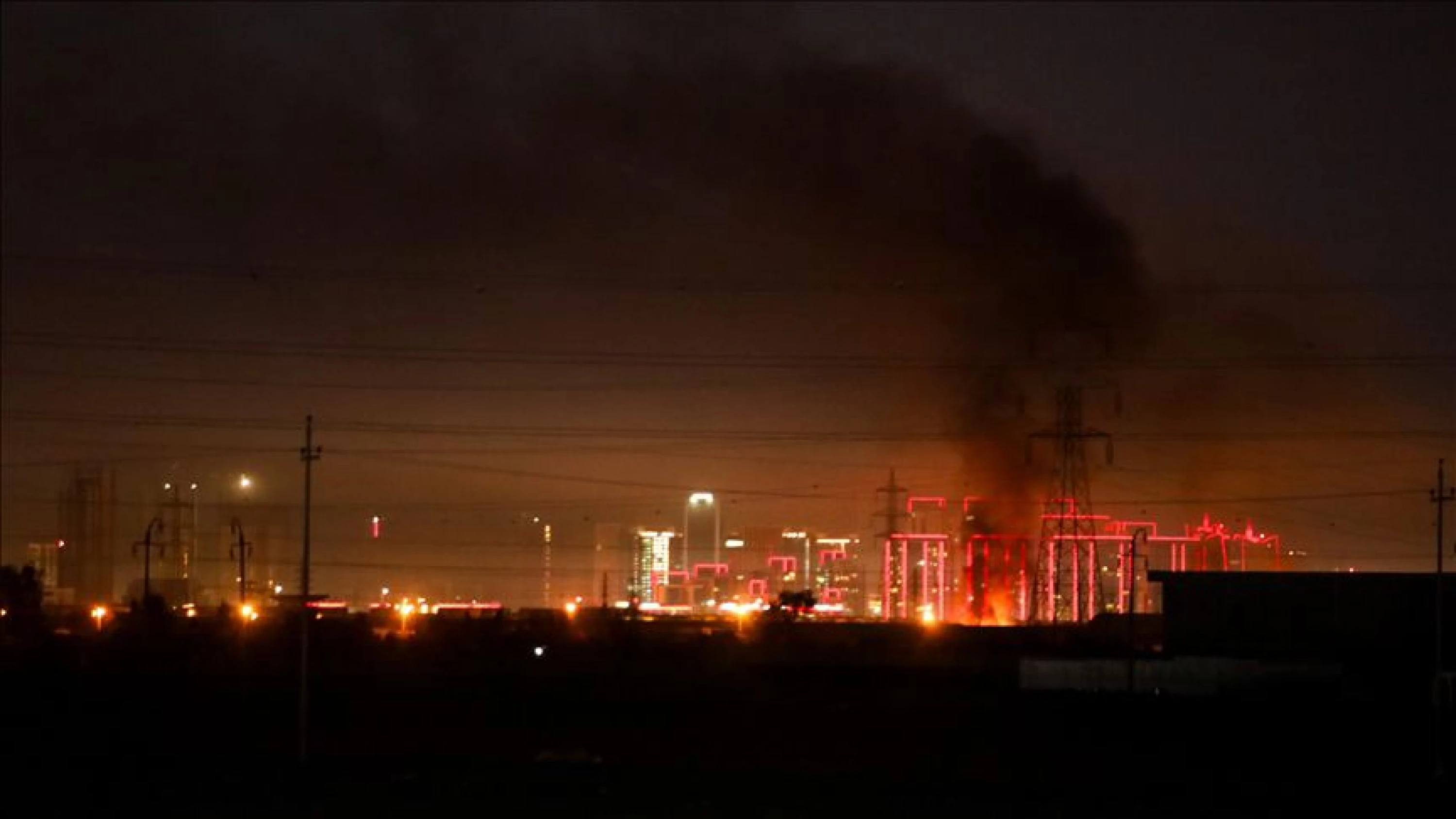
ERBIL, Kurdistan Region of Iraq – A drone was flying toward Erbil International Airport on Monday. Soon after, flames shot up into the sky, and a loud explosion was heard. The Islamic Resistance in Iraq, a network of shadow pro-Iran militia groups, has claimed responsibility for many of these attacks - a sign of their resurgence.
Erbil has been the target of more than 70 missile and drone attacks since the beginning of the US and Israel’s war with Iran, according to Iraqi Foreign Minister Fuad Hussein. As of Monday evening, drones continue hovering over the city, sending many residents into a state of panic and confusion.
It is clear that not all these drones are fired from Iran. On Sunday, the Islamic Resistance in Iraq, a network of pro-Iran Iraqi militias, issued a statement saying they had carried out 23 attacks using dozens of drones against US bases in Iraq and the Kurdistan Region.
The Islamic Resistance in Iraq was very active during the immediate onset of the Israel-Gaza war in October 2023, but has largely remained on the sidelines since November 2024. Back then, they targeted Israeli, Kurdish, and US assets.
Eventually, the network of groups stopped its activities, under pressure from Baghdad not to drag Iraq into regional conflicts.
The pro-Iran militias under the network have particularly attacked American troops in a bid to make them leave Iraq, but Baghdad resolved the matter diplomatically and reached an agreement with Washington in September 2024 to have all US-led coalition troops leave Iraq by 2026.
Phillip Smyth, a researcher focused on Shiite armed groups, told The New Region on Monday that these groups were always active, “they just took breaks on armed activity and still posted material [threats].”
Such groups affiliated with Iran also carried out attacks on the Kurdistan Region’s oil infrastructure last year.
On Monday, Saraya Awliya al-Dam, a member of the Islamic Resistance in Iraq, targeted the US military’s Camp Victory base at Baghdad International Airport “with a squadron of drones.” In a statement, the group said the attack was in retaliation for the killing of Ayatollah Ali Khamenei, Iran’s Supreme Leader.
Groups affiliated with the Islamic Resistance in Iraq have also launched protests around Baghdad’s heavily-fortified Green Zone, where the US embassy is located, in several attempts to storm the compound.
Victoria Taylor, former US Deputy Assistant Secretary of State for Iraq and Iran and Director of the Iraq Initiative in the Atlantic Council’s Middle East program, told The New Region that “With US forces departing federal Iraq and moving to Kurdistan, the most obvious US military target in Iraq is Erbil Air Base,” near the city’s airport.
According to Smyth, the network is a front organization for more powerful pro-Iran militias such as Kataib Hezbollah, and is not a real group.
“It is staffed by Kataib Hezbollah people. The so-called ‘Islamic Resistance in Iraq’ is a front group that acts as an umbrella for other front groups that are controlled by Kataib Hezbollah, Kataib Sayyid al-Shuhada, Harakat Hezbollah al-Nujaba, Harakat Ansar Allah al-Awfiya, and other smaller Kataib Hezbollah-linked groups,” he said.
Nicolas Heras, Senior Director for the Strategy and Programs Unit in the Academic Division at the New Lines Institute, stressed that the Popular Mobilization Forces (PMF) “functions best for Iran when they are used against targets inside Iraq.”
Iranian Kurdish opposition groups based in the Kurdistan Region have also been the target of attacks, as well as the US military base near Erbil International Airport, the US Consulate General, and the Harir airbase in northeastern Erbil.
“Erbil is one of the most important forward operating bases for the US to collect intelligence and would also be an important staging point for clandestine activities targeting Iran. PMF groups can launch attacks at Erbil to disrupt U.S. activities with short notice for the Americans,” Heras added.
Most of the US-led coalition forces last year moved from Baghdad to Erbil. Earlier this year, the last group left Ain al-Asad airbase in Iraq’s western Anbar province, as part of the strategic agreement with Baghdad to remove coalition forces.
This was also one of the main demands of the Iran-backed groups. The coalition forces in Erbil are set to leave by September.
A source from the US-led coalition told The New Region that they were expecting Iran-backed groups to carry out attacks on Erbil airport when the war broke out. Most of the military’s non-essential personnel were moved out of the military base near the airport before the conflict’s onset for security reasons.
There have also been strikes on pro-Iran armed groups in Jurf al-Nasr and the border town of al-Qaim in the west, two PMF strongholds, which have killed at least eight pro-Iran fighters. It is unclear if these strikes were carried out by the US, Israel, or both.
“The significant US and Israeli strikes on Iran, which killed the supreme leader, and US strikes in Iraq against militia targets in Jurf al-Sakhar [former name of Jurf al-Nasr] and al-Qaim made it almost impossible for the most ideologically committed of the militias to sit this out,” Taylor said.
However, many Iraqi militias will choose to protect their political and economic interests and not act militarily against the US, according to Taylor.
“The most extreme groups, such as Kataib Hezbollah and Harakat al-Nujaba, are the most aligned with Iran and the most responsive to Iranian direction. Thus far, Iran’s strategy appears to be expansive escalation throughout the region, and the Iraqi militias can certainly play a role in this,” she said.
Alex Almeida, a lead security analyst at political risk consultancy Horizon Engage, said that the pro-Iran groups have decided to join the Iranian campaign since the Islamic republic feels under threat.
“We’re in a different scenario now. Iran really has its back to the wall this time, so it makes sense that their Iraq-based proxy networks would be instructed to go harder than they did during the June war. The Iranians need to show that they can do damage and reestablish some form of deterrence, or their credibility will be completely gone,” Almeida explained.
Iraqi Prime Minister Mohammed Shia’ al-Sudani on Monday tasked the country's security forces “to confront and counter any actions” that could drag Iraq into a regional conflict, as Iran continues to exchange fire with the US and Israel.
However, Kurdish officials in the past have complained that Baghdad has failed to prevent such attacks, such as during the strikes on the Kurdistan Region’s oil and gas infrastructure, including the key Khor Mor gas field in Sulaimani province.
Experts also think it is unlikely that Baghdad would stop these attacks.
“It would require them to crack down on some truly large and influential groups, smaller networks, and overlapping interests between the Iraqi state--which includes many Iranian proxy groups, Iran, and the militias,” Smyth said.
“They were instructed to shut down the attacks by Iran, and even then, it was a little ragged - we still got a couple of attacks several weeks after the ceasefire. This time, there are no instructions coming from Iran to stop the attacks - signaling it is exactly the opposite. Keep maybe hitting and probably even escalate,” Almeida also added.
It is likely that attacks by the Islamic Resistance in Iraq and other pro-Iran groups will continue until a potential deal is reached between Washington and Tehran, or if the Islamic republic collapses and regime change takes place.
 Facebook
 LinkedIn
 Telegram
 X
X