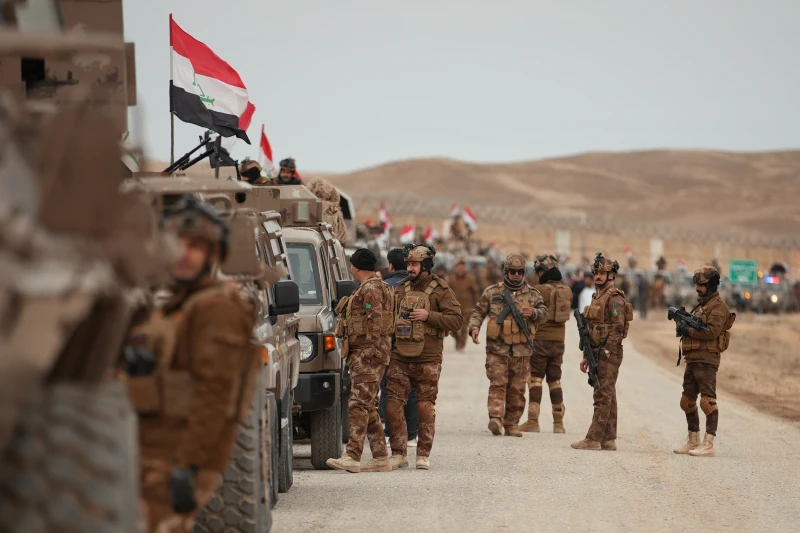
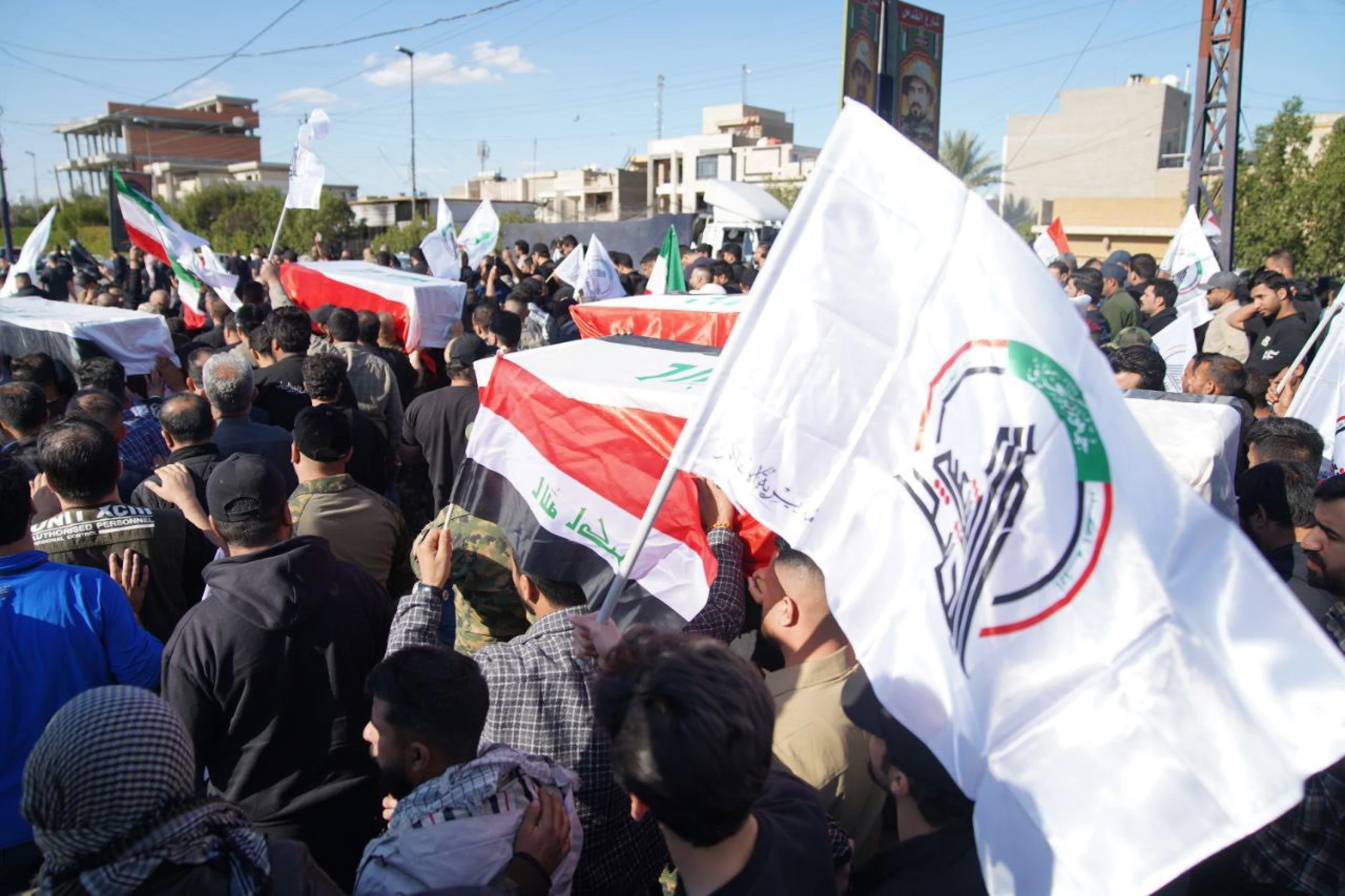
ERBIL, Kurdistan Region of Iraq - Iraq’s Popular Mobilization Forces (PMF) on Thursday said that their forces have had no role in targeting US bases inside Iraq or elsewhere, expressing their “categorical rejection and strong condemnation” of the American attacks which have killed over two dozen PMF fighters.
Iran-backed Iraqi factions have claimed responsibility for dozens of attacks on US diplomatic missions and military bases in Iraq and the Kurdistan Region since the Iran war began in late February.
The US has responded to the attacks by targeting the Iran-aligned groups, which includes many factions that are incorporated into the Iraqi state security apparatus as part of the PMF.
The PMF on Thursday said they have been targeted by airstrikes at least 32 since the war began, leading to the death of 27 fighters and the injury of at least 50 others.
“This statement is not coming from the militias that are actively conducting the attacks, but it does represent the position of the larger Iraqi leadership, who are walking a fine line between the US and Iran,” David Witty, a retired US Army Special Forces Colonel and Foreign Area Officer, told The New Region.
“They have labeled militia attacks on diplomatic installations, civilian infrastructure, and US interests as terrorist acts, while at the same time calling the US response of targeting militias headquarters as violations of international law and Iraqi sovereignty. In short, they are playing a balancing act and hedging their bets between both sides.”
The PMF was formed by Shiite paramilitary groups in 2014 following a call from Shiite Grand Ayatollah Ali al-Sistani to mobilize against the Islamic State (ISIS), after the militant group occupied one-third of Iraqi territory. In 2016, the PMF was granted official status by the Iraqi government.
Although ISIS was defeated in Iraq in 2017, the PMF continued to operate in Iraq, including in Sunni majority areas, such as Anbar and Mosul. Some of the more hardline factions in the PMF have become increasingly involved in the recent war, while others have stayed on the sidelines.
ALSO RELATED: Iran-aligned Iraqi ‘Islamic Resistance’ groups resurface from the shadows
The PMF mostly stayed out of the 12-Day War between Israel and Iran in June 2025, but things have changed during the current war.
“Iran-aligned PMF groups are stuck between a rock and a hard place: they are compelled to back their Iranian patrons but they have to be aware of the sensitivities of their institutional leaders in Baghdad,” Nicholas Heras, the Executive Director at the Washington-based Middle East Policy Council, said.
“Yet, the Iran-aligned groups in the PMF will fight the US and its partners in Iraq if called upon to do so by the IRGC [Islamic Revolutionary Guard Corps]. The situation is volatile and trending toward outright war between the Iran-aligned PMF and the United States in Iraq.”
The increase in US or Israeli airstrikes on the PMF has angered officials in Baghdad, who have condemned the strikes.
Sabah al-Numan, spokesperson for Iraq’s Commander-in-Chief of the Armed Forces, Prime Minister Mohammed Shia’ al-Sudani, on Thursday said that the targeting of PMF sites and headquarters, is “not merely a military violation,” rather “it represents a desperate attempt to create confusion, undermine societal stability, and weaken the security achievements secured through the blood of Iraqis and the sacrifices of our martyrs.”
“We affirm that the blood of our service members is a solemn responsibility upon our shoulders, and we will not allow Iraq to become a battleground for settling scores or a stage for violating national dignity,” Numan added.
The Kurdistan Region has been targeted by hundreds of drones, missiles, and rockets since the start of war, including nearly 50 attacks since Wednesday.
Coalition bases in Iraq and the Kurdistan Region have faced repeated attacks since late February. A base housing both Kurdish and French forces in Makhmour, southwest of Erbil, was targeted late Thursday night, leading to the death of Arnaud Frion, a French soldier, and the injury of several others.
Italian Defense Minister Guido Crosetto on Thursday said that the Italian military will temporarily be withdrawing from a military base in Erbil amid ongoing regional conflict, though noting that the process was underway before the base in question was struck by a missile the night prior.
“In my previous experience in Operation Inherent Resolve, the Popular Mobilization Forces… did attack US forces with drones, rockets, and artillery. It is logical to believe that the Iranian-backed PMF are still attacking US Forces in Iraq,” Wayne Marotto, a retired soldier and former spokesperson for the US-led global coalition against ISIS, told The New Region.
Victoria Taylor, former US Deputy Assistant Secretary of State for Iraq and Iran and Director of the Iraq Initiative in the Atlantic Council’s Middle East program, told The New Region that the double-hatting of the militias as part of the PMF allows the PMF to claim that its forces are not part of any strikes on US targets.
“But when the US strikes the very militias who have been targeting the United States the PMF is then ready to condemn the US for killing its soldiers. The militias may, at times, use new names or facades to create some distance when they claim responsibility for these attacks, but ultimately its Kataib Hezballah, Harakat al-Nujaba, and Kataib Sayyid al-Shuhada who continue to be the groups largely responsible for kinetic activity and all of which have units falling under the PMF umbrella.”
Kurdistan Regional Government (KRG) officials have expressed frustration over Baghdad’s failure to stop the attacks on the Kurdistan Region, many of which are carried out by groups on the federal government’s payroll as part of the PMF.
A senior KRG official told The New Region that the Kurdistan Region has “been hit by hundreds of missiles, drones and rockets, often by Iran’s proxies on the Iraqi government payroll.”
“We’re very disappointed by Prime Minister Sudani’s silence in the face of ongoing attacks against us. We get it – Iran’s proxies are part of his cabinet, but he has mishandled both this crisis and the country’s economy. He is not a credible partner. He needs to earn Kurdish support, but so far has given us zero evidence of effort. In fact, it’s been the opposite; he’s doubled down on efforts to strip away our autonomy.”
In a post on X on Thursday, Ano Jawhar Abdoka, KRG’s Minister of Transportation and Communications, wrote: “Iraq is bombed from inside Iraq, with Iraqi weapons, purchased by Iraqi money, by Iraqi military groups, targeting Iraqi cities and Iraqi citizens. Then everyone goes on television to speak about Iraqi sovereignty.”
Phillip Smyth, a researcher focused on Shiite armed groups, also told The New Region that the claims by the PMF are untrue and that the groups that have carried out attacks on the US and neighboring countries are part of the PMF.
“The groups primarily engaged in this effort--and they have not hidden it--are active members of al-Hashd al-Sha'abi [PMF]. One of them, Kataib Hizballah, has 3 brigades within al-Hashd al-Sha'abi's structure. Abu Fadak, the Hashd's ostensible #2 leader is a Kataib Hezballah commander.”
“Harakat al-Nujaba and Kataib Sayyid al-Shuhada, two groups that are also involved have their own respective brigades within al-Hashd as well.”
Matin Parishan, a Kurdish fighter of the Organization of Iranian Kurdistan Struggle (Khabat), which has lost at least two members in the attacks, blamed the PMF for the attacks.
At Khabat’s base outside of Erbil, he showed the remains of two drones that targeted their party. Khabat officials told The New Region that the attack was carried out by Kataib Hezballah, with the drones originating from Mosul.
“Indeed, it is Hashd that is attacking... Just around here a 2-ton truck was found - a white KIA truck - on which a rocket launcher was installed,” Parishan said. “I am not sure if there were attacks from Iran; there could be, but we know for sure that Hashd are attacking.”
The longer the US-Israeli war with Iran continues, the more likely that the PMF will become increasingly involved, targeting US bases and the Kurdistan Region, which in return will invite more airstrikes on the PMF, making it even more difficult for Baghdad to maintain a balance in its relations with both Iran and the United States.
“[The PMF] are doing so to destabilize Kurdistan Region and Iraq, and to create chaos, and hence the indiscriminate attacks against the cities. They and Iran are doing this because that's what they do, they want to create problems not only for us but for the world,” Parishan concluded.
 Facebook
 LinkedIn
 Telegram
 X
X