ERBIL, Kurdistan Region of Iraq - As pressure mounts on Iraq’s ruling Shiite Coordination Framework to name a new prime minister for the country, the current premier is keen to push his chief of staff into the spotlight, a militia-friendly figure in disguise who has facilitated Iran’s bidding for none other than the US-designated Asaib Ahl al-Haq (AAH), sources told The New Region.
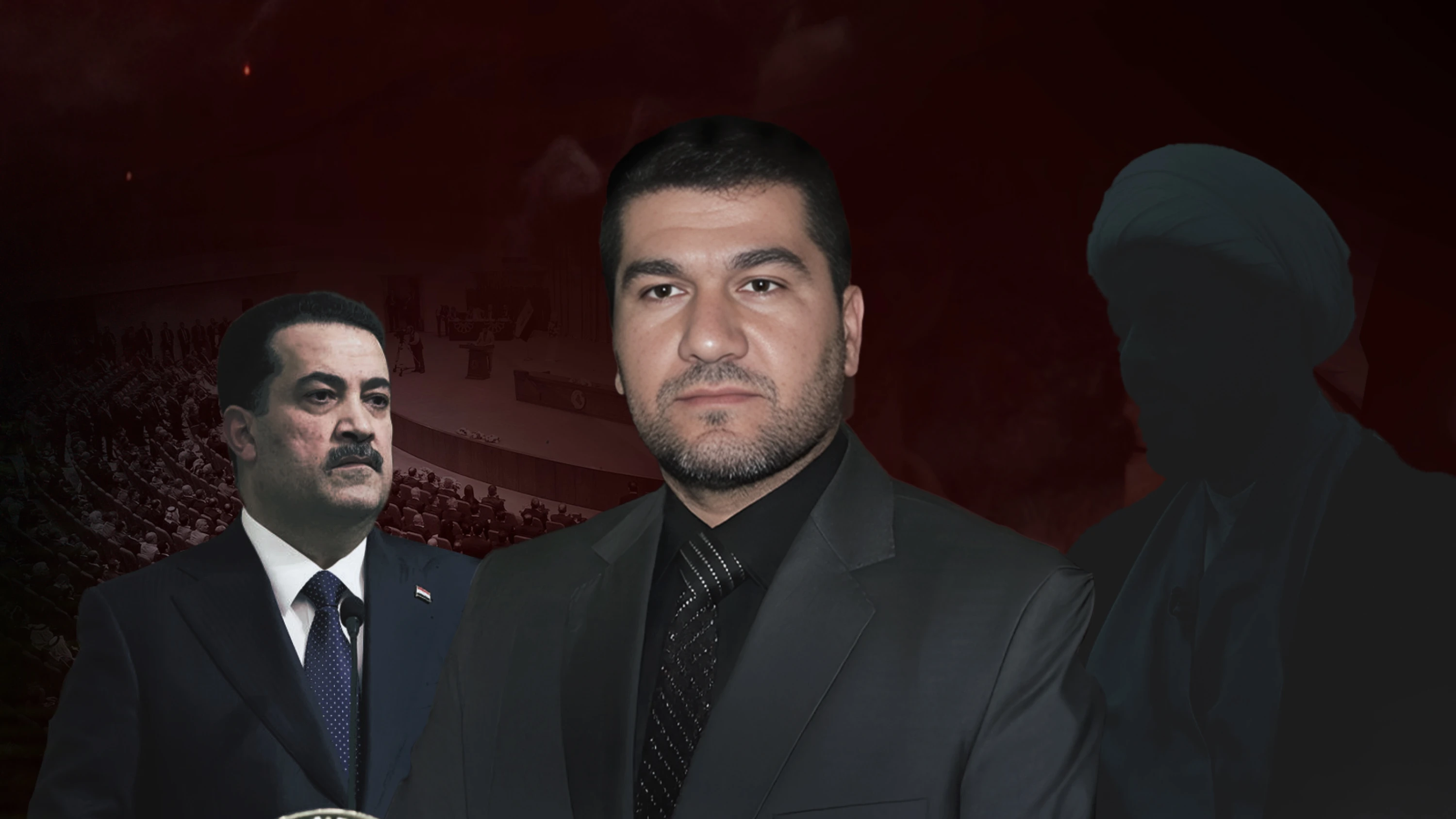
Ihsan al-Awadi is the Chief of Staff to incumbent Iraqi Prime Minister Mohammed Shia’ al-Sudani and a former Iraqi ambassador backed by former Prime Minister Haider al-Abadi. A man who has shifted allegiance a number of times, from his tenure as a parliament member to becoming chief of staff of the premier and now potentially the man to take the torch from Sudani.
Sudani, whose own election for prime minister was strongly backed by AAH kingpin Qais al-Khazali, is now unable to run again for a second term. Partly due to a concession he had to make to former Prime Minister Nouri al-Maliki, but also due to his inability to rein in Iran’s proxy militias, many of which are on the Iraqi state’s payroll.
Maliki, who until January was thought to be premier again, was directly vetoed by US President Donald Trump. In turn, exploiting his role in the Shiite alliance, he had demanded that no other person who had held the office be allowed to go at it again; this was a veto by Maliki on both Sudani and Abadi.
Following Trump’s post about Maliki, Sudani had raised his support base within the Coordination Framework in hopes of a second term. But Sudani is not only not supported by Maliki, but he has also lost credibility with the US camp. During his term, attacks on US interests by the militias were not stopped, and to top that, his tenure was marred further with the militia abductions of Russian/Israeli researcher Elizabeth Tsurkov and, recently, American journalist Shelly Kittleson.
Though Sudani did concede to Maliki within the Framework, he does not seem to want a Maliki-appointed candidate like Bassem al-Badri to take the post, which is why he has now gathered with him Khazali, Ammar al-Hakim, and Hadi al-Amri of the Badr Organization, all of whom would potentially help his chief of staff Awadi gain the nomination despite Maliki’s clear rejection of him.
To secure this, Sudani has promised his allies quite some.
One well-informed Iraqi source told The New Region on Wednesday that Sudani has gone as far as offering a deputy premiership role, along with the premier’s chief of staff and the head of the federal police, to Khazali, in return for him once again playing kingmaker, as well as securing a spot for his brother Laith al-Khazali as Awadi's deputy.
In addition to Khazali, Amiri and Hakim have all been offered ministries, the source told The New Region.
“This makes Awadi's proposed government a blatantly pro-militia government, fitting with Awadi's record of supporting the smuggling of Iranian oil and facilitation of activities of militia and IRGC operations,” the Iraqi source added.
Awadi’s record
Awadi, unlike how Sudani makes him seem, is believed by many to not be so much of a compromise candidate, but rather an extension of Sudani’s tenure that saw Iranian and militia control surge.
“Sudani has cleverly positioned Bassem al-Badri as Iran’s pick for Iraq as a cover against his own chief of staff who has systematically empowered Iran inside Iraq under this cabinet,” one senior Kurdish official told The New Region on Tuesday.
The Kurds, who have over the years suffered most at the hands of Iran-aligned militias, with the Kurdistan Region’s energy and civilian infrastructure attacked hundreds of times, are concerned about a potential Iraqi government led by Awadi, whom they believe would deepen the Kurdish grievances and systematically deprive the Region of its constitutional rights.
“Ihsan Awadi has been facilitating the Iran-Iraq oil blending in Basra, the oil/fuel subsidies to Asaib,” the Kurdish official said.
To evade US sanctions, Iran has for years made use of its proxies, including AAH, to disguise Iranian oil as Iraqi oil before sending it off to the markets, in turn gaining the country illegal cash.
The US Treasury has on several occasions sanctioned entities for said practice.
In September, the Treasury sanctioned a network of shipping companies and vessels led by Iraqi-Kittitian businessman Waleed al-Samarra’i.
“This network operates primarily by covertly blending Iranian oil with Iraqi oil, which is then marketed intentionally as solely of Iraqi origin to avoid sanctions,” the Treasury said at the time.
The Kurdish official said that Awadi “is well known to be affiliated with Asaib, and is part of an effort to make sure that Iran’s oil blending and subsidies to Asaib continue.”
The US Treasury on April 17 designated seven Iraqi militia commanders, amongst them Safaa Adnan Jabbar Suwaed, described by the Treasury as “a senior AAH official and military commander, as well as a chief of operations in Salah ad-Din Province, Iraq.”
The Treasury further added that AAH “claimed responsibility for thousands of attacks against US and Coalition Forces. AAH has been extensively funded and trained by Iran since its founding in 2006,” specifically referencing that the group had utilized Iranian drones in order to attack US and Coalition forces in the Kurdistan Region as of March 2026.
The Kurdish official said that they had previously voiced their concerns about a possible nomination of Awadi by the Coordination Framework, a move that they claim would only continue on the path of Sudani’s alienation of the Kurdistan Region.
“We have conveyed this to US officials. Awadi will be worse than Sudani for the Kurdistan Regional Government (KRG) - and he will continue to economically strangle the KRG, as did Sudani,” the official said, adding that such a nomination would also lead to an increase in AAH’s power.
“He cannot go up against Asaib or the militias,” the official said. “He is part of their network and has facilitated all their operations with Iranian blessing.”
But the Kurds are not alone in thinking an Iraqi government led by Awadi would not be good news.
“Washington has signaled no second term for Mohamed Shia' al-Sudani due to his inability or unwillingness to protect US persons from Iraqi terrorist groups,” Michael Knights, head of research for Horizon Engage, a strategic advisory firm, and adjunct fellow at the Washington Institute for Near East Policy, told The New Region on Wednesday.
“So appointing Sudani's chief of staff, Al-Awadi, makes no sense. It is just reappointing Sudani by proxy.”
However, it is not just that Awadi would be an extension of Sudani, but according to Knights, Awadi himself “has been closely involved in facilitating all the same problematic terrorist fund-raising initiatives that the Sudani government has undertaken, particularly sending billions of dollars worth of oil to such terrorists and helping terrorists to gain huge grants of Iraqi government land and salaries.”
And while Sudani is trying to sell Awadi as a more suitable character in the eyes of the US, the rise of Awadi’s name in the conversation came at a tricky time.
“It is notable that Awadi was identified by Sudani and US-designated terrorist Qais al-Khazali immediately after Islamic Revolutionary Guard Corps Quds Force commander Esmail Qaani visited Baghdad,” Knights said.
“Qaani, Sudani, and Khazali seem to view Ihsan Al-Awadi as their last chance to avoid losing control of the premiership to less ideological candidates like Hamid al-Shatri, Bassim Al-Badri, and Ihsan Abdal-Jabr Ismail,” he added.
Following his visit to Baghdad, Qaani, in a statement on Monday, said that “forming a government is the right of the Iraqi people,” ironically adding that Iraq is “far too great” to allow outside interference in its internal affairs.
The New Region reached out to the US State Department for comment on the US view on a potential Iraqi government formed by Awadi, but has yet to receive a response at the time of publication.
The Coordination Framework is set to convene a meeting again on Wednesday night in hopes of finalizing who will form the next government.
A Monday meeting of the prominent Shiite bloc’s leaders did not see it settle on a final candidate for the post. The meeting came after an earlier session was already postponed amid disagreements inside the alliance.
However, with just hours left for the meeting, unless Sudani bypasses Maliki, a mutual Shiite candidate seems an unlikely prospect.
Wael al-Rukabi, a member of Maliki’s State of Law Coalition, on Wednesday said that the meeting is not expected to settle the bloc’s prime minister candidate.
“The disagreements are still centered around the mechanism for resolution and the principle of the compromise candidate, indicating that the failure to reach a unified formula has led to the suspension of negotiations,” he told Iraq’s state-run al-Sabah newspaper.
It is likely that the constitutional 15-day period expires before the Framework decides its candidate for the post, Rikabi added.
 Facebook
 LinkedIn
 Telegram
 X
X