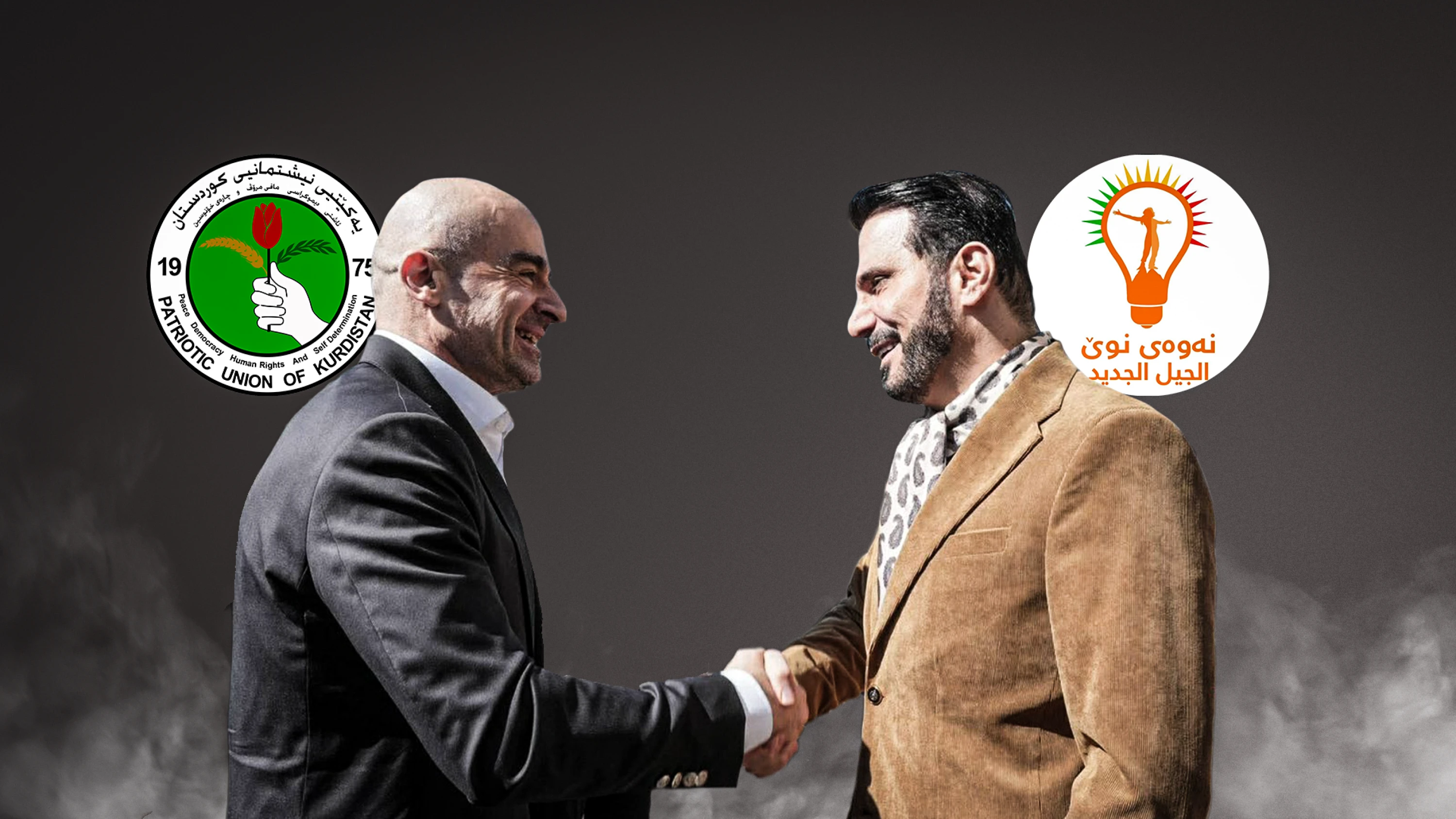
ERBIL, Kurdistan Region of Iraq - A power-sharing agreement between the New Generation Movement (NGM) opposition party and the ruling Patriotic Union of Kurdistan (PUK) has triggered a wave of controversy, with critics questioning whether legal and political pressure on NGM leader Shaswar Abdulwahid influenced the move.
The agreement has been negotiated between the two sides since January, and the NGM’s Political Council formally signed it earlier in May. The timing and circumstances of the agreement have generated significant controversy, with critics questioning whether legal and political pressure on NGM leader Shaswar Abdulwahid influenced the party’s decision to cooperate with the PUK after years of being a public opposition movement.
The agreement represents a significant shift in NGM’s policy, having previously positioned itself as a more democratic alternative to the Kurdistan Region’s two dominant parties, the PUK and the Kurdistan Democratic Party (KDP), and consistently pledged not to join either in government.
Many observers and opposition figures contend that the party now risks losing the political credibility that contributed to its initial rise.
The Kurdistan Region’s October 2024 parliamentary elections produced a fragmented legislature. The KDP won 39 seats in the 100-member parliament, while the PUK secured 23, and the NGM won 15.
The Kurdistan Islamic Union (KIU) secured four seats, while the National Stance Movement (Halwest) won two, with the remaining seats going to smaller parties, while five spots were reserved for minority quotas, including Christian and Turkmen representatives.
With no party holding an outright majority, negotiations over cabinet formation have dragged on for more than eighteen months amid disputes over governance mechanisms, parliamentary leadership, and the distribution of key positions.
The Kurdistan Justice Group (KJG), an opposition party in the Kurdistan Region, has won three seats, but it has announced that it will boycott the parliament’s sessions, alleging it was pre-designed.
Omar Gulpi, a lawmaker from KJG, told The New Region that the agreement between PUK and NGM had damaged public confidence in opposition politics.
“The issue lies in the previous political discourse of the NGM,” he said in an interview over the phone. “Their message to voters was always that they would never join forces with ruling parties under any circumstances. When a party completely changes its position, voters naturally feel deceived.”
Gulpi argued that the agreement had reinforced broader public distrust towards opposition parties.
“The deal appears suspicious,” he added. “Abdulwahid was in prison facing numerous legal cases, and immediately after his release he entered into a partnership agreement as though nothing had happened.”
The New Region contacted NGM spokesperson Himdad Shaheen and PUK spokesperson Karwan Gaznayi, but neither was available for comment.
A complete reversal of policy
NGM officials have publicly defended the agreement in recent media appearances, asserting that opposition parties must seek power to reform governance from within institutions rather than remain permanently outside government.
Party representatives argue that years of protest politics and parliamentary opposition did not yield meaningful structural reform, whereas participation in government may enable NGM to address corruption, unemployment, and restrictions on civil liberties more effectively.
The prolonged paralysis has deepened public frustration at a time of ongoing economic difficulties, salary disputes, and tensions between Erbil and Baghdad over oil exports and budget transfers.
Under the agreement, the two parties are expected to coordinate their parliamentary blocs, and the NGM is anticipated to receive ministerial portfolios in the next Kurdistan Regional Government (KRG) cabinet.
The agreement’s implications have also extended to Baghdad. Srwa Abdulwahid, sister of Shaswar Abdulwahid and head of the NGM’s bloc at the Iraqi parliament, was recently appointed Iraq’s environment minister in the cabinet of Prime Minister Ali al-Zaidi. This ministry fell under the PUK’s quota in the government of former Prime Minister Mohammed Shia’ al-Sudani.
Shaswar Abdulwahid first rose to prominence during the Kurdistan Region’s 2017 independence referendum, when he openly opposed the vote and criticized the Kurdish leadership, alleging it was “ill-timed”.
He later founded the New Generation Movement in Sulaimani, positioning it as a reformist force capable of challenging the entrenched political dominance of the KDP and PUK.
The movement quickly attracted younger voters who were frustrated by alleged corruption, high unemployment, and economic stagnation, as the federal government in Baghdad pursued retaliatory measures against the Kurdistan Region after most voters there supported the Region’s independence from Iraq.
The party won eight seats in the Kurdistan Region’s 2018 parliamentary elections and later secured four seats in Iraq’s 2021 parliamentary elections.
Throughout that period, NGM consistently maintained that it would never join the ruling parties in government formation, pursuing a populist policy in the Kurdistan Region and in Baghdad, positioning itself as working to preserve the rights of the people.
This agreement and the party’s 180-degree reversal of its previous populist campaigning have become a focal point of criticism from both political rivals and some NGM supporters.
Abdulwahid has also faced a series of legal and financial disputes over the years, including judicial charges of unpaid business obligations related to the Chavy Land amusement park in Sulaimani and electricity debts owed to the KRG.
In 2019, Shadi Nawzad, a former NGM MP, accused the opposition leader of secretly recording personal videos of her and threatening to leak them.
Critics allege that several legal complaints against Abdulwahid had previously been contained through political mediation by senior PUK figures seeking concessions behind closed doors.
Tensions escalated further after Abdulwahid travelled to Turkey to discuss possible arrangements for government formation with the KDP. Soon afterwards, dormant legal cases against him resurfaced.
He was later arrested and, in August 2025, a court in Sulaimani sentenced him to six months in prison on charges of criminal threat/intimidation against the former lawmaker, as per Article 431 of Iraq’s Penal Code.
Opposition figures claim that Abdulwahid ultimately accepted the agreement with the PUK under increasing pressure while spending his jail term, amid concerns about further prosecutions, financial seizures of his real estate properties, and threats to shut down his NRT television network.
Concerns regarding political pluralism
Shaduman Mala Hassan, a senior official in the People’s Front Party, said the NGM agreement had been reached under direct pressure.
“It is definitely true that NGM signed the agreement with the PUK under threats while the party leader was in prison,” he told The New Region. “His release was conditional upon joining the agreement.”
The controversy surrounding the agreement has intensified concerns among opposition figures and activists that political pluralism in Sulaimani is increasingly constrained by judicial and security pressures.
These concerns intensified following a major security operation in August 2025 targeting the People’s Front party, led by imprisoned Kurdish politician Lahur Sheikh Jangi.
PUK forces raided facilities associated with Jangi near the Lalezar Hotel in Sulaimani, accusing his supporters of forming an illegal militia and threatening regional security. Clashes involving tanks and drones resulted in several fatalities and hundreds of detentions from Jangi’s supporters.
Jangi, a former co-president of the PUK and cousin of current PUK leader Bafel Talabani, split from the party after being accused of plotting to assassinate Talabani, destabilizing security and establishing an unlicensed militia — allegations later dismissed by the courts.
He remains imprisoned pending trial on separate security-related charges, including accusations of plotting to assassinate Talabani.
During a recent court hearing, a former bodyguard linked to Jangi said that he had been subjected to severe torture while detained by security forces in Sulaimani.
Mala Hassan said the People’s Front occupies what he described as a distinct political position, arguing that it should not be viewed strictly as either a ruling or opposition force.
He noted that Lahur Sheikh Jangi had been elected to the Kurdistan parliament, but did not attend the legislature’s inaugural session to formally take the oath of office. Since parliament failed to convene again afterwards, Mala Hassan argued, Jangi had not formally acquired parliamentary immunity at the time of his arrest.
Concerns regarding a potential constitutional crisis
Mohammed Dushiwani, a former PUK MP in the Iraqi parliament, defended his party’s deal with NGM and warned that the Kurdistan Region’s political paralysis could not continue indefinitely.
Speaking to The New Region, he said Kurdish parties now face two options: reactivate parliament and proceed with government formation, or dissolve the legislature and move towards snap elections.
Dushiwani warned that prolonged dysfunction could eventually trigger legal challenges before Iraq’s Federal Supreme Court concerning the status and legitimacy of the Kurdistan parliament.
He warned that if the crisis escalates, Iraq’s top court could seek broader authority over the Kurdistan Region and revoke its constitutional position as a Region within Iraq’s federal system.
Meanwhile, the KIU has sought to position itself as a mediator to ease tensions between the KDP and the PUK.
KIU leader Salahaddin Bahaddin recently met with Kurdistan Region Prime Minister Masrour Barzani and Bafel Talabani to present an initiative aimed at ending the political stalemate. Both parties are expected to announce their formal positions on the initiative, which proposes resuming parliament sessions and forming a broad coalition government with the participation of key opposition parties, after next week’s Eid al-Adha holidays.
Gulpi last year filed a complaint before Iraq’s Federal Supreme Court seeking the annulment of the 2024 Kurdistan parliamentary election results, though the case was ultimately rejected.
Asked whether opposition parties were considering another legal challenge, Gulpi said no formal plans currently existed, though he did not rule out the possibility that political parties or independent figures could pursue such a move in the future.
He argued that the current leadership of Iraq’s top court had repeatedly avoided intervening in Kurdish political disputes on the grounds that such matters fall outside the court’s jurisdiction.
Gulpi said both the PUK and KDP retain the ability to reactivate parliament, but warned that the deeper dispute concerns what comes afterwards — particularly the election of parliamentary leadership and the formation of a new cabinet.
According to Gulpi, Kurdish parties now face two possible paths: either parliament resumes its sessions and elects a speaker and president who can formally nominate a prime minister-designate to form a cabinet, or the legislature should be dissolved altogether and new elections held.
Relatively, KIU’s initiative also received cautious support from some political parties and independent figures, though critics accused the KIU of pursuing partisan interests under the guise of mediation.
The New Region reached out to Salahaddin Babakir, spokesperson for KIU, but he was not made immediately available.
Several residents of Sulaimani told The New Region that they believe the NGM was forced to sign the agreement. The residents, speaking on condition of anonymity out of fear of reprisals, said that they no longer believe that opposition parties in the Kurdistan Region were capable of delivering meaningful change, whether inside or outside government.
For many Kurdish voters, the PUK–NGM agreement now symbolizes more than a political compromise. It reflects a growing perception that the distinction between opposition and power-sharing in the Kurdistan Region is diminishing.
 Facebook
 LinkedIn
 Telegram
 X
X